The Quantum World Explained
Introduction to Quantum Mechanics
A Different Set of Rules
For centuries, classical physics gave us a reliable picture of the world. With Newton's laws, we could predict the path of a planet or the arc of a cannonball with stunning accuracy. These rules work perfectly for the world we can see and touch. But as scientists began to explore the realm of atoms, they found that these trusted laws started to break down.
At the atomic scale, things get strange. According to classical physics, an electron orbiting a nucleus should continuously radiate energy, spiral inward, and crash into the center in a fraction of a second. If this were true, atoms couldn't exist, which means nothing could exist. Clearly, something was missing. The universe needed a new set of rules for its smallest inhabitants.
Everything is Quantized
One of the first major clues was the discovery that in the quantum world, many physical properties are 'quantized.' This means they can only take on specific, discrete values, not any value in between.
Think of it like the difference between a ramp and a staircase. On a ramp, you can stand at any height. On a staircase, you can only stand on one step or another, never in between. In an atom, an electron's energy is like a staircase. It can be on the first energy level or the second, but it can't exist at an energy level of 1.5. These allowed energy levels are discrete.
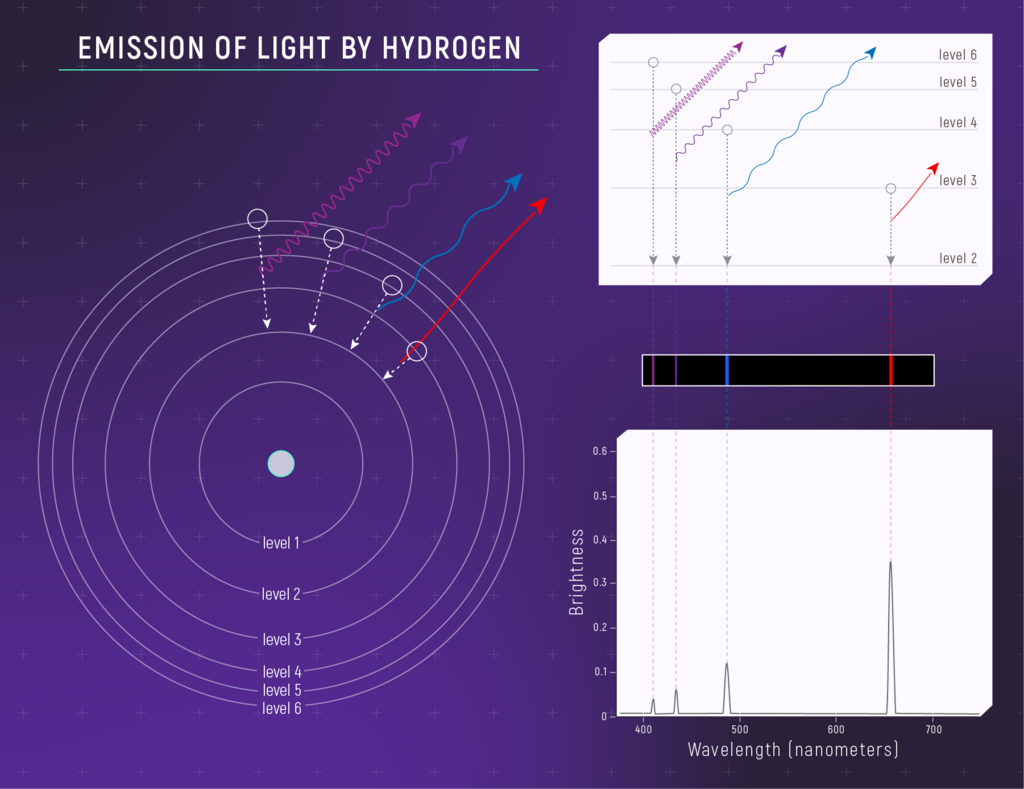
This idea of quantization solved the puzzle of the collapsing atom. Since an electron can only exist in specific energy orbits, it can't continuously lose energy and spiral into the nucleus. It's stuck on its step, unless it gains or loses the exact amount of energy needed to jump to another allowed step.
The Physics of Maybe
Another core difference from our everyday world is that quantum mechanics is fundamentally probabilistic. In classical physics, if you know the position and momentum of a baseball, you can calculate its exact trajectory. The outcome is certain.
In the quantum world, certainty vanishes. We can no longer say exactly where a particle like an electron is. Instead, we can only calculate the probability of finding it in a particular location. It’s like a weather forecast. A meteorologist can’t tell you with 100% certainty that it will rain, but they can give you a 70% chance. Quantum mechanics gives us the odds for the universe at its smallest scales.
Instead of predicting definite outcomes, quantum mechanics predicts the likelihood of all possible outcomes.
To describe this probabilistic state, physicists use a mathematical tool called the wave function, often represented by the Greek letter psi, . The wave function itself doesn't tell you where the particle is. Instead, the square of its magnitude at any point in space gives you the probability of finding the particle at that point. A higher value means a higher probability.
So, how does this cloud of probability change over time? That's where one of the most famous equations in physics comes in: the Schrödinger equation. It's the quantum equivalent of Newton's second law. Just as describes how an object's motion changes due to a force, the Schrödinger equation describes how a particle's wave function evolves over time.
This equation allows physicists to predict how the probabilities of a quantum system will change. By solving it, we can understand the behavior of atoms, the nature of chemical bonds, and the workings of lasers and semiconductors. It is the bedrock of modern chemistry and materials science.
These concepts—quantization, probability, and the wave function—form the foundation of quantum mechanics, a theory that provides a stunningly accurate, if counterintuitive, description of the universe at its most fundamental level.