The Quantum Nature of Light
Introduction to Photons
The Particle of Light
For a long time, scientists debated whether light was a wave or a stream of particles. In the early 20th century, physicists like Max Planck and Albert Einstein provided evidence that light energy comes in discrete packets. These fundamental packets, or quanta, of light and all other forms of electromagnetic radiation are called photons.
photon
noun
The elementary particle that is a quantum of the electromagnetic field, including electromagnetic radiation such as light and radio waves, and the force carrier for the electromagnetic force.
Think of a photon as the smallest possible amount of light energy you can have. You can't have half a photon, just like you can't have half a person. It's the basic unit. Every time you turn on a lamp, your eyes are being bombarded by countless photons.
Fundamental Traits
Photons have some very specific and unusual properties that set them apart from the particles that make up matter, like electrons and protons.
| Property | Description |
|---|---|
| Mass | A photon has zero rest mass. It's never stationary; it always moves at the speed of light. |
| Electric Charge | Photons are electrically neutral. They have no charge, so they aren't deflected by electric or magnetic fields. |
| Stability | A photon is a stable particle. Left on its own, it will travel through the universe forever unless it interacts with another particle. |
Because they have no mass, photons must travel at the universe's ultimate speed limit: the speed of light, which is about 299,792 kilometers per second in a vacuum. Nothing with mass can ever reach this speed.
A photon is pure energy, constantly in motion at the speed of light.
A Carrier of Force
In physics, forces aren't just mysterious pulls or pushes. They are transmitted by particles. The photon's job is to carry the electromagnetic force. This is the fundamental force responsible for everything from the friction that lets you walk to the interactions that hold atoms together.
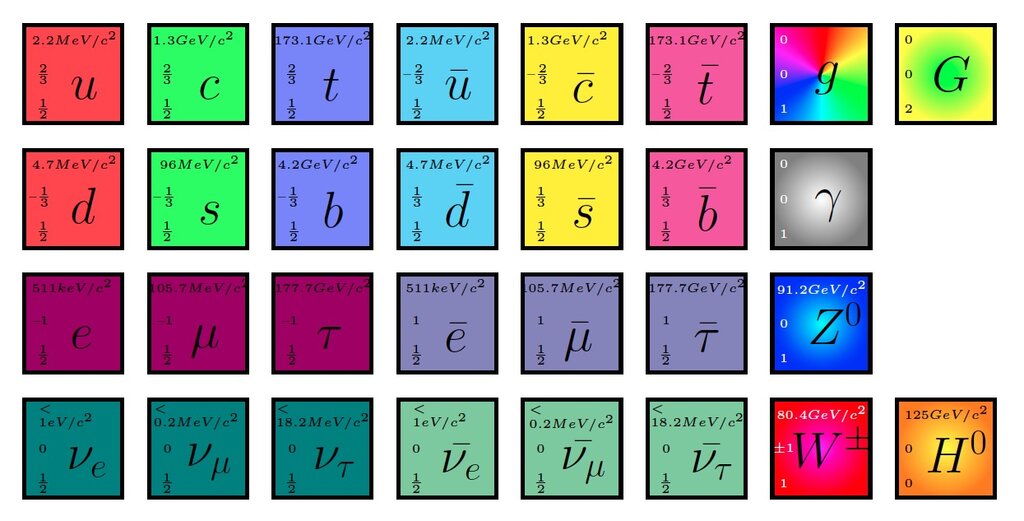
Particles that carry forces are called gauge bosons. When two charged particles, like two electrons, interact, they do so by exchanging photons. Imagine two ice skaters throwing a ball back and forth. The exchange of the ball pushes them apart. In a similar way, electrons "throw" photons at each other, causing them to repel. This constant exchange is what we perceive as the electromagnetic force.
Photons are also a specific type of boson that follows Bose-Einstein statistics. A key implication is that any number of photons can occupy the same quantum state. This property is what makes lasers possible. In a laser, countless photons are packed into the exact same state, creating a powerful, focused beam of light.
Light's Hidden Direction
Another important property of a photon is its polarization. You can think of polarization as the orientation of the light wave's oscillation. While an individual photon doesn't oscillate, its wave function does, and this gives it a specific polarization.
Most light sources, like the sun or a light bulb, produce unpolarized light, with photons having random orientations. A polarizing filter works by blocking all photons except those with a specific polarization.
This principle has many practical uses. Polarized sunglasses reduce glare by blocking horizontally polarized light that reflects off surfaces like water or roads. The screen on your phone, laptop, and calculator also uses polarization to control which pixels are lit.
Ready to check your understanding?
What is the fundamental role of a photon in the context of forces?
Why must photons always travel at the speed of light in a vacuum?
Understanding photons is the first step into the strange and fascinating world of quantum mechanics, where particles of light and matter follow a different set of rules from the world we see every day.