The Pythagorean Theorem
Right Triangles
Meet the Right Triangle
All triangles have three sides and three angles. But not all triangles are the same. We can sort them into different groups based on their properties. One of the most common ways to classify a triangle is by looking at its angles.
Sorting Triangles by Angle
The sum of the angles in any triangle is always 180 degrees. How those degrees are distributed determines what kind of triangle it is. There are three main types based on angles.
- Acute Triangle: All three angles are acute, meaning they are all less than 90 degrees.
- Obtuse Triangle: One angle is obtuse, meaning it is greater than 90 degrees. The other two must be acute.
- Right Triangle: One angle is a right angle, meaning it is exactly 90 degrees.
You can't have a triangle with more than one obtuse or right angle. The math just doesn't work out. The star of the show for us is the right triangle, which has a special place in geometry.
Anatomy of a Right Triangle
Every right triangle has a unique set of parts. The two sides that form the 90-degree angle have a special name.
leg
noun
One of the two sides of a right triangle that form the right angle.
The third side, which is always the longest, is found opposite the right angle. It also has its own name.
hypotenuse
noun
The longest side of a right triangle, opposite the right angle.
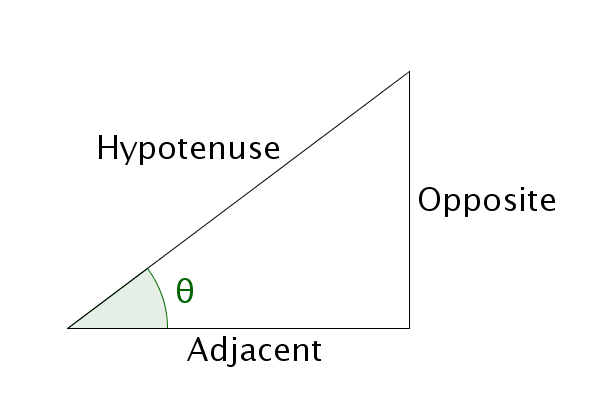
Knowing how to spot the legs and the hypotenuse is a critical first step for working with right triangles. The hypotenuse is always across from the right angle, and it's always the longest side. The other two sides are the legs.
Let's check your understanding of these new terms.
What is the sum of the interior angles in any triangle?
In a right triangle, what is the special name for the side opposite the 90-degree angle?
Understanding these basic properties is the foundation for many important concepts in geometry and trigonometry.