The Pythagorean Theorem
Right Triangle Basics
What Makes a Triangle Right?
A triangle is a shape with three sides and three angles. A right-angled triangle, or just a right triangle, is a special kind where one of those angles is exactly 90 degrees. This 90-degree angle is also called a right angle. It’s the same angle you see at the corners of a square or a book page.
The presence of one 90-degree angle is the only thing that defines a right triangle.
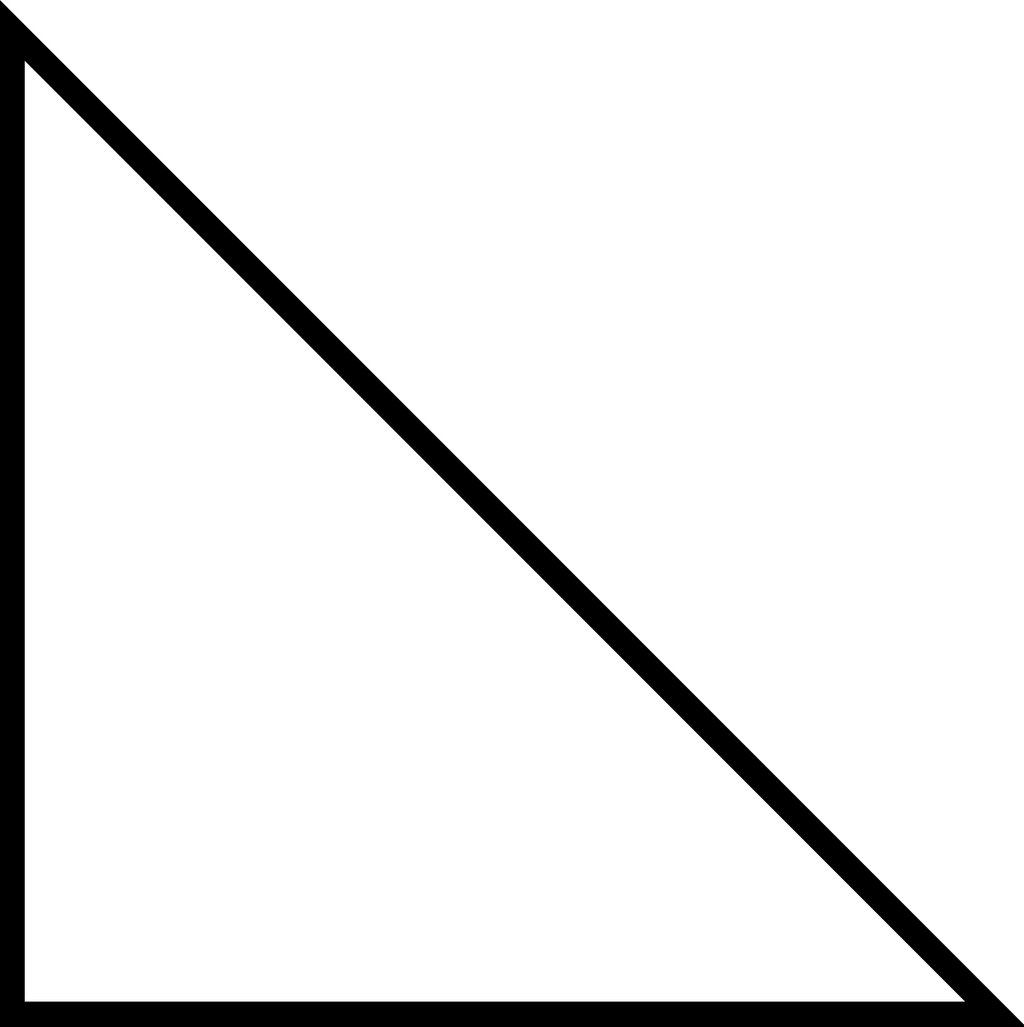
The Sides Have Names
Every right triangle has three sides, and each one has a specific name. The two sides that meet to form the right angle are called the legs. The third side, which is always the longest and sits opposite the right angle, is called the hypotenuse.
hypotenuse
noun
The longest side of a right-angled triangle, opposite the right angle.
It’s crucial to know which side is which. Identifying the hypotenuse is easy: just find the right angle and look at the side directly across from it.
Angle Relationships
The three angles inside any triangle always add up to 180 degrees. This is a fundamental rule of geometry. Since a right triangle already has one 90-degree angle, the other two angles must share the remaining 90 degrees.
This means that the other two angles in a right triangle are always acute, which means they are both less than 90 degrees. They are also complementary, meaning they add up to 90 degrees.
If you know one of the acute angles in a right triangle, you can always find the other by subtracting it from 90.
For example, if one acute angle is 30 degrees, the other must be 60 degrees, because $30 + 60 = 90$.
Ready to check your understanding? Let's see what you've learned about the basics of right triangles.
What is the defining characteristic of a right-angled triangle?
In a right triangle, what is the name for the longest side, which is located opposite the right angle?
Understanding these core parts—the right angle, the legs, and the hypotenuse—is the first step to unlocking more powerful ideas in geometry.