The Pythagorean Theorem Explained
Right Triangle Basics
Meet the Right Triangle
Triangles are one of geometry's most fundamental shapes. Among them, the right-angled triangle, or simply the right triangle, holds a special place. What makes it special is one of its angles. It's a perfect 90-degree corner, just like the corner of a book or a square tile.
A right triangle is any triangle that contains one angle measuring exactly 90 degrees.
This single 90-degree angle defines the entire shape and gives its sides special names.
Legs and Hypotenuse
Every right triangle has three sides, but we don't just call them 'side 1, side 2, and side 3'. The two sides that meet to form the 90-degree angle are called the legs. They are the perpendicular sides.
The third side is different. It's always the longest side of the triangle and sits directly opposite the right angle. This side has a unique name: the hypotenuse.
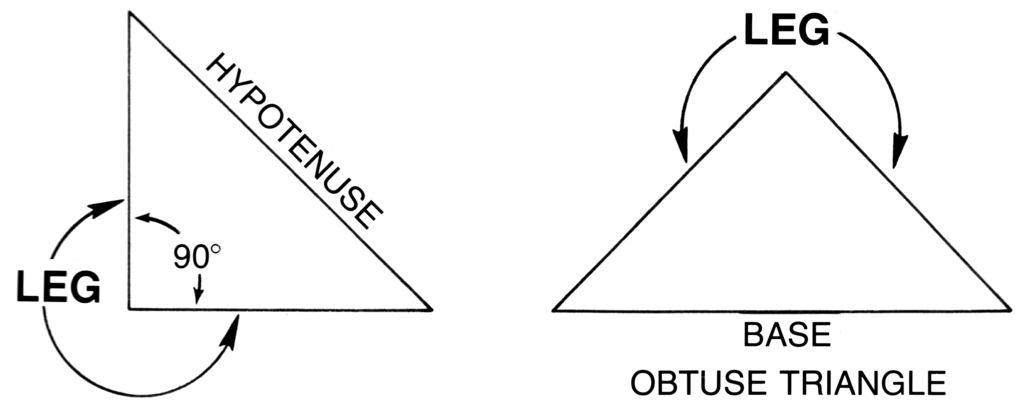
Learning to spot the hypotenuse is easy. Just find the right angle and look at the side across from it. That's always your hypotenuse.
The Angle Story
There's a simple rule for all triangles: their three interior angles must add up to 180 degrees. This rule becomes even more specific for right triangles. Since we already know one angle is 90 degrees, the other two have to share the remaining 90 degrees.
This means the two smaller angles in a right triangle are always complementary. If you know one, you can instantly find the other. For example, if one acute angle is 30 degrees, the other must be 60 degrees to make a total of 90.
These basic properties—one 90-degree angle, two legs, one hypotenuse, and two complementary angles—are the building blocks for everything else we can do with right triangles.