The Psychology of Sales
Introduction to Behavioral Economics
More Than Just Numbers
Traditional economics often pictures people as perfectly rational calculating machines. We weigh all our options, consider every piece of information, and always make the choice that gives us the most value. But how often does that really happen?
Behavioral economics offers a more realistic view. It's where psychology meets economics, exploring how our emotions, social influences, and mental shortcuts shape our financial decisions. It doesn't throw out traditional economics, but it adds a crucial layer: the human one.
Behavioral finance is the combination of psychology and economics to understand why we tend to act against our own financial interests.
Instead of assuming we're all flawless logicians, it acknowledges that we're busy, sometimes irrational, and often take the easy way out. Understanding these predictable patterns of irrationality can help explain why we do things like overspend on credit cards or fail to save for retirement, even when we know better.
Mental Shortcuts and Common Mistakes
Our brains are constantly looking for ways to save energy. To do this, we rely on mental shortcuts, or heuristics, to make quick judgments and decisions. These are often incredibly useful, allowing us to navigate a complex world without getting bogged down.
For example, if a product has thousands of positive reviews, you might use the heuristic that it's a good product, saving you hours of research. The problem is, these shortcuts can sometimes lead to systematic errors in thinking, known as cognitive biases.
Heuristic
noun
A mental shortcut that allows people to quickly make judgments and solve problems.
One classic cognitive bias is the anchoring effect. This is our tendency to rely too heavily on the first piece of information offered (the "anchor") when making decisions. If the first price you see for a used car is $15,000, that number will influence your perception of what's a fair price, even if the car is only worth $10,000.
Cognitive biases aren't signs of failure; they're simply the result of our brain's attempt to simplify the world around us. They are predictable patterns of thought that can lead us astray.
Why Losses Hurt More Than Gains
One of the cornerstones of behavioral economics is Prospect Theory. Developed by Daniel Kahneman and Amos Tversky, it describes how people choose between probabilistic alternatives that involve risk. A key insight is loss aversion.
Simply put, we feel the pain of a loss about twice as much as we feel the pleasure of an equivalent gain. Losing $100 feels much worse than finding $100 feels good. This simple idea has huge implications.
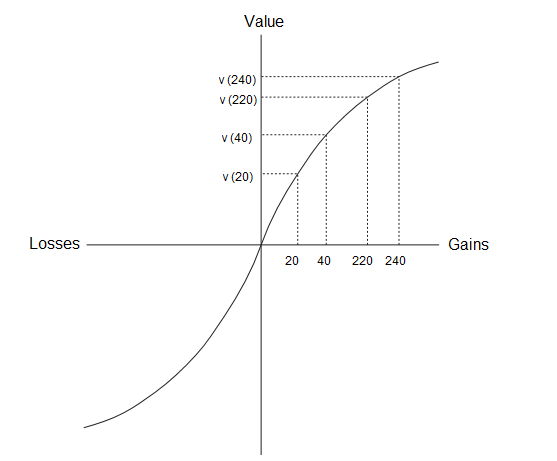
Loss aversion explains why we might hold onto a losing stock for too long, hoping it will recover. The thought of selling and “realizing” the loss is just too painful. It also explains why free trials are so effective. Once we have something, the thought of losing it makes us more likely to pay to keep it.
Good Enough is Good Enough
Traditional economics assumes we have unlimited information and brainpower to make the perfect choice. Herbert Simon, another pioneer in this field, called this idea into question with the concept of bounded rationality.
Bounded rationality is the idea that our ability to be rational is limited by the information we have, the cognitive limitations of our minds, and the finite amount of time we have to make a decision. Because we can't possibly know and process everything, we don't optimize. Instead, we satisfice—we look for a decision that is simply “good enough.”
Think about buying a new phone. You don't research every single model available worldwide. You probably look at a few popular options, read some reviews, and pick one that meets your needs and budget. You satisfice, and that's perfectly rational in a world of limited time and energy.
Now that you have a grasp of these core concepts, let's test your knowledge.
Which statement best captures the core difference between traditional and behavioral economics?
A car dealership lists a car with a very high initial price, and then offers a 'significant discount' that brings it to a more reasonable price. The dealership is likely using which cognitive bias to make the final price seem more attractive?
Behavioral economics gives us a powerful lens to understand why people behave the way they do in the real world. It reminds us that behind every data point is a human, with all their quirks and shortcuts.