The Psychology of Gambling and Addiction
Introduction to Gambling Psychology
The Mind at Play
Why do people gamble when the odds are stacked against them? It's not just about money or luck. The real game is happening inside the brain. Our minds are wired with shortcuts and reward systems that can make gambling feel incredibly compelling, even when we're losing.
Understanding these psychological hooks is the first step to seeing why gambling can be so hard to walk away from. It's less about a desire to lose money and more about how our brains interpret chance, reward, and the tantalizing possibility of a win.
Chasing Patterns
Imagine you're flipping a coin. It lands on heads five times in a row. What do you bet on the next flip? Many people would instinctively bet on tails, thinking it's "due" to happen. This is the gambler's fallacy.
Gambler's Fallacy
noun
The mistaken belief that if a particular event occurs more frequently than normal during the past, it is less likely to happen in the future, or vice versa.
In reality, each coin flip is an independent event. The coin has no memory. The odds of it landing on heads are always 50/50, no matter what happened before. The same is true for a roulette wheel, a roll of the dice, or a lottery number.
Our brains are built to find patterns, even in random noise. The gambler's fallacy is a side effect of this powerful, but sometimes misleading, instinct.
The Thrill of the Near Miss
Have you ever played a slot machine and had two cherries line up, with the third just one spot away? That feeling of being so close to a win is powerful. It's not just disappointing; it's also encouraging. This is known as the near-miss effect.
Neurologically, a near miss activates the same reward pathways in the brain as an actual win. Your brain almost tastes the victory, which makes you want to try again immediately. Instead of thinking, "I lost," the brain interprets it as, "I almost won! I should keep going."
Game designers know this. Slot machines are often programmed to produce near-miss results far more frequently than random chance would suggest, keeping players engaged and spinning the reels.
The Brain's Reward System
At the heart of gambling's allure is a simple brain chemical: dopamine. Often called the "feel-good" neurotransmitter, dopamine is central to the brain's reward system. It's released when we do things that are essential for survival, like eating or exercising, making us want to do them again.
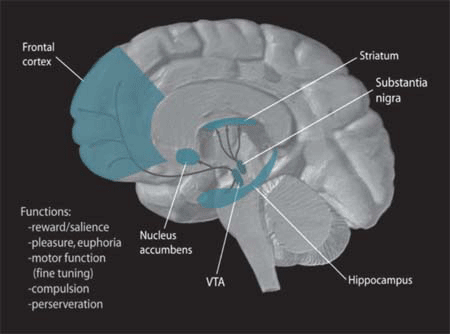
Gambling hijacks this system. When you place a bet, your brain releases a surge of dopamine not just when you win, but in anticipation of a potential win. The uncertainty is the key. The possibility of a large reward for a small investment is incredibly stimulating to our reward circuits.
For individuals with GD, the brain’s reward pathways are activated when they engage in gambling activities, Sternlicht notes, similar to how an individual with drug addiction might respond to stimuli.
Over time, the brain can become less sensitive to dopamine. This means a person needs to take bigger risks or gamble more often to get the same feeling of excitement. This process, known as tolerance, is a hallmark of addiction and explains why casual betting can sometimes escalate into a compulsive habit.
A roulette wheel lands on black seven times consecutively. According to the gambler's fallacy, what is the most likely outcome of the next spin?
How does the brain's reward system typically interpret a 'near-miss' event, like getting two out of three cherries on a slot machine?