The Psychology of Gambling and Addiction Prevention
Introduction to Gambling Psychology
More Than Just a Bet
At its core, gambling is the act of wagering something of value on an event with an uncertain outcome, hoping to win something of greater value. This simple definition covers everything from a state lottery ticket to a high-stakes poker game.
Gambling
noun
The practice of risking money or other stakes on an event with an uncertain outcome.
Gambling activities generally fall into two broad categories: games of chance and games of skill. While both involve uncertainty, the role of the player is vastly different.
Games of chance are determined entirely by random events. Think of a roulette wheel, a lottery drawing, or a slot machine. No amount of practice or expertise can change the random outcome. In contrast, games of skill involve a significant degree of player ability, strategy, and decision-making that can influence the result. Poker and sports betting are classic examples where knowledgeable players have a better long-term chance of winning than novices.
| Feature | Games of Chance | Games of Skill |
|---|---|---|
| Primary Factor | Randomness | Player expertise & strategy |
| Player Control | None | High |
| Predictability | Low (random) | Higher (based on skill) |
| Examples | Roulette, Slots, Lottery | Poker, Blackjack, Sports Betting |
Of course, many games blend these two elements. Blackjack involves the luck of the draw (chance), but strategic decisions about when to hit or stand (skill) dramatically affect the outcome.
The Brain on a Bet
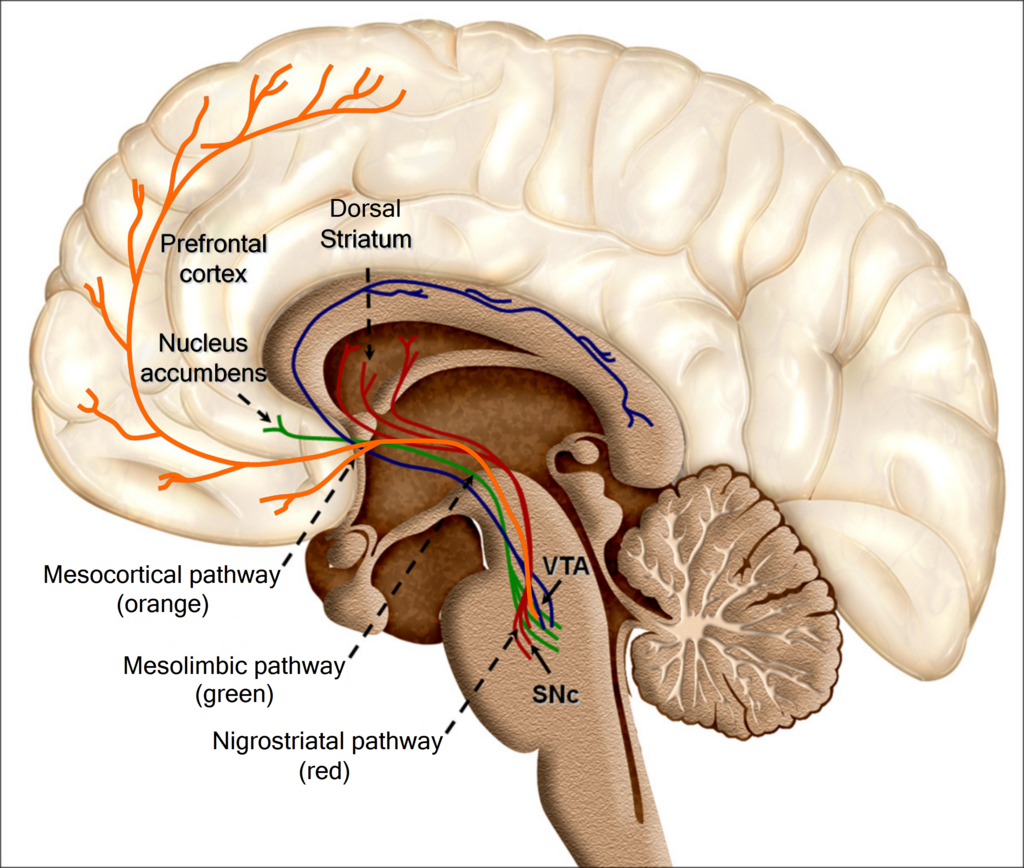
Why is gambling so compelling? The answer lies deep within our brain's wiring. When we anticipate or experience a rewarding event, our brain releases a neurotransmitter called dopamine. This chemical is associated with pleasure, motivation, and reinforcement, making us want to repeat the behavior that caused its release.
The brain's reward system, particularly the mesolimbic pathway, is central to this process. It connects areas responsible for motivation and reward, creating a powerful loop. When you place a bet, this system lights up with anticipation, releasing dopamine not just for a win, but for the possibility of a win.
Psychology has long studied how behaviors are learned through reinforcement. One of the most powerful ways to solidify a behavior is through a variable-ratio schedule of reinforcement. This means rewards are given after an unpredictable number of responses.
Slot machines are the perfect example. You don't know if the next pull will be a win, or if it will take ten, or even a hundred more pulls. This unpredictability keeps dopamine levels elevated and makes the behavior highly resistant to extinction. It’s the same principle that keeps people checking their phones for notifications. The reward isn't guaranteed, but it could come at any moment.
With a variable-ratio schedule, the uncertainty of the reward is what makes the activity so engaging and repeatable.
Thinking Traps
Our brains are designed to find patterns, but this strength can become a weakness in the random world of gambling. We often rely on mental shortcuts, or heuristics, to make quick decisions. When these shortcuts lead to errors in judgment, they are called cognitive biases. Gamblers are particularly susceptible to several of these thinking traps.
The Gambler's Fallacy: This is the mistaken belief that if a particular outcome has happened frequently, it is less likely to happen in the future in a series of independent random events. For example, after a coin flip results in five heads in a row, someone might feel that tails is "due." In reality, the probability of tails on the next flip remains exactly 50%.
The Near-Miss Effect: When an outcome is very close to a win, like getting two out of three cherries on a slot machine, the brain treats it almost like a victory. This near-miss triggers a similar dopamine response to an actual win, powerfully encouraging another attempt. The feeling of "I was so close!" is a strong motivator to keep playing.
Illusion of Control: This is the tendency for people to overestimate their ability to control events that are, in fact, random. A gambler might blow on the dice before a roll or have a "lucky" way of pulling a slot machine lever, believing these actions influence the outcome. This bias gives a false sense of security and skill.
Understanding these psychological drivers—from the chemical rush of dopamine to the common cognitive biases we all share—is the first step in seeing why gambling holds such a powerful allure.