The Power of Ten Mental Models
Introduction to Mental Models
What Are Mental Models?
Your brain is constantly trying to make sense of the world. To do this, it builds simplified representations of how things work. These internal pictures are called mental models. They are the frameworks you use to understand everything, from how to make a cup of coffee to the complex dynamics of a friendship.
Mental Model
noun
An internal representation of external reality that helps you understand, reason, and interact with the world around you. It's an explanation in your mind of how something works.
You use mental models every day, whether you realize it or not. When you get into a car, you don't re-learn how to drive each time. You rely on your mental model of how a steering wheel, pedals, and gears interact to move the vehicle. When you use a new app on your phone, you apply a mental model of how user interfaces generally work, looking for familiar icons and menus.
These models aren't the territory itself, just the map. And like any map, they can be incredibly useful, but they can also be incomplete or wrong. A flawed mental model can lead to misunderstanding and poor decisions, while a robust one can give you a powerful advantage in navigating life's challenges.
A Quick History
The idea that we use internal representations to understand the world isn't new. Philosophers have discussed similar concepts for centuries. However, the term "mental model" gained scientific traction in the 20th century.
Scottish psychologist Kenneth Craik was a key pioneer. In his 1943 book The Nature of Explanation, he proposed that the mind constructs “small-scale models” of reality. He argued that we use these models to anticipate events, reason about situations, and decide what actions to take. It was a revolutionary idea that framed the brain not just as a passive receiver of information, but as an active simulator of the world.
The theory was further developed in the 1980s by cognitive psychologist Philip Johnson-Laird. He argued that human reasoning is not based on formal logic, but on the construction and manipulation of mental models. When someone tells you, "The cat is to the left of the dog," you don't process it as a logical proposition. Instead, you build a small mental scene with a cat and a dog in a specific arrangement. If you get more information, you update the scene. This model-based reasoning is more flexible and intuitive than applying rigid rules of logic.
How Models Shape Your Thinking
Mental models are the scaffolding of your cognition. They act as filters, helping you sort through the overwhelming amount of information you encounter every moment. They allow you to see patterns, understand cause and effect, and fill in the gaps when information is missing. When you hear a surprising statistic, your mental model of the topic is what tells you whether it's plausible or likely incorrect.
Because they are simplifications, mental models are essential for quick thinking and decision-making. Imagine trying to analyze every single data point before making a choice, you'd be paralyzed. Your mental models provide shortcuts, allowing you to make good-enough decisions quickly. They are the foundation of your intuition.
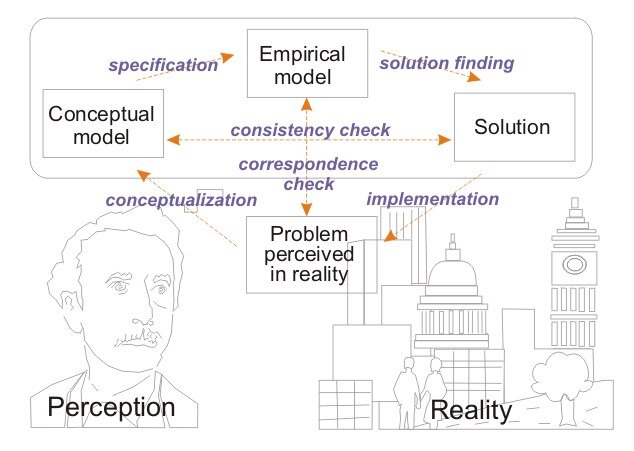
This filtering process is also how mental models guide our behavior. The models you hold about social situations, for example, dictate how you act at a party versus in a business meeting. Your model for how to solve a problem determines the steps you take. If your model for fixing a computer is “turn it off and on again,” that will be your first and perhaps only action.
When you encounter a problem you can't solve, it’s often because your existing mental model is inadequate for the task. The key to better problem-solving is not just to acquire more information, but to build better, more accurate mental models. Recognizing the models you use, questioning them, and being open to updating them is a critical skill for learning and growth.
The quality of your thinking is proportional to the quality of the models in your head and their usefulness in the situation at hand.
Now that you understand what mental models are, let's test your knowledge.
What is the best description of a mental model?
According to the text, which pioneer first proposed in his 1943 book that the mind constructs “small-scale models” of reality?
Grasping this core concept is the first step toward consciously using mental models to improve your thinking and decision-making.