The Power of Steam
Introduction to Thermodynamics
Energy, Heat, and Work
At its heart, thermodynamics is the study of energy. Energy is just the capacity to do work. It comes in many forms, like the chemical energy in fuel or the kinetic energy of a moving car. In thermodynamics, we're especially interested in a system's internal energy (), which is the sum of all the microscopic energies of its atoms and molecules.
Often, we talk about heat. It's easy to confuse heat with temperature, but they're different. Temperature is a measure of the average kinetic energy of the particles in a substance—how fast they're jiggling around. Heat (), on the other hand, is the transfer of energy from a hotter object to a colder one. You feel heat when you touch a hot stove because energy is flowing from the stove into your hand.
Work () is what happens when energy is used to move something. In physics, work is done when a force acts over a distance. A simple example in thermodynamics is a gas expanding in a cylinder and pushing a piston. The expanding gas exerts a force on the piston and moves it, doing work. This is the fundamental principle behind how an engine generates motion.
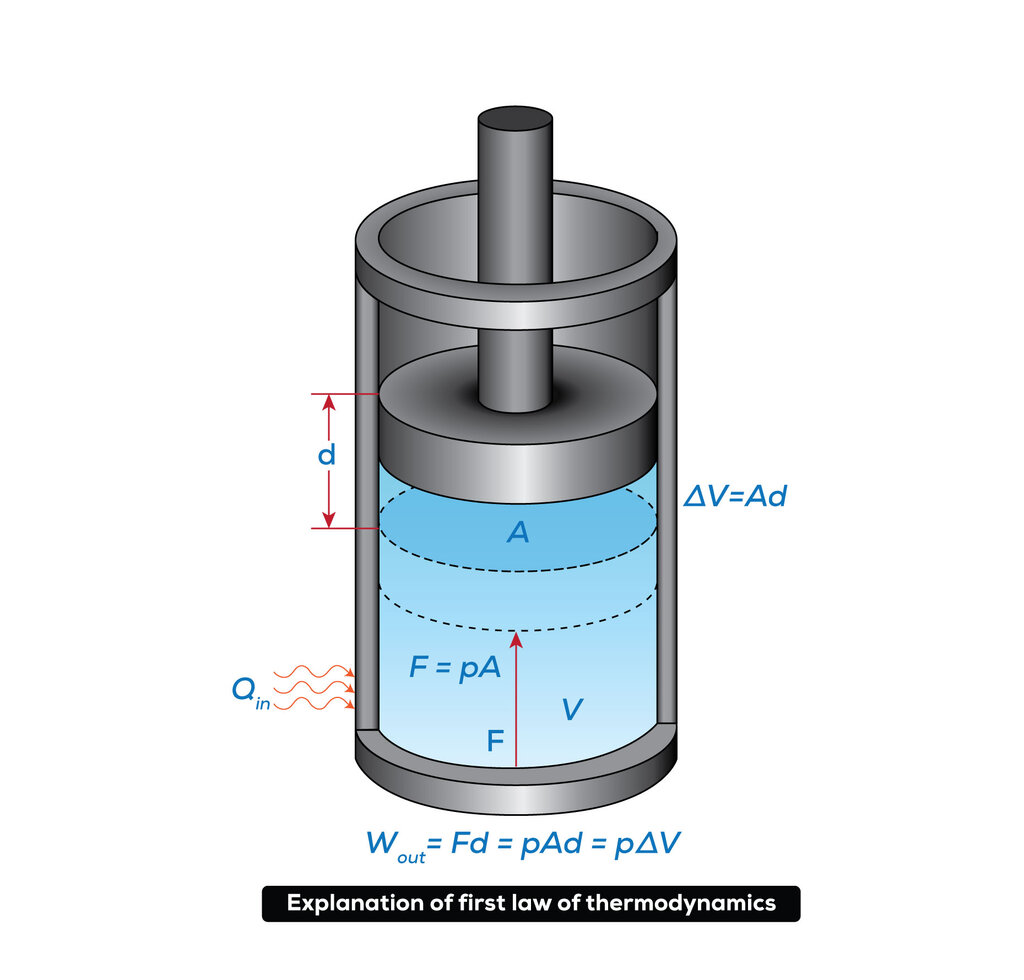
The amount of work done by an expanding gas at constant pressure is given by the formula:
Here, is the pressure and is the change in volume. Finally, power is simply the rate at which work is done. An engine that does the same amount of work in half the time is twice as powerful.
The Laws of the Game
Thermodynamics is built on a few fundamental laws that energy always seems to follow. The first is a familiar idea: the conservation of energy.
The First Law of Thermodynamics states that energy cannot be created or destroyed, only converted from one form to another.
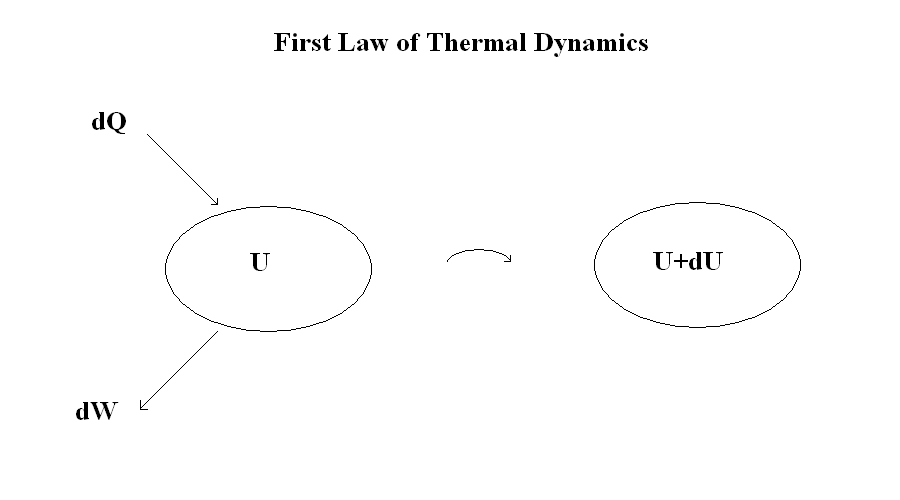
Imagine a system's internal energy is like a bank account. Adding heat () is like making a deposit. The system doing work () on its surroundings is like making a withdrawal. The change in your account balance (the internal energy, ) is the deposits minus the withdrawals.
This equation is the mathematical form of the First Law. It tells us that the change in a system's internal energy is equal to the heat added to the system minus the work done by the system.
The First Law says you can't get something for nothing. But it doesn't say you can't break even. The Second Law of Thermodynamics is a bit more pessimistic. It sets a fundamental limit on the efficiency of any process.
The Second Law of Thermodynamics states that the total entropy of an isolated system can never decrease over time.
In simpler terms, this law gives direction to energy processes. Heat naturally flows from hot objects to cold ones, and never spontaneously in the reverse. A broken egg won't unscramble itself. This directionality is tied to a concept called entropy.
Entropy and Disorder
Entropy
noun
A thermodynamic quantity representing the unavailability of a system's thermal energy for conversion into mechanical work, often interpreted as the degree of disorder or randomness in the system.
Entropy () is a measure of randomness or disorder. A neatly organized deck of cards has low entropy. Shuffle it, and its entropy increases. It's statistically far more likely for the cards to be in a disordered state than in a perfectly ordered one.
The Second Law says that for any spontaneous process, the total entropy of the universe increases. While you can create order in one place (like cleaning your room), doing so requires energy and creates even more disorder elsewhere (like the heat and exhaust from your body and the power plant that generates your electricity).
This has a huge implication for engines. When we burn fuel to create heat, not all of that heat can be converted into useful work. Some of it must be discarded into a colder environment (like the atmosphere) to satisfy the Second Law. This
This unavoidable
waste heat increases the entropy of the surroundings, ensuring the total entropy of the universe goes up. This is why no heat engine can be 100% efficient.
The Ideal Engine
So, what's the most efficient an engine can be? A French scientist named Sadi Carnot figured this out in the 1820s. He imagined an ideal, theoretical engine that operates in a special cycle of four steps. This is now called the Carnot cycle.
The Carnot cycle isn't a blueprint for a real engine. It's a theoretical benchmark. It assumes perfect processes with no friction or other real-world inefficiencies. The efficiency of a Carnot engine depends only on the temperatures of the hot source () and the cold sink () it operates between, measured in an absolute scale like Kelvin.
This simple formula is profound. It tells us that to get the highest possible efficiency, you want the temperature of your heat source to be as high as possible, and the temperature of your exhaust environment to be as low as possible. No real engine can beat this limit; it's the best that physics allows.
Time to see what you've learned about the fundamental rules of energy.
What is the fundamental difference between heat and temperature?
A gas in a cylinder has 100 Joules of heat added to it ( J). The gas then expands, doing 40 Joules of work on a piston ( J). What is the change in the internal energy () of the gas?
These concepts form the foundation of how we understand and engineer systems that use heat to create power.