The Power of Lithium Batteries
Introduction to Battery Basics
Energy in a Box
Batteries are portable power packs. They store chemical energy and convert it into electrical energy on demand. Think of a battery like a small, self-contained dam. A dam holds back water, storing potential energy. When the gates open, the flowing water's energy can be used to generate electricity. Similarly, a battery holds chemical potential energy, releasing it as a flow of electrons—an electric current—when you connect it to a device.
Batteries store electrical energy by converting it into chemical potential energy.
This ability to convert and store energy makes countless modern technologies possible, from flashlights to smartphones and electric cars.
Inside a Battery
Every battery, no matter its size or shape, has three main parts that work together to create an electrical current.
- Anode (-): The negative electrode. It's where electrons are released during discharge.
- Cathode (+): The positive electrode. It's where electrons are accepted during discharge.
- Electrolyte: A chemical substance that contains ions. It sits between the anode and cathode and allows ions to move between them, but not electrons.
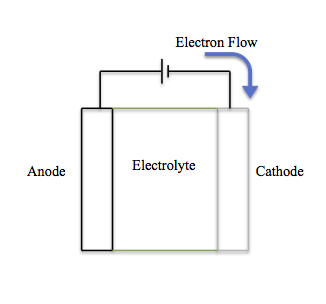
The anode and cathode are separated by a thin, porous material called a separator. This separator is soaked in the electrolyte and prevents the anode and cathode from touching and causing a short circuit. It's like a gatekeeper that lets ions pass through but blocks electrons.
When you connect a battery to a device, like a light bulb, you create an external path for electrons. A chemical reaction starts inside the battery. The anode gives up its electrons, which are eager to travel to the cathode. Since they can't go through the electrolyte, they flow through the external circuit, powering your device along the way. At the same time, positively charged ions travel from the anode through the electrolyte to the cathode to balance the charge. This completes the circuit and keeps the electricity flowing.
Key Battery Metrics
To compare batteries, we use a few key measurements. These terms help describe a battery's performance and suitability for different applications.
voltage
noun
The difference in electrical potential between the anode and cathode, measured in volts (V).
Voltage is like the electrical "pressure" that pushes electrons through a circuit. A higher voltage can push more current through a given resistance. Think of it as the force behind the flow of water in a hose. More pressure means a more powerful stream.
capacity
noun
The total amount of electrical charge a battery can deliver, typically measured in Ampere-hours (Ah) or milliampere-hours (mAh).
Capacity tells you how long a battery can last at a certain current. A battery with a 2 Ah capacity can supply 2 amps of current for one hour, or 1 amp for two hours.
energy density
noun
The amount of energy a battery can store in relation to its volume (Wh/L) or mass (Wh/kg).
Energy density is a crucial metric for portable devices and electric vehicles, where you want to store the most energy in the smallest and lightest package possible. A battery with high energy density can power a device for longer without adding significant weight or bulk.
Let's review these core concepts before moving on.
Now, let's test your understanding with a few questions.
What is the primary energy conversion that takes place inside a battery when it is powering a device?
In a battery, which component is designated as the positive electrode and accepts electrons during discharge?
Understanding these fundamentals—the components, the process, and the key metrics—is the first step to understanding how different battery technologies power our world.