The Power of Fusion Energy
Introduction to Fusion Energy
The Power of the Stars
Every star, including our sun, is a giant fusion reactor. At their core, immense gravitational pressure and temperatures of millions of degrees create the perfect conditions for nuclear fusion. This is the process where light atomic nuclei, like hydrogen, are forced together to form a heavier nucleus, like helium. When this happens, a tiny amount of mass is converted into a huge amount of energy.
This conversion follows Einstein's famous equation, , which shows that mass and energy are two sides of the same coin.
On Earth, scientists are trying to replicate this process. The most promising reaction for a future power plant involves two isotopes, or versions, of hydrogen: deuterium and tritium. When they fuse, they create a helium nucleus, a spare neutron, and a burst of energy.
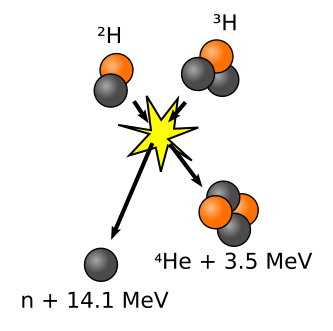
Recreating a Star on Earth
Fusing atoms is not easy. Atomic nuclei are all positively charged, and just like magnets with the same poles, they naturally repel each other. To overcome this repulsion and force them to merge, we need to create extraordinary conditions.
For fusion to occur, atomic nuclei must overcome their natural repulsion, which requires extremely high temperatures—often exceeding millions of degrees Celsius.
These temperatures, far hotter than the center of the sun, are so extreme that they strip electrons from their atoms. This creates an electrically charged gas called plasma, often called the fourth state of matter. Containing and controlling a substance this hot is one of the greatest engineering challenges in science today.
plasma
noun
A state of matter where atoms are stripped of their electrons, creating a mixture of charged particles (ions and electrons).
Fusion vs. Fission
Fusion is often confused with nuclear fission, the process used in today's nuclear power plants. They are opposites. Fission splits a large, unstable nucleus like uranium into smaller ones to release energy. Fusion combines small, light nuclei like hydrogen.
| Feature | Nuclear Fusion | Nuclear Fission |
|---|---|---|
| Process | Fuses light nuclei (e.g., hydrogen) | Splits heavy nuclei (e.g., uranium) |
| Fuel | Abundant (from water and lithium) | Limited (uranium ore) |
| Waste | Mostly harmless helium; some short-lived radioactive material | Long-lived radioactive waste |
| Safety | Inherently safe; reaction stops if conditions are lost | Risk of meltdown and chain reaction |
Why Pursue Fusion?
The immense challenge of achieving fusion is matched by its incredible promise as a clean energy source. Unlike fossil fuels, fusion produces no greenhouse gases. Its primary byproduct is helium, an inert and harmless gas.
The fuel for fusion is also virtually limitless. Deuterium can be extracted from ordinary seawater, and tritium can be produced from lithium, an element found in the Earth's crust.
Furthermore, fusion power plants would be inherently safer than fission plants. The fusion process is difficult to start and sustain, so there is no risk of a runaway chain reaction or meltdown. If there's any disruption, the plasma cools and the reaction simply stops.
A fusion power plant would offer a clean, safe, and nearly inexhaustible source of energy for future generations.
Ready to check your understanding of these core concepts?
What is the fundamental difference between nuclear fusion and nuclear fission?
Why are extremely high temperatures, hotter than the center of the sun, required to achieve nuclear fusion on Earth?
Harnessing the power that makes stars shine is one of humanity's greatest scientific endeavors, with the potential to fundamentally change our world.