The Power of Electricity
Electricity Basics
The Nature of Charge
At the heart of all things electrical is a fundamental property of matter called electric charge. It's carried by subatomic particles. Protons have a positive charge (+), and electrons have a negative charge (-). You've probably experienced the effects of charge yourself, like when you get a shock from a doorknob after walking across a carpet. That's static electricity, a buildup of charge.
A key rule governs how charges interact: like charges repel each other, while opposite charges attract. A positive charge and a negative charge will pull toward one another, but two positive charges will push each other away.
Electric Charge
noun
A fundamental property of matter that causes it to experience a force when placed in an electromagnetic field.
Conductors and Insulators
Electric charge can move through some materials more easily than others. The difference comes down to how tightly a material's atoms hold onto their electrons.
Materials that allow electrons to move freely are called conductors. Metals like copper, silver, and gold are excellent conductors. This is why electrical wires are typically made of copper. The electrons in a conductor are not tied to any single atom and can flow easily when a force is applied.
On the other hand, materials that prevent or resist the flow of electrons are called insulators. Rubber, glass, plastic, and wood are common insulators. They hold onto their electrons very tightly. This property makes them perfect for safety applications, like the rubber coating around an electrical cord.
| Category | Description | Examples |
|---|---|---|
| Conductors | Allow electric charge to flow easily. | Copper, Aluminum, Gold, Silver |
| Insulators | Resist the flow of electric charge. | Rubber, Glass, Plastic, Wood |
Current, Voltage, and Resistance
To understand how electricity works in a circuit, we need to know three key concepts: current, voltage, and resistance. A helpful analogy is to think of electricity flowing through a wire like water flowing through a pipe.
Electric Current (I) is the flow of electric charge, specifically the movement of electrons. In our analogy, current is the amount of water flowing through the pipe. It's measured in amperes (A), or amps for short.
Voltage (V) is the pressure from the power source that pushes the charged electrons through a circuit. You can think of it as the electrical
Think of it this way: Voltage is the push, and current is the flow that results from that push.
With our water analogy, voltage is like the water pressure. A higher pressure pushes more water through the pipe. Voltage is measured in volts (V).
Resistance (R) is a measure of how much a material opposes the flow of current. In the pipe analogy, resistance could be a narrow section that restricts water flow. Different components in a circuit have different levels of resistance. It's measured in ohms (Ω).
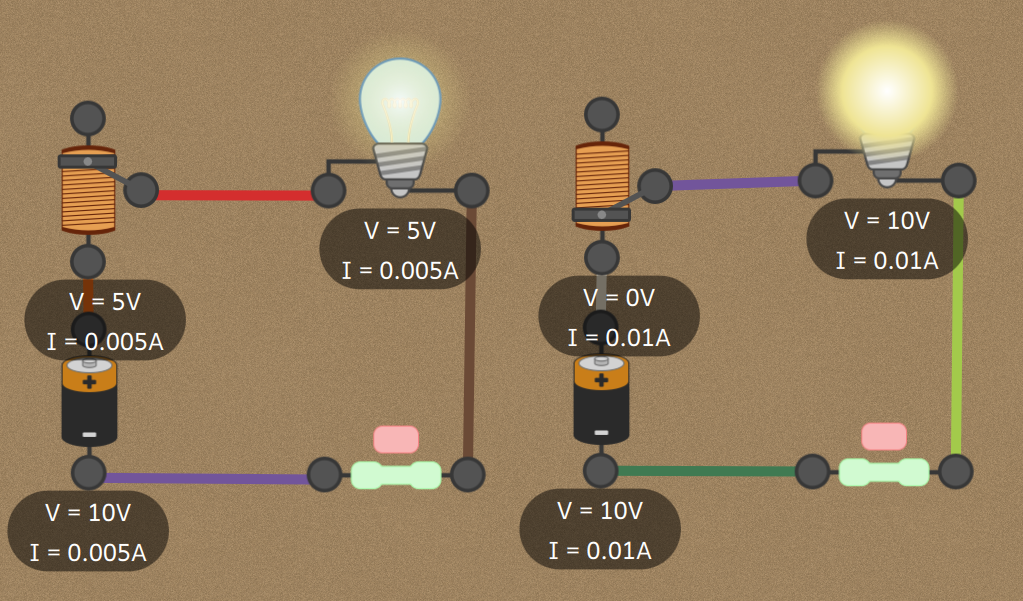
These three quantities are not independent; they are related by a fundamental principle known as Ohm's Law.
This simple equation states that the voltage across a circuit is equal to the current flowing through it multiplied by the resistance. This means if you know any two of the values, you can easily calculate the third.
For example, if a small device running on a 9-volt battery has a resistance of 3 ohms, we can find the current. Rearranging the formula to , we get:
So, 3 amps of current would flow through the device.
DC vs. AC
Electric current can flow in two different ways: direct current (DC) or alternating current (AC).
Direct Current (DC) is electricity that flows in only one direction. The flow is constant and steady. Batteries are the most common source of DC power. Many small electronic devices, like your smartphone, laptop, and flashlight, run on DC power.
Alternating Current (AC) is electricity that changes direction periodically. The current flows back and forth, alternating its direction many times per second. This is the type of electricity that comes from the outlets in your home. AC is used for power grids because it can be easily transformed to higher or lower voltages, making it efficient for long-distance transmission.
Many devices you own use a power adapter—that little box on the power cord. Its job is to convert the AC power from your wall outlet into the DC power the device's sensitive electronics need to operate.
What happens when two particles with positive charges are brought near each other?
Which of the following materials is considered an excellent electrical conductor?
These core concepts form the foundation of electricity. Understanding charge, flow, and the relationship between voltage, current, and resistance is the first step to understanding the electrical world around us.