The Policy Making Process Explained
Introduction to Policy Making
From Idea to Action
Public policy is how a community addresses its problems and achieves its goals. It's the system of laws, regulations, actions, and funding priorities implemented by a government. Think of it as a society's chosen path for handling everything from public health and education to economic growth and environmental protection.
Essentially, policies are the strategies governments use to manage public affairs and guide a community's development.
Without clear policies, governance would be chaotic and reactive. Policymaking provides a structured way to make decisions, allocate resources, and create programs that serve the public. It transforms political debate and public demand into concrete actions. This process is the core of public administration, turning broad intentions into tangible services and rules that affect our daily lives.
The Policy Cycle
Policymaking isn't a one-and-done event. It's a continuous process, often pictured as a cycle. A problem is identified, a solution is developed and carried out, and then the results are reviewed. This review often reveals new problems or ways to improve the policy, starting the cycle all over again. Understanding this flow helps us see how policies evolve over time.
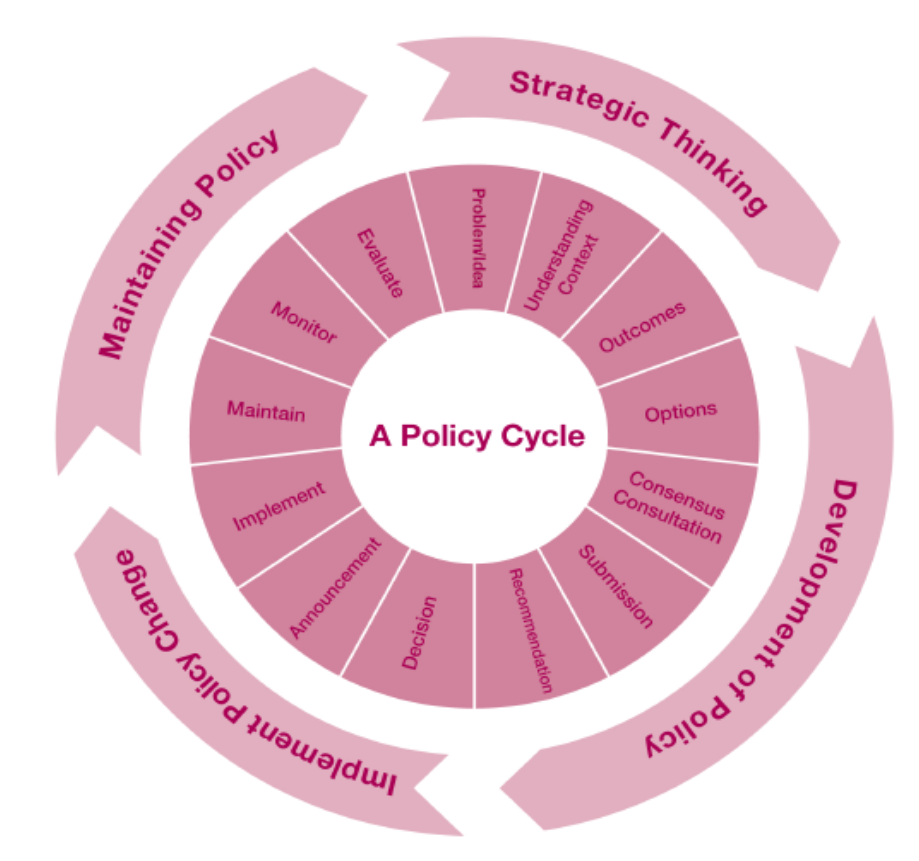
The cycle is typically broken down into five distinct stages. While they're presented in order, the process can be messy in the real world, with stages overlapping or repeating.
Five Key Stages
1. Agenda Setting This is the starting point. An issue must be recognized as a public problem deserving of government attention. Not every problem makes it onto the official agenda. Issues gain prominence through public outcry, media coverage, advocacy groups, or a significant event that highlights a need for action.
2. Formulation Once a problem is on the agenda, policymakers begin to develop possible solutions. This stage involves research, debate, and consultation with experts and interest groups. Various policy alternatives are proposed and analyzed to determine their potential effectiveness, cost, and political feasibility. The goal is to create a well-defined plan of action.
3. Adoption At this stage, a specific policy solution is chosen and formally approved. This often involves passing legislation, issuing an executive order, or creating a new regulation. It's the moment of decision, where the government officially commits to a particular course of action. This stage requires building political support and navigating the formal procedures of government.
Policy implementation is the process of putting formulated policies into action.
4. Implementation With a policy adopted, the focus shifts to putting it into effect. This is where public administration takes center stage. Government agencies are tasked with carrying out the policy, which might involve creating new programs, hiring staff, distributing funds, and enforcing new rules. The success of a policy often hinges on how well it is implemented.
5. Evaluation Finally, the policy's impact is assessed. Did it solve the problem it was designed to address? Were there any unintended consequences? Evaluation involves collecting and analyzing data to measure the policy's effectiveness and efficiency. The findings from this stage are crucial, as they can lead to the policy being continued, modified, or terminated, which feeds back into the agenda-setting phase for the next cycle.
What is the primary purpose of public policy?
A massive data breach highlights the need for stronger online privacy laws. This issue gains widespread media coverage and public attention, prompting lawmakers to act. Which stage of the policy cycle does this represent?