The Plasma Membrane
Plasma Membrane Basics
The Cell's Gatekeeper
Every living cell, from a simple bacterium to the cells in your own body, has a boundary. This isn't a rigid wall, but a flexible, oily bag called the plasma membrane. Think of it as a selective bouncer at a club. It decides who gets in, who gets kicked out, and keeps the cell's internal environment stable and separate from the outside world.
This separation is crucial. Inside a cell is a bustling, organized city of molecules and structures. The plasma membrane creates compartments, allowing the cell to maintain the specific conditions needed for life's chemical reactions to occur. Without this barrier, the cell's contents would spill out, and harmful substances could rush in. It’s the gatekeeper that makes cellular life possible.
Building the Barrier
The plasma membrane is surprisingly simple in its basic design, built primarily from three types of molecules: phospholipids, proteins, and carbohydrates.
phospholipid
noun
A lipid molecule that is a primary component of cell membranes. It has a hydrophilic (water-attracting) head and two hydrophobic (water-repelling) tails.
The foundation of the membrane is the phospholipid bilayer. Each phospholipid molecule has a “head” that is attracted to water (hydrophilic) and two long “tails” that repel water (hydrophobic). Because the inside and outside of a cell are watery environments, these phospholipids arrange themselves in a clever double layer. The water-hating tails point inward, facing each other to hide from the water, while the water-loving heads point outward, toward the inside and outside of the cell. This structure forms a stable, flexible barrier.
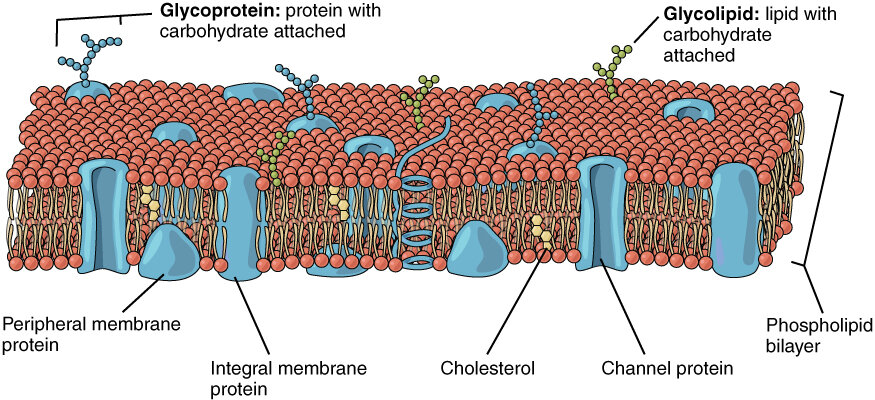
But the membrane is more than just a fatty barrier. Studded within this bilayer are various proteins. Some proteins span the entire membrane, creating channels or tunnels for specific molecules to pass through. Others are attached to the surface and act as docking stations or enzymes. These proteins are the functional workhorses of the membrane, carrying out most of its specific jobs.
Finally, carbohydrates attach to some of the proteins and lipids on the outer surface of the membrane. These sugar chains act like cellular ID badges, helping cells recognize each other and communicate. They play a key role in the immune system, which needs to distinguish between your body's own cells and foreign invaders.
The Fluid Mosaic Model
Early models of the plasma membrane pictured it as a static structure. We now know it's much more dynamic. The currently accepted theory is the fluid mosaic model. This model describes the plasma membrane as a two-dimensional liquid where phospholipids and proteins can move around.
Imagine the membrane as a sea of phospholipids. The proteins are like icebergs floating in this sea, able to drift laterally. The carbohydrates are like flags on these icebergs.
This fluidity is essential for the membrane's function. It allows the cell to be flexible, to grow, and to change shape. It also means that membrane components can be easily rearranged as the cell's needs change. Molecules like cholesterol are also embedded within the bilayer, acting like a temperature buffer to keep the membrane from becoming too fluid or too stiff.
Key Functions
The structure of the plasma membrane directly enables its primary functions. The most important of these is its role as a selective barrier.
The membrane is selectively permeable, meaning it allows some substances to pass through easily while blocking others. Small, uncharged molecules like oxygen and carbon dioxide can slip right through the phospholipid bilayer. However, larger molecules like glucose and charged ions like sodium cannot. They need help from the membrane's embedded proteins to get across.
This selective nature is fundamental to life. It allows a cell to take in nutrients, export waste, and maintain a precise internal balance of water and ions, a state known as homeostasis.
To wrap up, the plasma membrane is far from a simple bag. It is a dynamic, fluid, and intelligent barrier that defines the cell's boundaries, manages everything that goes in and out, and allows the cell to interact with its environment. This elegant structure is a cornerstone of all life.