The Philosophy of Ludwig Wittgenstein
Introduction to Wittgenstein's Philosophy
A Life in Thought
Ludwig Wittgenstein was one of the 20th century's most influential philosophers, yet he lived a life that often seemed at odds with his intellectual stature. Born in 1889 into one of Europe's wealthiest families in Vienna, he gave away his entire inheritance. He studied engineering and became fascinated by the philosophical foundations of mathematics, which led him to Cambridge to study under Bertrand Russell.
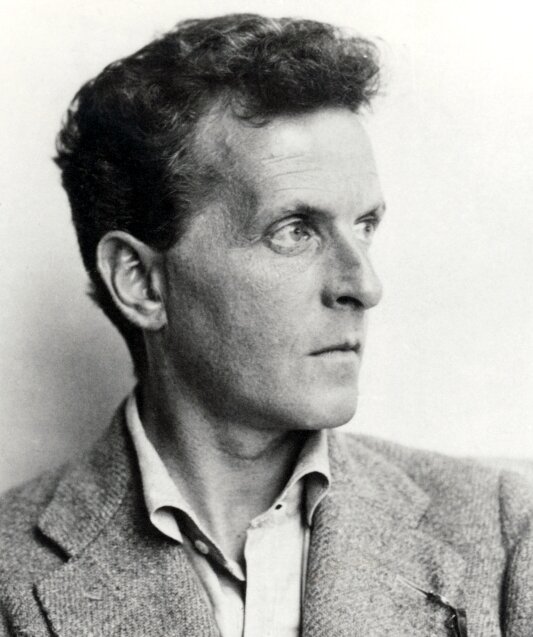
His philosophical work was interrupted by World War I, where he served as an officer in the Austro-Hungarian army. It was during his time as a soldier, much of it spent in prisoner-of-war camps, that he completed his first major book. After its publication, believing he had solved all of philosophy's problems, he abandoned the subject and worked for years as a primary school teacher in remote Austrian villages.
The World in Pictures
Wittgenstein's first book, the Tractatus Logico-Philosophicus, is a short, dense work that attempts to map the limits of thought, language, and the world. Its central idea is the "picture theory of meaning." Wittgenstein argued that language works by creating logical pictures of facts. A statement is meaningful only if it corresponds to a possible state of affairs in the world.
For example, the sentence "The cat is on the mat" is meaningful because we can picture that reality. It paints a logical picture. According to the early Wittgenstein, sentences about ethics, religion, or beauty are technically meaningless because they don't picture facts in the world. They lie outside the boundaries of what can be said clearly.
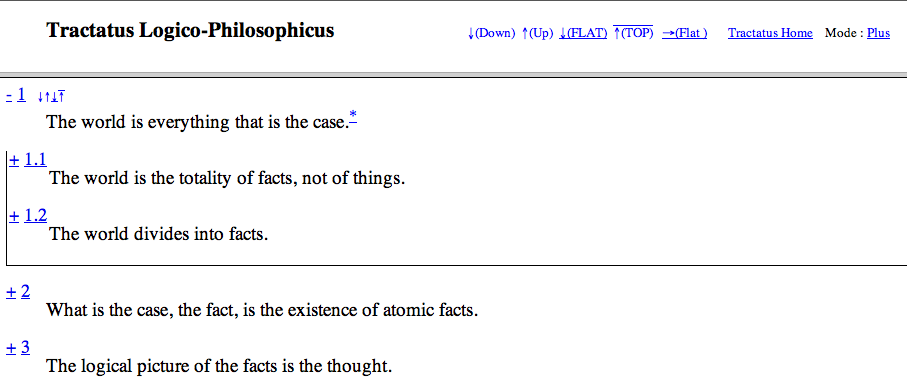
The Tractatus concludes with a famous and powerful line that summarizes its entire project. It suggests that philosophy's role isn't to answer unanswerable questions, but to clarify which questions can be asked at all.
Whereof one cannot speak, thereof one must be silent.
A Radical Reversal
Years later, Wittgenstein returned to philosophy, convinced his earlier work was fundamentally wrong. He realized that language was far more complex and fluid than the rigid structure he described in the Tractatus. This shift led to his second masterpiece, Philosophical Investigations, published after his death in 1951.
In this later work, he abandoned the picture theory. Instead, he proposed that the meaning of a word is not found in the object it points to, but in how it's used in a particular context. He called these contexts "language-games."
Thus, throughout the work Wittgenstein establishes some cornerstones of his new thought, such as the idea that "the meaning of a word is its use in the language" (§ 43): in order to know the meaning of a sign, one must observe the situations in which that sign is employed, examine the ways in which its usage is taught, and the customary practices by which that usage is transmitted, preserved, or transformed.
Think of the word "game." We use it to describe board games, card games, sports, and video games. These activities don't share one single, essential feature. Instead, they are connected by a web of overlapping similarities, what Wittgenstein called "family resemblances." The meaning of "game" isn't a fixed picture but emerges from its use in the flow of life.
For the later Wittgenstein, philosophical problems arise when we take words out of their context—their language-game—and try to give them a universal meaning. Philosophy's job, then, is not to build grand theories, but to untangle these linguistic knots. His work evolved from trying to define the limits of language to describing its infinite, practical variety.
Ready to test your understanding of Wittgenstein's two major philosophical phases?
What did Ludwig Wittgenstein do after publishing his first major philosophical work, the Tractatus Logico-Philosophicus, believing he had solved all of philosophy's problems?
The central idea of Wittgenstein's Tractatus Logico-Philosophicus is the 'picture theory,' which states that meaningful language must correspond to a possible state of affairs in the world.
Wittgenstein's journey from the rigid logic of the Tractatus to the fluid, use-based approach of the Philosophical Investigations represents one of the most significant shifts in modern thought, influencing not just philosophy but also linguistics, psychology, and computer science.