The Pareto Principle in Marketing
Introduction to the Pareto Principle
The Vital Few
Have you ever felt like a small portion of your work creates most of your results? Or that you wear the same few outfits from a closet full of clothes? This feeling points to a surprisingly common pattern in life and business.
Roughly 80% of outcomes come from 20% of causes.
This observation is known as the Pareto Principle, or the 80/20 rule. It’s not a strict law of nature, but a powerful rule of thumb that highlights a predictable imbalance in the world. It suggests that in many situations, the relationship between input and output is unequal. A small number of causes, the "vital few," are responsible for the majority of the effects.
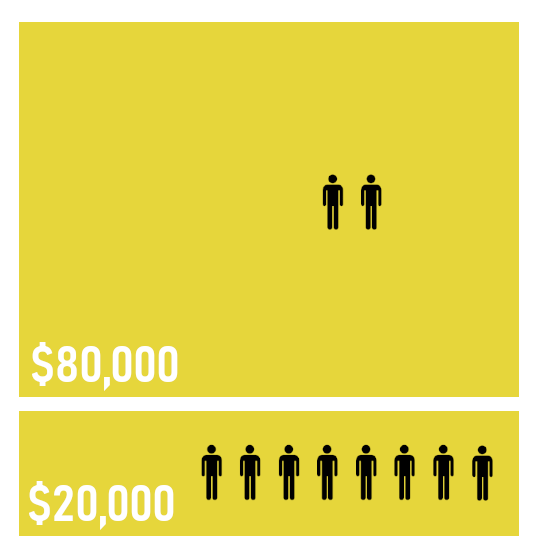
The principle gets its name from Vilfredo Pareto, an Italian economist. In the late 1800s, he noticed that about 80% of the land in Italy was owned by only 20% of the population. He reportedly saw a similar pattern in his garden, where 20% of the pea pods produced 80% of the peas. This sparked an idea: what if this imbalance was everywhere?
An Idea with Reach
It turns out, he was onto something. Once you start looking for the 80/20 rule, you see it in many different fields.
- Software Development: A small number of bugs (about 20%) often cause the vast majority of software crashes (about 80%).
- Time Management: A few key tasks in a day (20%) typically generate most of the meaningful progress (80%).
- Urban Planning: A minority of drivers (20%) account for the bulk of traffic accidents (80%).
- Health and Fitness: 20% of the exercises in a workout routine often deliver 80% of the physical benefits.
These numbers are not always exactly 80 and 20. Sometimes the split is 90/10 or 70/30. The core idea is that effort and reward are rarely, if ever, evenly distributed.
Focusing on What Counts
In business and marketing, the Pareto Principle is a fundamental concept for making smarter decisions. It pushes you to ask critical questions: Which 20% of customers generate 80% of the revenue? Which 20% of products make up 80% of sales? Which 20% of marketing efforts are driving 80% of the new leads?
The principle encourages businesses to focus on the critical few rather than the trivial many.
By identifying this "vital few," a business can focus its resources where they will have the most impact. Instead of treating every customer, product, or marketing channel as equally important, a company can prioritize what truly drives growth. This is the first step toward working smarter, not just harder.
The Pareto Principle is also commonly known as the:
Who first observed the principle that a small percentage of a population controlled the majority of the wealth, which later became known as the Pareto Principle?