The OSI Model Explained
Introduction to OSI Model
A Universal Language for Networks
Imagine trying to send a package from Paris to Tokyo. The process involves many steps. You have to write the address in a specific format, choose a shipping company, and package the item securely. The shipping company then has its own process for sorting, flying the package across the world, and handing it off to a local delivery service in Japan. Each step is a distinct task, handled by different people or systems, but they all work together to get your package to its destination.
Sending data over a network is surprisingly similar. It’s a complex journey with many stages. To make this process manageable, computer scientists developed the Open Systems Interconnection (OSI) model. It’s not a piece of hardware or software, but a conceptual framework—a map that breaks down the job of network communication into seven distinct stages, or layers.
The main purpose of the OSI model is standardization. In the early days of networking, systems from different manufacturers couldn't communicate with each other. It was like everyone speaking a different language. The OSI model created a universal standard, ensuring that a device made by one company could successfully exchange data with a device made by another.
The Seven Layers
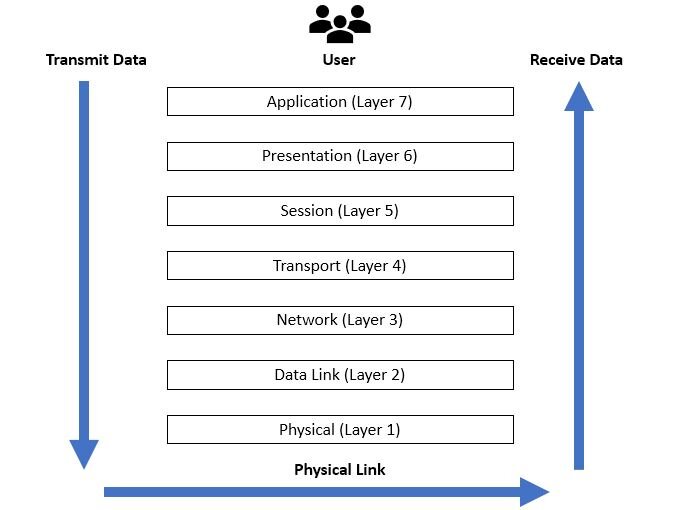
The OSI model is organized into a stack of seven layers. Each layer has a specific responsibility and only interacts with the layers directly above and below it. This modular design makes it much easier to develop new network technologies and troubleshoot problems. If something goes wrong, you can isolate the issue to a specific layer instead of having to inspect the entire system.
When you send data, it travels down the stack, from Layer 7 on your computer to Layer 1. At each layer, information is added. When another computer receives the data, it travels back up the stack, and each layer strips off the information added by its counterpart.
Here are the seven layers, starting from the top (where your applications live) and going down to the bottom (the physical hardware).
| Layer Number | Layer Name |
|---|---|
| 7 | Application |
| 6 | Presentation |
| 5 | Session |
| 4 | Transport |
| 3 | Network |
| 2 | Data Link |
| 1 | Physical |
That can be a lot to remember. A popular mnemonic helps keep the layers in order from top to bottom:
Please Do Not Throw Sausage Pizza Away
Why It Matters Today
While most modern networks, like the internet, run on a simpler model called TCP/IP, the OSI model remains incredibly important as a teaching and reference tool. Network engineers, software developers, and IT professionals use it every day.
Understanding the OSI model gives you a powerful mental map for how data moves. When a website fails to load, is it a problem with the physical cable (Layer 1)? Is your Wi-Fi router failing to assign an address (Layer 3)? Or is the web server's software itself having an issue (Layer 7)? The OSI model provides a logical framework for diagnosing and solving these kinds of real-world problems. It's the foundational knowledge for anyone looking to understand how digital communication truly works.
Next, we'll begin our journey through the layers, starting from the ground up.