The Odyssey Unbound: An Epic Journey of Mind and Myth
Origins and Oral Traditions
The Unwritten Epic
Before The Odyssey was a book, it was a performance. For centuries, it existed only in memory, passed down through generations of oral poets, or rhapsodes. These storytellers were the living libraries of their time, weaving together tales of heroes, gods, and monsters for audiences in halls and public squares. They didn't read from a script; they composed in the moment, drawing from a vast, shared well of stories and poetic formulas.
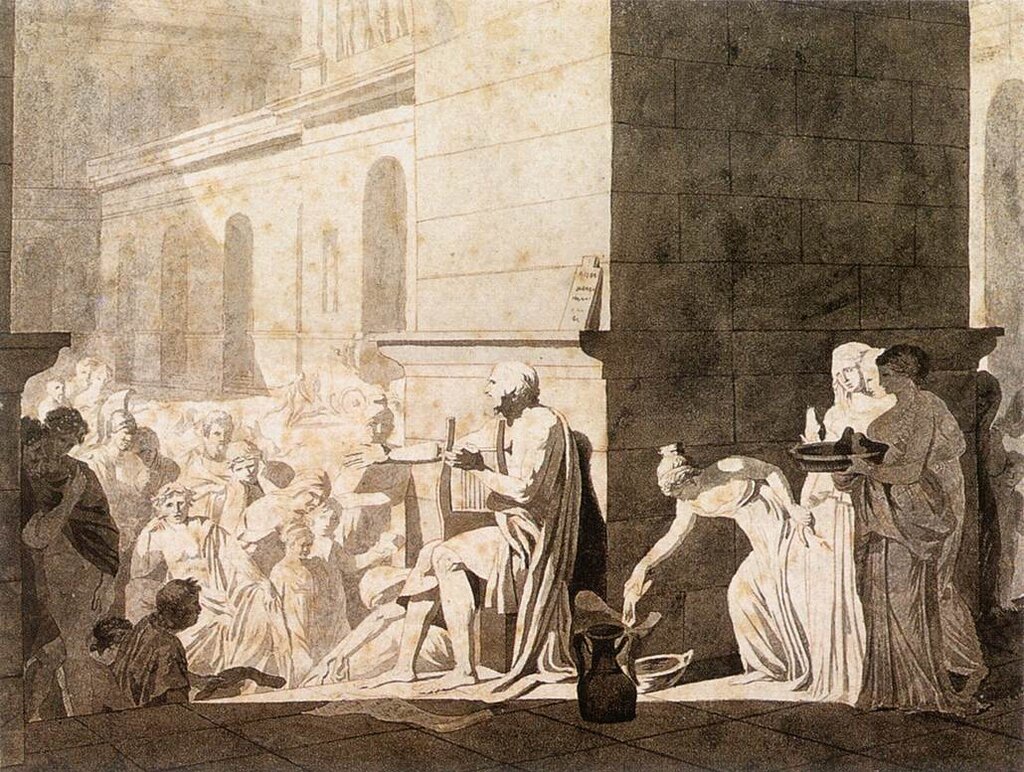
This raises the "Homeric Question": Was Homer a single, brilliant poet who authored both The Iliad and The Odyssey? Or is "Homer" the name we give to a long tradition of anonymous poets who collectively shaped these epics over time? The truth is likely somewhere in between. The poems show a remarkable consistency of style, suggesting a singular artistic vision, yet they also bear the hallmarks of a fluid, oral tradition.
The Poet's Toolkit
Reciting thousands of lines of poetry from memory is a monumental task. To manage it, rhapsodes relied on a sophisticated set of tools. The first was a strict rhythmic structure called dactylic hexameter. Every line of the epic follows this pattern, giving the performance a hypnotic, song-like quality.
Another key tool was the epithet, a descriptive phrase repeatedly linked to a specific person or thing. Think of "swift-footed Achilles," "grey-eyed Athena," or "wise Odysseus." These weren't just decorative; they were mnemonic building blocks. The poet could slot them into the dactylic hexameter to fill out a line while giving their brain a split-second to recall what came next. These stock phrases helped ensure a smooth, continuous performance.
Epithets and meter were the grammar of oral poetry, allowing for both structure and improvisation.
Literary Crystallization
The Odyssey is set in the Mycenaean Bronze Age, a world of powerful kings and grand palaces that collapsed around 1200 BCE. Yet the poem was likely composed and written down much later, during the Archaic period or Iron Age of Greece, around the 8th century BCE. This gap of several hundred years means the poem is a fascinating blend of historical layers.
The world Odysseus inhabits has the grand scale of Mycenaean memory, but the social values, technology, and political structures often reflect the later Iron Age society of the poets themselves. The story is an artifact of a culture remembering its own heroic past, filling in the gaps with the realities of its present.
Homer's epics, the Iliad and the Odyssey, are prime examples of this oral tradition.
Think of this process as a kind of literary crystallization. Just as a gemstone forms under immense pressure over time, consolidating minerals into a coherent structure, an oral epic consolidates stories, historical memories, and cultural values. Each generation of rhapsodes was like a new layer of pressure, refining the narrative, polishing its facets, and embedding new cultural material. The story told in the Mycenaean era wasn't the same as the one performed in the Archaic period. It had been compressed and reshaped by centuries of societal change until it solidified into the brilliant, multi-faceted epic we know today.
What was the primary role of the rhapsodes in ancient Greece before epics like The Odyssey were written down?
The "Homeric Question" refers to the debate over whether Homer was a single, brilliant poet or a name representing a long tradition of oral poets.