The Number 67
Introduction to Number 67
Exploring the Number 67
At a glance, the number 67 might seem ordinary, just another integer sitting between 66 and 68. But in mathematics, some numbers have special properties that make them unique. For 67, its special quality is that it's a prime number.
Prime Number
noun
A whole number greater than 1 that has only two divisors: 1 and itself.
Following this definition, 67 is prime. You can only divide it evenly by 1 and 67. Try dividing it by any other whole number, and you'll always end up with a remainder. This property of indivisibility is what sets it apart from composite numbers like 66 (which can be divided by 2, 3, 6, 11, etc.) or 68 (divisible by 2, 4, 17, etc.).
Checking for Primality
How can we be sure 67 is prime without trying every number? There's a handy shortcut. We only need to check for divisibility by prime numbers up to the square root of the number in question.
The square root of 67 is approximately 8.18. So, we only need to test the prime numbers less than 8.18, which are 2, 3, 5, and 7.
| Divisor | Result of 67 ÷ Divisor | Remainder? |
|---|---|---|
| 2 | 33.5 | Yes |
| 3 | 22.33... | Yes |
| 5 | 13.4 | Yes |
| 7 | 9.57... | Yes |
Since none of these smaller prime numbers divide 67 evenly, we can confidently say that 67 is a prime number. It is, in fact, the 19th prime number.
The Importance of Primes
Prime numbers like 67 are fundamental in number theory. They act as the basic building blocks for all whole numbers. This is a concept known as the fundamental theorem of arithmetic, which states that any integer greater than 1 is either a prime number itself or can be represented as a unique product of prime numbers.
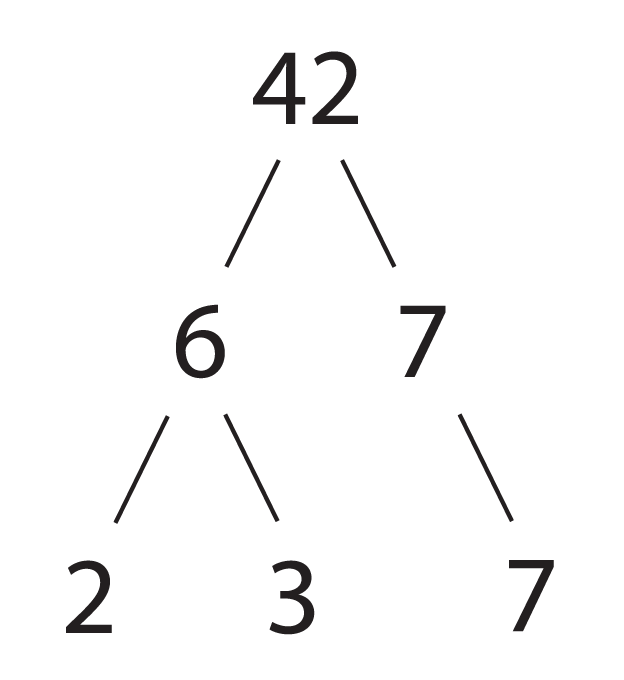
This property isn't just an academic curiosity. The difficulty of factoring very large numbers into their prime components is the foundation of modern cryptography. The secure transactions you make online, from banking to sending private messages, are protected by algorithms that rely on the properties of large prime numbers. While 67 is far too small to be used in this way, it belongs to the same special class of numbers that keep our digital world secure.
Now, let's test your understanding of these concepts.
Why is the number 67 considered a prime number?
To efficiently check if 67 is a prime number, you only need to test for divisibility by prime numbers up to its square root (). What is the largest prime number you must check?
So, 67 isn't just another number. It's a prime, a fundamental piece of the mathematical puzzle.