The Navier-Stokes Equations Unveiled
Introduction to Fluid Dynamics
What Makes a Fluid Flow?
Everything around us is either a solid or a fluid. The difference is simple: how they handle stress. If you push on a solid, like a book, it might move or deform a little, but it stays together. It resists the force. A fluid, on the other hand, gives way. When you apply the same kind of force—called a shear stress—a fluid continuously deforms. In a word, it flows.
This category includes both liquids, like water, and gases, like the air you're breathing. They might seem different, but they share this fundamental property of flowing under stress. Think about stirring coffee. The liquid moves and swirls. Now imagine trying to stir a block of ice. It just won't work the same way. The ice block is a solid; it resists that shearing motion.
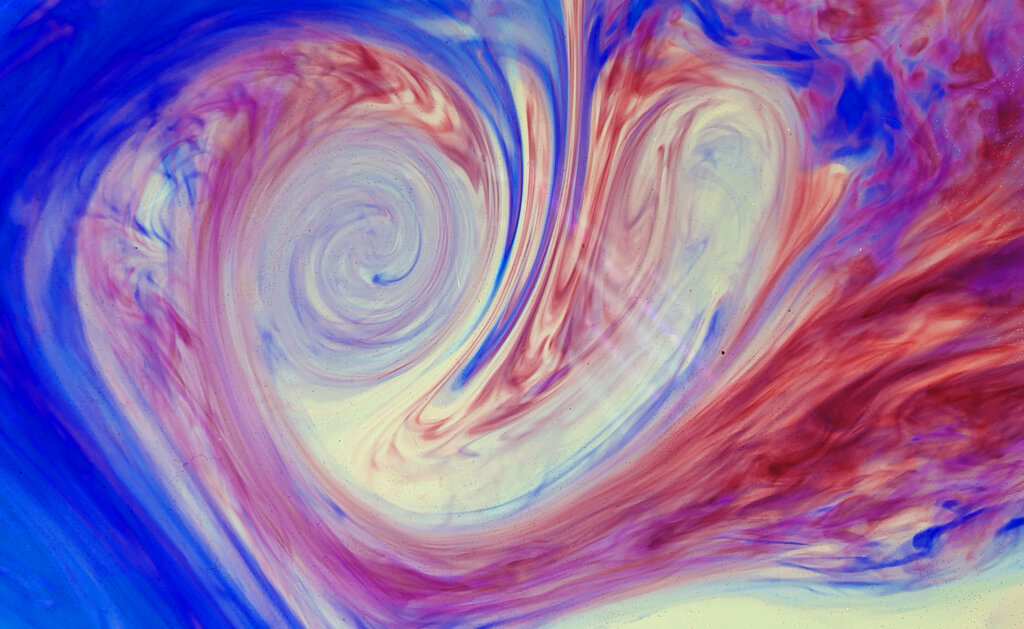
This ability to flow is the defining characteristic of all fluids, and understanding it is the first step in exploring fluid dynamics.
Key Fluid Properties
Of course, not all fluids are the same. A bucket of honey behaves very differently from a balloon full of helium. We use a few key properties to describe and predict how a fluid will act. The two most important are density and viscosity.
Density is about how much "stuff" is packed into a space.
Imagine holding a brick in one hand and a loaf of bread of the same size in the other. The brick feels heavier because it has more mass packed into the same volume. It is denser. We measure density by dividing an object's mass by its volume.
Here, (the Greek letter rho) is density, is mass, and is volume. Air is far less dense than water, which is why a bubble of air rises to the surface of a lake.
viscosity
noun
A measure of a fluid's resistance to flow. It describes the internal friction of a moving fluid.
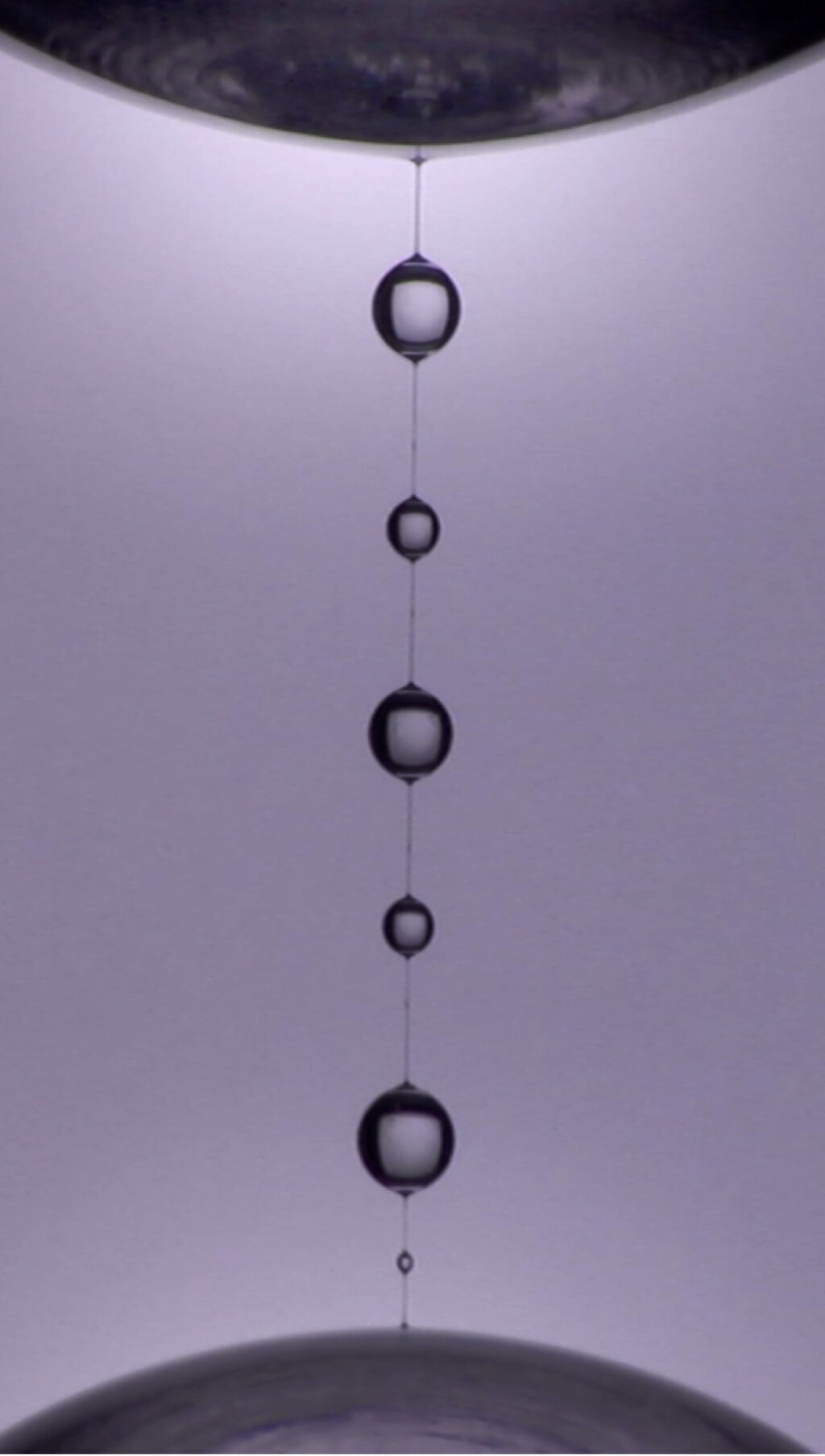
Viscosity is essentially fluid friction. It's what makes honey ooze slowly while water splashes easily. A fluid with high viscosity strongly resists motion because its molecules are, in a sense, sticking together more. A fluid with low viscosity flows freely.
Temperature has a big effect on viscosity. Heating honey makes it runnier, lowering its viscosity. In contrast, the viscosity of gases typically increases with temperature, as the gas particles move faster and collide more often.
The Language of Flow
When a fluid is in motion, we need ways to describe what's happening. The most basic principle is the idea of a flow field, where we imagine that at every single point in the fluid, there is a specific velocity—a speed and a direction.
This flow can be simple or incredibly complex. Physicists and engineers often start by classifying the flow into one of two major types: laminar or turbulent.
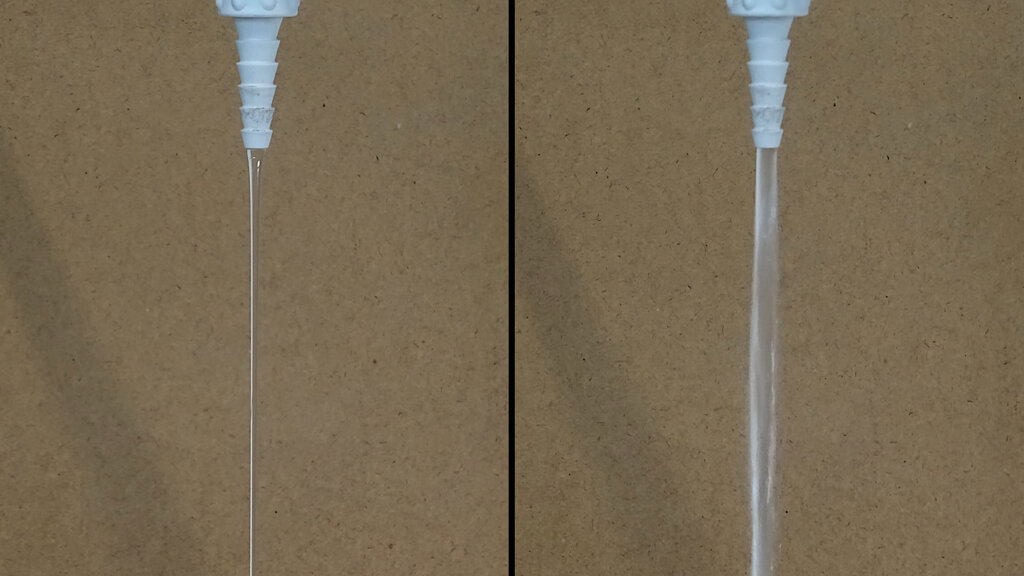
Laminar flow is smooth and orderly. You can picture it as thin layers, or laminae, sliding past one another without much mixing. A slow-moving, deep river or honey pouring from a jar are good examples. The flow is predictable.
Turbulent flow is the opposite. It's chaotic, with swirls, eddies, and vortices. The flow is irregular and highly mixed. Think of a raging waterfall, the smoke from a candle, or cream being stirred into coffee. Most fluid flows we encounter in nature and technology, from the weather to the air flowing over an airplane's wing, are turbulent.
The distinction between laminar and turbulent flow is one of the most important concepts in all of fluid dynamics.
Finally, we have the principle of mass conservation. It's a simple but powerful idea: mass cannot be created or destroyed. For fluids, this means that if you have fluid flowing through a pipe, the amount of mass entering one end of the pipe must equal the amount of mass leaving the other end (unless the pipe has a leak!).
This leads to an interesting outcome. If the pipe narrows, the fluid must speed up to get the same amount of mass through the smaller area in the same amount of time. If the pipe widens, the fluid slows down. This relationship is described by the continuity equation, a fundamental tool for analyzing fluid flow.
This equation applies to incompressible fluids (fluids whose density doesn't change). It states that the product of the cross-sectional area () and the fluid's velocity () at one point is equal to the product of the area and velocity at another point. It’s a mathematical statement of common sense: what goes in must come out.
What is the defining characteristic of a fluid that distinguishes it from a solid?
If a fluid is flowing through a pipe that narrows, what happens to the speed of the fluid according to the principle of mass conservation?
These core ideas—what a fluid is, its key properties like density and viscosity, and the basic rules of its motion—form the bedrock of fluid dynamics. They are the essential building blocks for understanding more complex behaviors.