The Navier-Stokes Equations Explained
Fluid Mechanics Basics
What Makes a Fluid Flow?
Think about pouring a glass of water, or the air you're breathing. Both are fluids. But what does that actually mean? At its core, a fluid is a substance that can't hold its own shape. It flows and conforms to the shape of its container.
The defining characteristic of a fluid is that it continuously deforms, or flows, when a shear stress is applied to it, no matter how small that stress is.
Let's break down "shear stress." Imagine you place your hand flat on the surface of water and drag it sideways. That sideways force is a shear stress. The water moves and flows with your hand. Now, imagine doing the same thing to a wooden table. If you push on it sideways, it might slide, but the wood itself doesn't flow or change its shape. It resists that shearing force.
That's the fundamental difference between fluids and solids. A solid resists shear stress with a static deformation; it might bend or compress a little, but it maintains a fixed shape. A fluid, on the other hand, simply can't resist. It flows. This category includes liquids, like water and oil, as well as gases, like air and helium.
Key Fluid Properties
To understand how fluids behave, we need to know their key properties. These characteristics determine everything from why a ship floats to how a plane flies.
Density
noun
The amount of mass contained in a given volume.
Density, often represented by the Greek letter rho (), is essentially a measure of how tightly packed the matter in a substance is. A block of wood floats because it's less dense than water, while a rock sinks because it's more dense.
Viscosity
noun
A fluid's measure of resistance to flow.
Think of viscosity as a fluid's internal friction. It describes how "thick" a fluid is. Pouring honey is a slow process because it has high viscosity—its molecules resist sliding past each other. Water, with its low viscosity, pours easily. This property is crucial in applications like engine lubrication, where motor oil needs to have the right viscosity to protect moving parts at different temperatures.
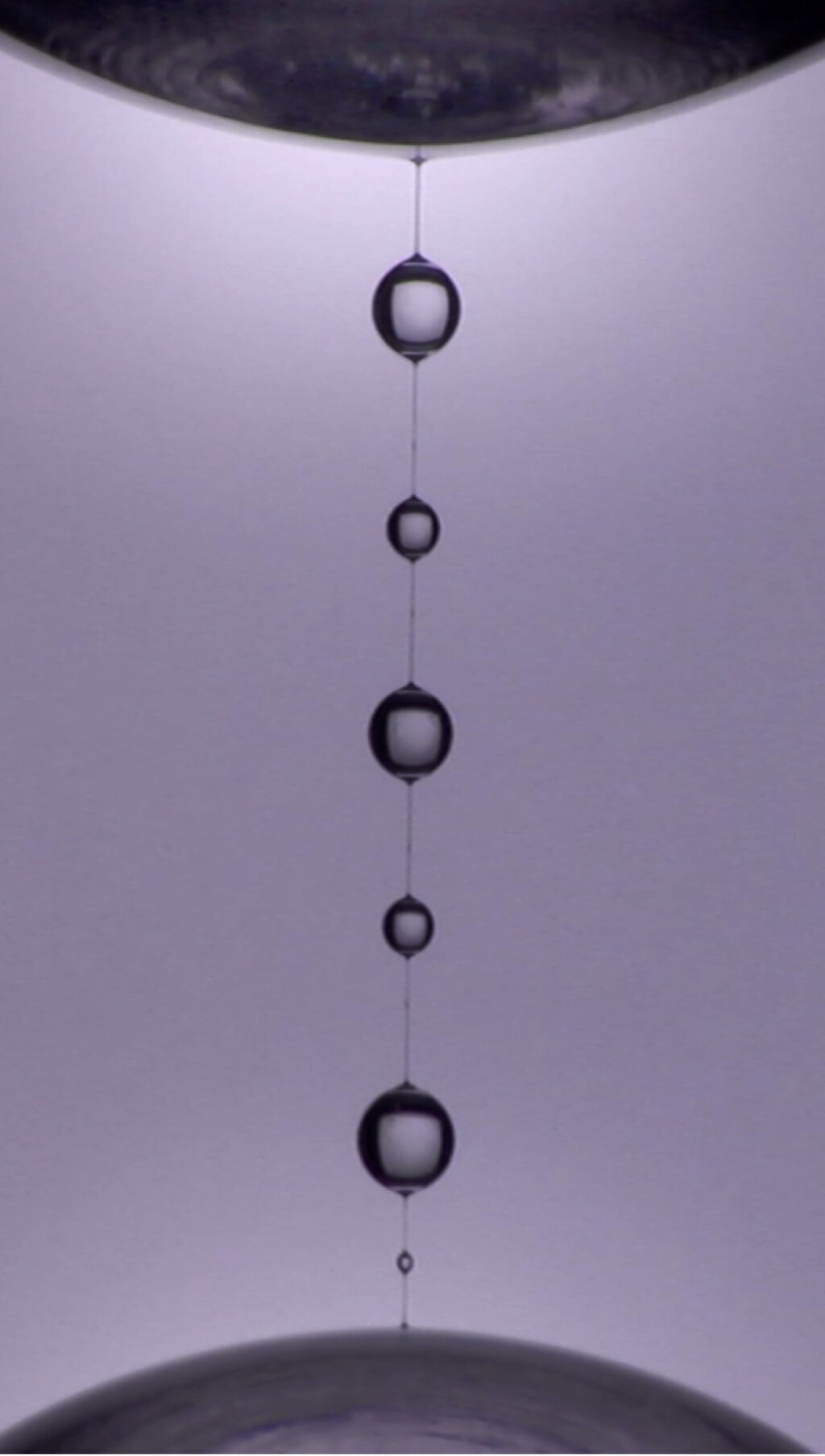
Another key property is pressure. It's the force a fluid exerts on a surface, spread out over the area of that surface. When you dive into a swimming pool, you can feel the water pressure increasing on your eardrums as you go deeper. This is because the weight of the water above you is pushing down.
Finally, there's compressibility. This is the ability of a fluid's volume to decrease when pressure is applied. Gases are highly compressible; you can easily squeeze a large amount of air into a small scuba tank. Liquids, on the other hand, are considered nearly incompressible. Squeezing a sealed water bottle doesn't change its volume much at all.
Fundamental Principles
A few basic principles govern how fluids in a static, or non-moving, state behave.
Archimedes' principle states that the upward buoyant force exerted on a body immersed in a fluid is equal to the weight of the fluid that the body displaces.
This is why massive steel ships can float. A ship's hull displaces an enormous volume of water. The weight of that displaced water creates a powerful upward buoyant force. As long as this buoyant force is greater than or equal to the ship's weight, the ship will float.
Another core idea is Pascal's principle. It says that a pressure change at any point in a confined, incompressible fluid is transmitted equally throughout the fluid. This is the magic behind hydraulic systems.
When a driver presses the brake pedal, they apply a small force to a small piston in the master cylinder. This creates pressure in the brake fluid. Because the fluid is confined in the brake lines, this pressure is transmitted to much larger pistons at the wheels. This multiplies the initial force, creating enough stopping power to halt a fast-moving car.
Finally, let's touch on how fluids move. Fluid flow can be categorized in two main ways: laminar and turbulent.
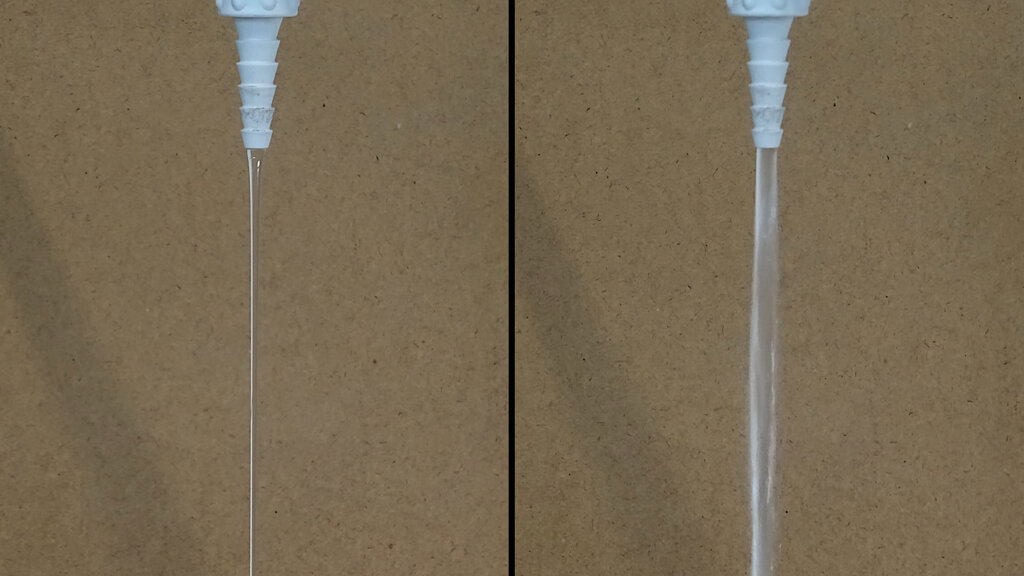
Laminar flow is smooth and orderly. Imagine a slow-moving river; the fluid particles move in straight, parallel lines. It's predictable and efficient. Turbulent flow is chaotic and swirling, full of eddies and vortices. Think of a raging waterfall or smoke rising from a chimney. Most fluid flow we see in nature and engineering is turbulent.
What is the defining characteristic of a fluid?
A massive steel ship floats on water because the upward buoyant force is equal to the weight of the...
These basic concepts—what a fluid is, its core properties, and the principles that govern it—are the building blocks for understanding the complex and beautiful world of fluid mechanics.