The Nature of Photons
Introduction to Photons
The Particle of Light
For a long time, scientists were confident that light was a wave. It rippled through space like waves on a pond, spreading out, bending around corners, and interfering with itself. This model explained a lot about how light behaves. But at the turn of the 20th century, a few stubborn experimental results just didn't fit.
The solution was radical. It turned out that light isn't just a wave. It's also a particle. Light travels in tiny, individual packets of energy. These fundamental particles of light and all other forms of electromagnetic radiation are called photons.
Photon
noun
The elementary particle of light and all other forms of electromagnetic radiation. It is the quantum of the electromagnetic field.
Thinking of light as a stream of particles was a huge leap. To see why it was necessary, we need to look at an experiment that the old wave theory couldn't explain.
A Puzzling Effect
Imagine shining a light on a piece of metal. Under the right conditions, this light can knock electrons right out of the metal's surface. This is called the photoelectric effect. According to the wave theory of light, a brighter light—a more intense wave—should carry more energy and therefore knock out electrons with more force. The color of the light shouldn't matter as much as its brightness. But that's not what happened.
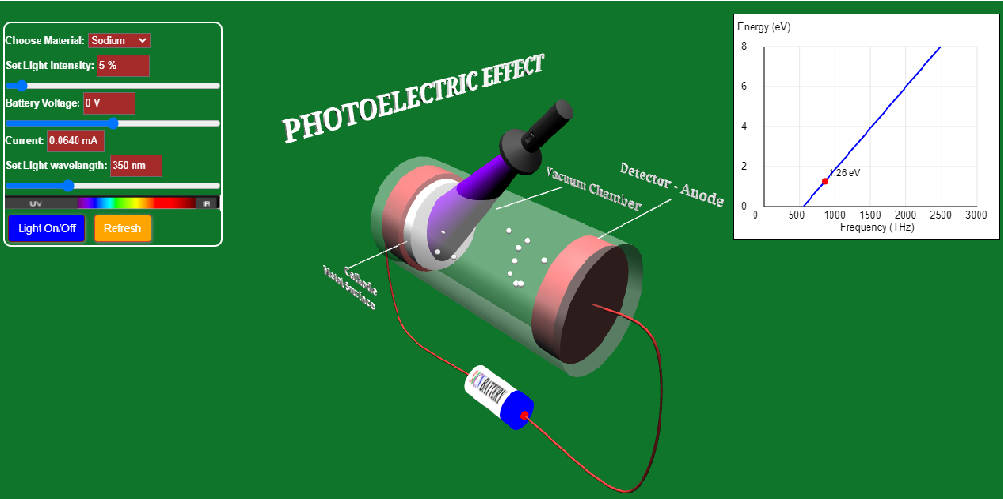
Experiments showed two strange things. First, for any given metal, only light of certain colors (or frequencies) could eject electrons. A dim violet light might work, while a very bright red light did nothing at all. This was bizarre. In the wave model, an intense red light should have plenty of energy to dislodge electrons. Second, when the light was the right color, electrons were ejected instantly. There was no time lag, even for very faint light. The wave theory predicted that a faint light wave would need to build up energy over time before it could knock an electron loose.
Einstein's Bright Idea
In 1905, a young Albert Einstein proposed a solution. He suggested that light isn't a continuous wave but is instead composed of discrete packets of energy—quanta. These quanta are what we now call photons.
This simple idea beautifully explained the photoelectric effect. Each photon carries a specific amount of energy determined by its color. An electron in the metal can only be knocked out if it's hit by a single photon with enough energy.
This explains why a bright red light does nothing. Each individual red photon lacks the energy to free an electron. It doesn't matter how many of them you send; it's like trying to knock down a wall by throwing a million ping-pong balls at it. A violet photon, however, has more energy. Even one is enough to do the job, which is why a dim violet light works instantly. A brighter violet light simply means more photons are arriving, knocking out more electrons.
Light energy is not spread out in a wave but is concentrated in individual particles called photons. One photon interacts with one electron.
Photon Properties
This new particle view established some fundamental properties for the photon. For one, photons have no mass. They are pure energy. Because they are massless, they can, and must, travel at the universe's ultimate speed limit: the speed of light, denoted as . In the vacuum of space, this speed is a constant 299,792,458 meters per second.
Photons are also electrically neutral. They have no charge. This means they aren't affected by electric or magnetic fields, allowing them to travel in straight lines through space unless they interact with matter or are bent by gravity.
| Property | Value |
|---|---|
| Mass | 0 |
| Charge | 0 |
| Speed in Vacuum | (the speed of light) |
Understanding the photon as a particle of light opened the door to the strange and wonderful world of quantum mechanics. Let's review these foundational concepts.
What key observation in the photoelectric effect was impossible to explain using the wave theory of light?
According to Albert Einstein's explanation of the photoelectric effect, what does the brightness (or intensity) of a light beam correspond to?