The Nature of Light
Electromagnetic Spectrum
A Spectrum of Waves
The light you see is just a tiny sliver of a much bigger picture: the electromagnetic spectrum. This spectrum is the full range of electromagnetic waves, which are ripples of electric and magnetic fields traveling through space. They all travel at the speed of light, but they differ in their wavelength, frequency, and energy.
Wavelength is the distance between two consecutive peaks of a wave. Frequency is the number of waves that pass a point in a given amount of time. These two properties are inversely related. When the wavelength is long, the frequency is low. When the wavelength is short, the frequency is high. Think of it like a rope you're shaking. If you make long, slow waves, fewer peaks pass by each second. If you shake it quickly, you get short, choppy waves, and more peaks pass by each second.
Energy is directly related to frequency. The higher the frequency, the higher the energy. This relationship is fundamental to understanding how different waves behave.
Here, is the constant speed of light, (lambda) is wavelength, and (nu) is frequency. In the second equation, is energy and is a constant. Together, they show that as wavelength () decreases, frequency () and energy () must increase.
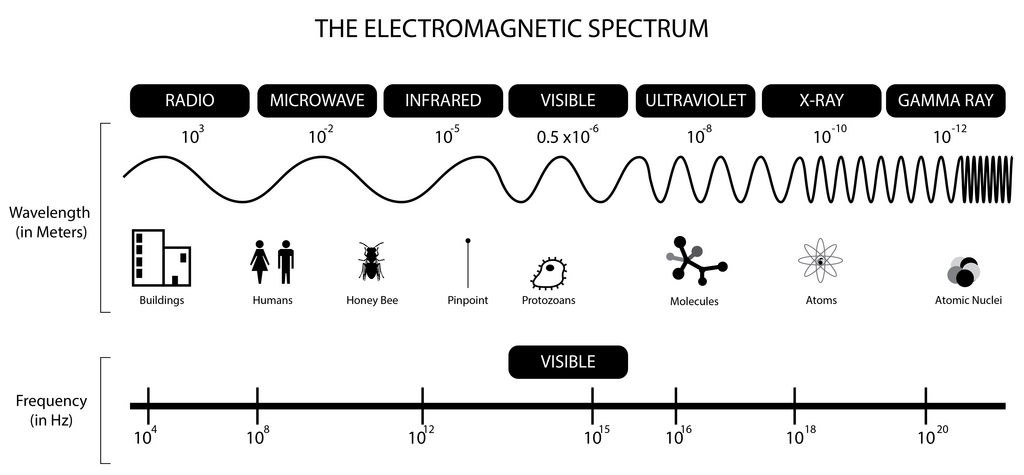
The Bands of the Spectrum
Let's journey through the spectrum, from the lowest energy waves to the highest.
Radio Waves: These are the long-haul travelers of the spectrum. With wavelengths ranging from the length of a football field to larger than our planet, they have the lowest frequencies and energy. They are great for broadcasting information over long distances.
Microwaves: With shorter wavelengths than radio waves, from about a foot down to a fraction of an inch, microwaves have more energy. They are used in radar and, of course, for cooking food.
Infrared (IR): Just below the red light we can see, infrared radiation has wavelengths measured in micrometers. We feel infrared radiation as heat. Everything with a temperature emits infrared waves, which is why night-vision goggles can see people and animals in the dark.
The visible light that humans can see is an incredibly narrow band of the electromagnetic spectrum. It's like seeing only one key on a massive piano.
Visible Light: This is the familiar rainbow of colors our eyes can detect, from red to violet. Red light has the longest wavelength in this band, and violet has the shortest. Each color corresponds to a slightly different wavelength and energy.
Ultraviolet (UV): Just beyond violet light lies ultraviolet. Its wavelengths are shorter and its energy is higher than visible light. This higher energy is why UV light from the sun can cause sunburn.
X-rays: These are high-energy waves with very short wavelengths. Their energy allows them to pass through soft tissues like skin and muscle but not through denser materials like bone, which is why they are used in medical imaging.
Gamma Rays: At the far end of the spectrum are gamma rays. They have the shortest wavelengths and the highest frequencies and energies. They are generated by nuclear reactions and cosmic events like supernovas. Their immense energy makes them the most penetrating of all electromagnetic waves.
Waves Meeting Matter
A wave's energy determines how it interacts with matter. Lower-energy waves, like radio waves, tend to pass through objects without much interaction. This is why you can listen to the radio inside a building. The long wavelengths don't "see" the smaller atoms in the wall.
Visible light interacts with objects in a way that allows us to see them. When light hits an object, its electrons can absorb the energy and then re-emit it, which we see as reflection. The colors we see depend on which wavelengths are absorbed and which are reflected.
Higher-energy waves, like ultraviolet, X-rays, and gamma rays, carry enough punch to knock electrons out of atoms, a process called ionization. This is why they are called ionizing radiation. While useful in medicine, this ability to alter atoms is what makes overexposure to them dangerous to living cells.
By understanding this full spectrum, we can see that the colorful world our eyes perceive is just one small part of a vast, invisible reality of energy waves, each with its own unique properties and behaviors.
An electromagnetic wave has a very long wavelength. What can you conclude about its frequency and energy?
Arrange the following types of electromagnetic radiation in order from LOWEST energy to HIGHEST energy: