The Mysteries of Black Holes
Introduction to Black Holes
The Ultimate Trapdoor
Imagine an object with gravity so powerful that once you get too close, there's no turning back. This isn't science fiction; it's a black hole. It's a region of spacetime where the gravitational pull is so immense that nothing, not even light, can escape.
A black hole is a one-way street in the cosmos. Anything can fall in, but absolutely nothing can come out.
The edge of this point of no return is called the event horizon. It's not a physical surface you could touch, but rather an invisible boundary. Crossing it means you've passed the limit where the escape velocity exceeds the speed of light. Since nothing can travel faster than light, escape becomes impossible.
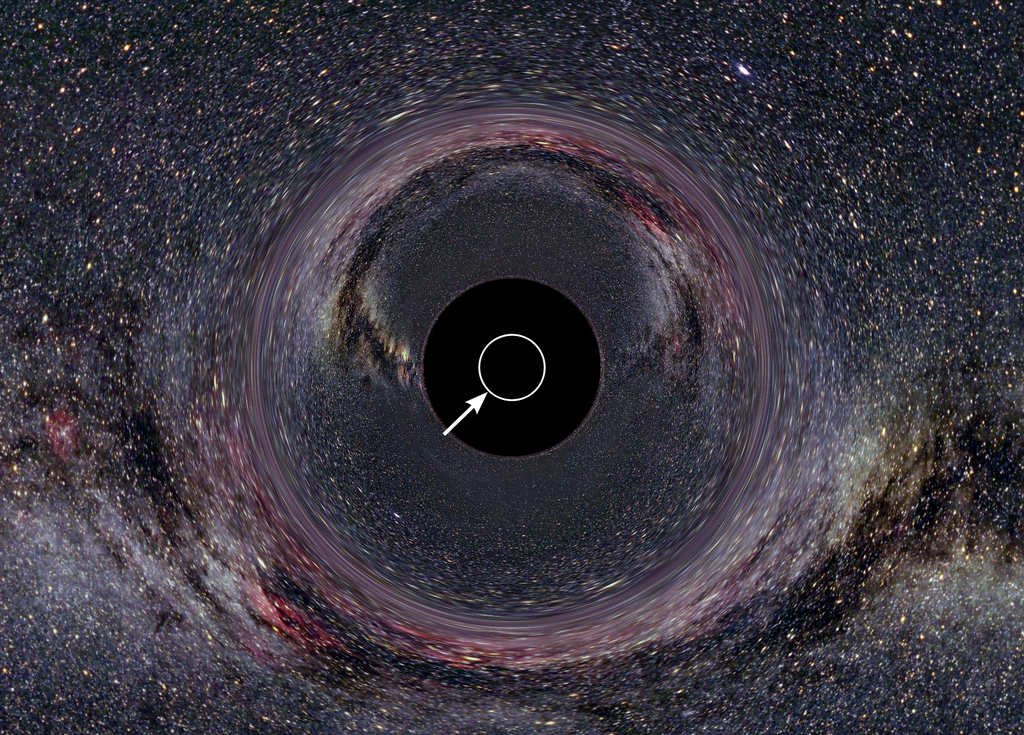
Inside the event horizon lies the singularity, a point where matter is crushed to an infinite density. Here, our current understanding of physics breaks down.
An Idea Before Its Time
The concept of an object massive enough to trap light is surprisingly old. In the late 18th century, thinkers like John Michell and Pierre-Simon Laplace imagined “dark stars.” Using Newtonian physics, they reasoned that if a star were dense enough, its escape velocity could be greater than the speed of light, rendering it invisible.
This was a fascinating thought experiment, but the modern understanding of black holes required a revolution in our concept of gravity. That came with Albert Einstein's theory of general relativity in 1915.
General relativity revealed that gravity isn't a force pulling objects together. Instead, it's a curvature in the fabric of spacetime caused by mass and energy. Massive objects create deep valleys in this fabric, and other objects follow these curves.
Just months after Einstein published his theory, a German physicist named Karl Schwarzschild found the first exact solution to its equations. His math described the spacetime around a single, non-spinning spherical mass. It showed that if enough mass was compressed into a small enough space, it would create an event horizon and a singularity, effectively describing a black hole.
However, the concept remained purely theoretical for decades. The term "black hole" wasn't even coined until 1967 by physicist John Wheeler. It took powerful new telescopes to turn this mathematical curiosity into an observed reality.
Seeing the Unseeable
Since black holes don't emit any light, we can't see them directly. So how do we know they're out there? Astronomers act like detectives, looking for the clues black holes leave in their cosmic neighborhoods.
One key method is watching the behavior of stars. If a star appears to be orbiting an empty spot in space, it's a strong sign that an unseen, massive object is there. This is how astronomers confirmed the existence of Sagittarius A*, the supermassive black hole at the center of our own Milky Way galaxy.
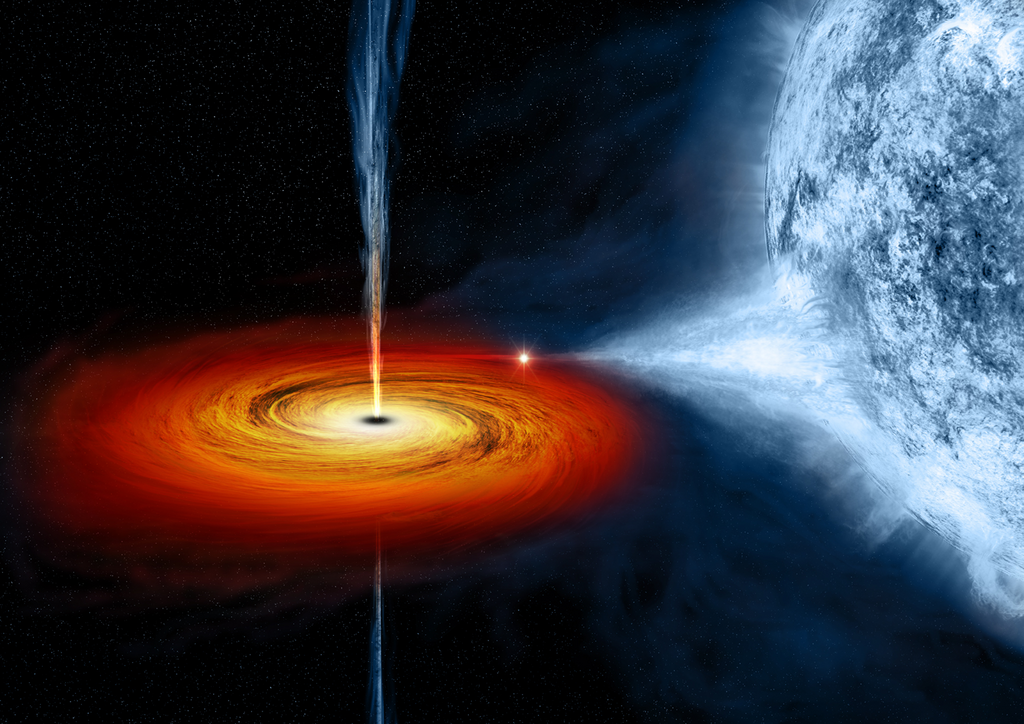
Another telltale sign is an accretion disk. When a black hole pulls in gas and dust from a nearby star or cosmic cloud, the material doesn't fall straight in. It swirls around, forming a flat, spinning disk. Friction within this disk heats the material to millions of degrees, causing it to glow brightly in X-rays and other forms of light. Telescopes can detect this intense radiation, pointing to the presence of a black hole.
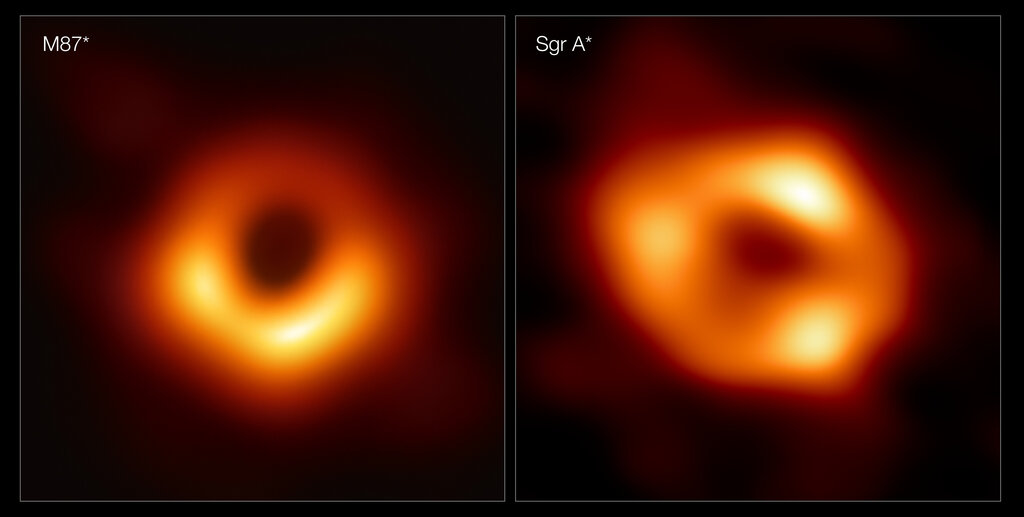
The most definitive evidence came in 2019. The Event Horizon Telescope, a global network of radio telescopes, captured the first-ever direct image of a black hole's silhouette. They photographed the supermassive black hole at the heart of the M87 galaxy, revealing a dark central region surrounded by a glowing ring of superheated gas. A few years later, they did the same for Sagittarius A*.
Black holes are more than just cosmic oddities. They are fundamental to the structure of the universe. Supermassive black holes, millions or billions of times the mass of our sun, are found at the centers of most large galaxies, including our own. Their immense gravity plays a crucial role in how galaxies form and evolve over billions of years. By studying them, we test the limits of physics and explore the most extreme conditions in the cosmos.