The Mighty Cholas
Origins and Rise
The First Cholas
The story of the Cholas begins long before their grand temples and naval expeditions. They were one of the three crowned kings of the Tamil-speaking lands in ancient South India, alongside the Cheras and Pandyas. This early period, known as the Sangam Age (roughly 300 BCE to 300 CE), saw the Cholas ruling from their capital at Uraiyur, a bustling city famous for its cotton textiles.
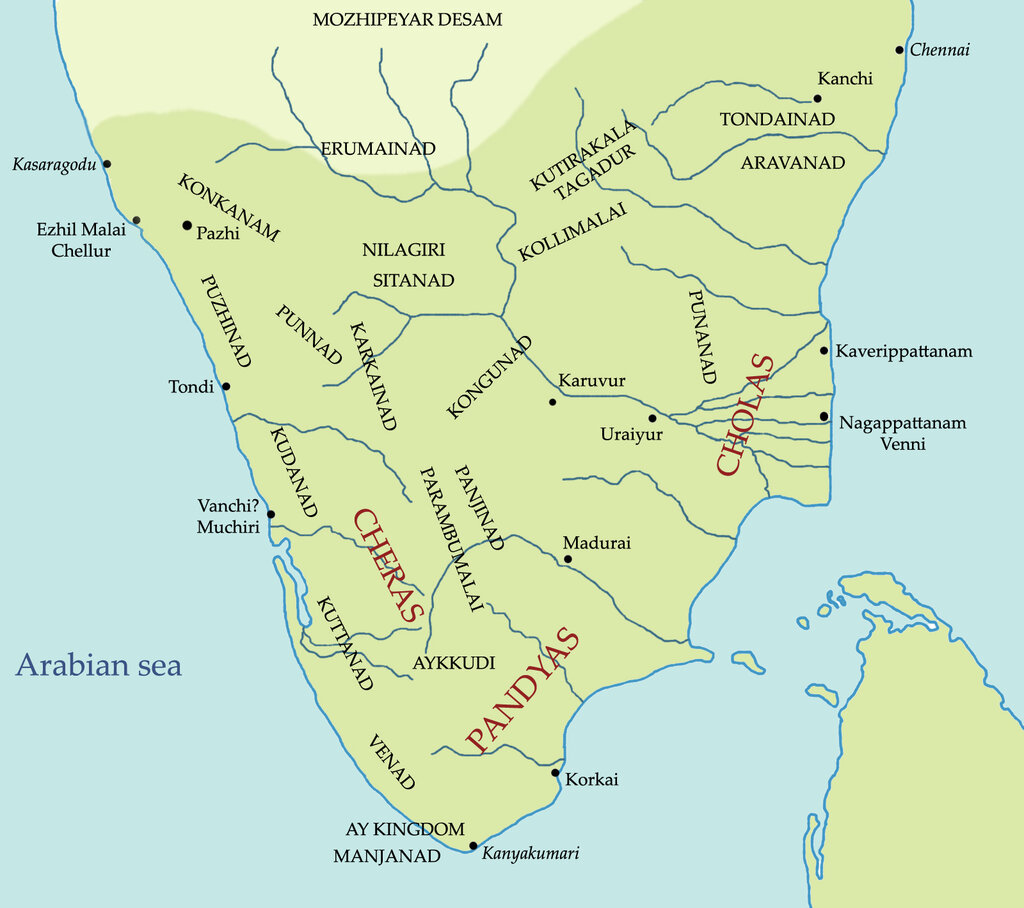
Early Chola kings, like Karikala, are celebrated in Sangam poetry as mighty warriors and patrons of the arts. Karikala is credited with building flood banks for the Kaveri river, the lifeline of the Chola heartland. This region, known as Cholamandalam, was incredibly fertile, and its agricultural wealth formed the foundation of Chola power.
However, after the Sangam period, the Cholas faded from the historical record for several centuries. A people known as the Kalabhras invaded from the north, disrupting the established order and pushing the traditional Tamil kingdoms into obscurity. For nearly 500 years, the Cholas existed only as minor local chieftains, waiting for an opportunity to reclaim their legacy.
A New Beginning
That opportunity came in the mid-9th century CE. The political landscape of South India was a tense three-way rivalry between the Pandyas to the south, the Pallavas to the north, and the Rashtrakutas in the Deccan plateau. The Cholas, though minor players, were strategically located in the middle of this power struggle.
Around 850 CE, a Chola leader named Vijayalaya saw his chance. He was technically a vassal of the Pallavas, but he acted decisively. While the Pallavas and Pandyas were busy fighting each other, Vijayalaya marched his forces and captured the strategic city of Thanjavur. This wasn't just another raid; it was a declaration of intent.
Vijayalaya established Thanjavur as his new capital, fortified it, and built a temple to the goddess Nishumbhasudani to commemorate his victory. This single act marked the rebirth of the Chola dynasty. From this small foothold, they would grow to become an empire.
Vijayalaya's capture of Thanjavur was the pivotal moment that transformed the Cholas from minor lords into the founders of a new empire.
Forging an Empire
The work of building an empire fell to Vijayalaya's successors. His son, Aditya I, was a brilliant military strategist. He continued to serve the Pallavas faithfully at first, even helping them win a decisive victory against the Pandyas at the Battle of Sripurambiyam around 885 CE.
But Aditya's loyalty had its limits. Seeing the Pallava kingdom weakened by constant warfare, he turned against his overlords. In a bold campaign, he invaded their territory, defeated their king, and annexed the entire Pallava realm into the growing Chola kingdom. With this single stroke, the Cholas became the undisputed masters of the northern Tamil lands.

The expansion continued under Aditya's son, Parantaka I, who ruled for nearly half a century. He pushed south, confronting the Pandyas and conquering their capital, Madurai. He earned the title Madurai-konda (Captor of Madurai) for this feat. He also expanded Chola influence into Sri Lanka.
Parantaka's reign wasn't without setbacks. Towards its end, the Rashtrakutas invaded from the north and dealt the Cholas a heavy blow at the Battle of Takkolam. But the foundation laid by Vijayalaya and Aditya I was strong enough to withstand the shock. The initial, explosive phase of Chola expansion had established them as the dominant power in South India, setting the stage for the imperial glory that was to come.
During the Sangam Age, the Cholas were known for ruling from their capital at Uraiyur, which was famous for what product?
What group's invasion pushed the Cholas and other Tamil kingdoms into a period of obscurity for several centuries following the Sangam Age?
These early kings transformed the Cholas from a forgotten dynasty into a formidable kingdom, paving the way for one of the most remarkable empires in Indian history.