The Mechanics of Power Modern Engine Engineering
Dynamic Valve Synchronization
The Engine's Breathing
The four-stroke cycle is a familiar rhythm: intake, compression, power, exhaust. But for an engine to generate power efficiently, it needs to 'breathe' properly. This means getting the air-fuel mixture in and the exhaust gases out at precisely the right moments. This critical timing is managed by the valvetrain, a system of components that act as the engine's lungs.
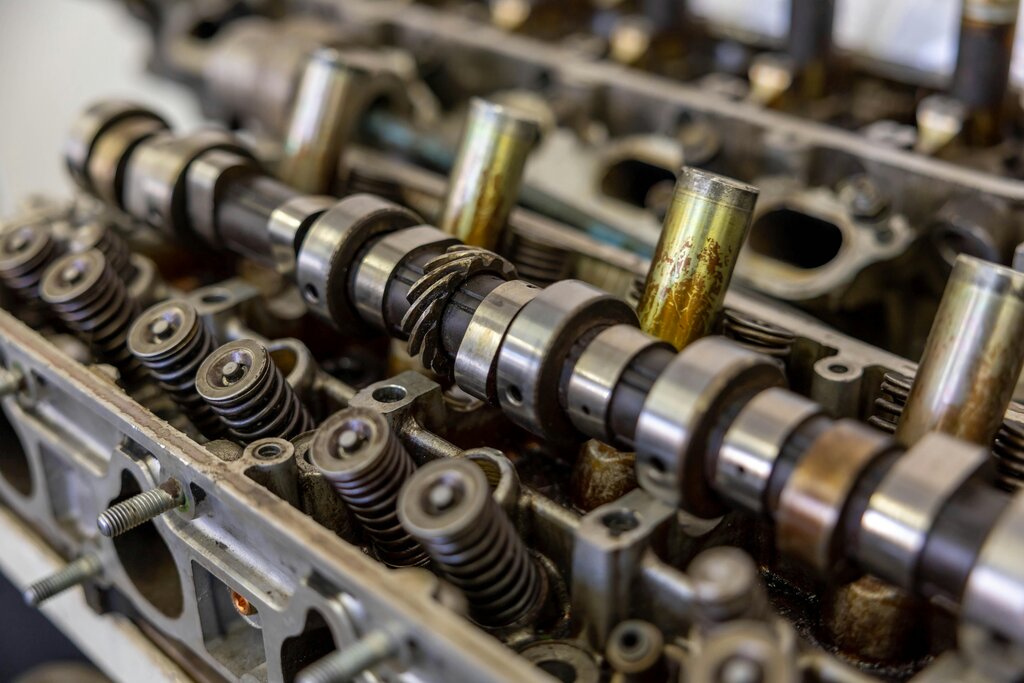
The heart of this system is the relationship between two rotating shafts: the crankshaft and the camshaft. The crankshaft converts the piston's linear motion into rotation. The camshaft, driven by the crankshaft, has a series of egg-shaped lobes that push open the intake and exhaust valves. To keep this dance perfectly synchronized, they are connected by a timing belt or chain.
For every two full rotations of the crankshaft, the camshaft completes just one rotation. This 2:1 ratio is fundamental, as each valve only needs to open once for every four-stroke cycle (intake and exhaust).
From Lobe to Valve
The shape of the camshaft's lobes dictates exactly how and when the valves open. The height of the lobe determines the valve "lift"—how far it opens into the cylinder. The width and shape of the lobe determine the "duration"—how long the valve stays open. Engineers design cam lobe profiles to balance performance, fuel efficiency, and emissions.
When the camshaft rotates, the lobe presses on a component that transfers this motion to the valve. This can be a simple bucket tappet that sits directly on top of the valve stem, or a more complex system involving pushrods and rocker arms. Each component must be precisely manufactured to transmit the cam's motion without wasted energy or damage. A valve spring is responsible for closing the valve quickly and seating it firmly once the cam lobe rotates away.
The Overlap Advantage
For a brief moment at the end of the exhaust stroke and the beginning of the intake stroke, both the intake and exhaust valves are slightly open. This is known as valve overlap and it’s a crucial aspect of engine breathing.
This overlap uses the momentum of the exiting exhaust gases to help pull the fresh air-fuel mixture into the cylinder. As the high-velocity exhaust gases rush out the exhaust port, they create a low-pressure area behind them. This vacuum effect helps to start the flow of the intake charge before the piston has even begun its intake stroke. This process, called scavenging, improves the engine’s volumetric efficiency—its ability to completely fill the cylinder with a fresh charge.
The amount of overlap is a trade-off. At high RPMs, more overlap allows for better scavenging and more power. However, at low RPMs, too much overlap can allow the fresh intake charge to leak out the exhaust valve, wasting fuel and causing a rough idle.
A crucial part of the engine’s internal mechanism, the timing belt plays a significant role in ensuring that the engine’s moving parts, like the pistons and valves, operate in sync.
The entire system—crankshaft, camshaft, timing connection, lobes, lifters, and valves—must work in perfect, high-speed harmony. This mechanical synchronization is what turns a simple container with a piston into a powerful, efficient engine. Understanding this relationship is key to grasping how engine performance is tuned and optimized.
Ready to test your knowledge?
What is the primary role of the valvetrain in an internal combustion engine?
The shape of a camshaft's lobes directly determines which two aspects of valve operation?
Now that you understand how the valvetrain works, you can see how an engine's 'breathing' is the fundamental limit on its power output.