The Mathematics of Similarity
Introduction to Similarity
Same Shape, Different Size
In geometry, when we say two shapes are similar, we mean they have the same shape but not necessarily the same size. Think of it like a photograph and an enlargement of that same photo. The details and proportions are identical, but one is bigger than the other.
This idea is built on two key properties. For any two shapes to be considered similar, they must satisfy both of these conditions.
- Corresponding angles are equal.
- Corresponding sides are in the same ratio, or proportion.
Let's break that down with an example. Imagine two triangles, one small and one large. If they are similar, every angle in the small triangle has a matching, equal angle in the large one. Additionally, if you take the length of a side from the large triangle and divide it by the length of the corresponding side from the small triangle, you'll get a certain number. This number, called the scale factor, will be the same for all three pairs of corresponding sides.
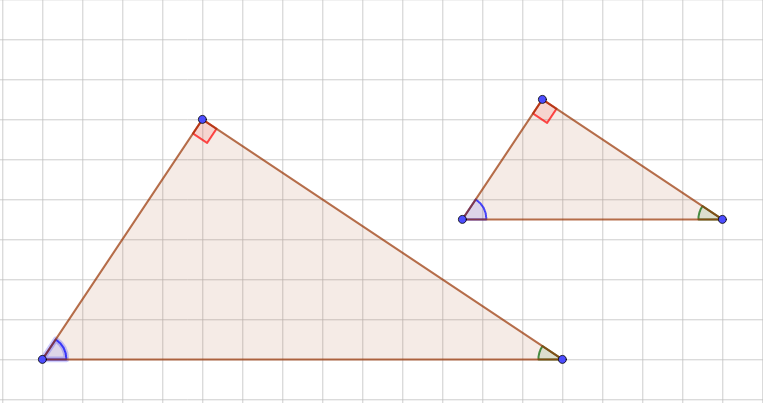
Similarity vs Congruence
You might have already learned about congruence. Congruent figures are identical in every way—they have the same shape and the same size. You could place one directly on top of the other, and they would match up perfectly.
Similarity is a broader concept. All congruent figures are also similar (their scale factor is 1), but not all similar figures are congruent. A figure and its scaled-up version are similar, but they are only congruent if the scaling factor is exactly 1.
| Feature | Congruent Figures | Similar Figures |
|---|---|---|
| Shape | Same | Same |
| Size | Same | Can be different |
| Corresponding Angles | Equal | Equal |
| Corresponding Sides | Equal | Proportional |
Shortcuts for Triangles
Triangles are special. We don't need to check all the angles and all the side ratios to know if two triangles are similar. There are three handy shortcuts, or criteria, we can use.
- Angle-Angle (AA): If two angles of one triangle are equal to two corresponding angles of another triangle, the triangles are similar.
This works because if two pairs of angles are equal, the third pair must also be equal (since the angles in any triangle add up to 180°).
- Side-Angle-Side (SAS): If two pairs of corresponding sides are in the same ratio, and the angle between those sides is equal in both triangles, the triangles are similar.
It's crucial that the equal angle is the one included between the two proportional sides.
Lastly, we have a rule that only looks at the sides.
- Side-Side-Side (S S): If all three pairs of corresponding sides have the same ratio, the triangles are similar.
With this rule, if the sides are proportional, we can be sure the corresponding angles will also be equal. These three criteria are powerful tools for proving similarity without needing to measure every part of a triangle.
Which statement best describes two similar geometric figures?
If two triangles are similar, which of the following must be true?