The Manhattan Project
Isotope Separation Engineering
The Race for an Isotope
Creating a nuclear chain reaction requires a specific ingredient: Uranium-235. The problem is that in nature, U-235 is incredibly rare. For every thousand uranium atoms, 993 are the stable, non-fissile isotope U-238. Only seven are U-235. Chemically, these two isotopes are identical. They react the same way and form the same compounds. The only difference is a tiny variance in mass—U-238 is just over 1% heavier. Separating them was one of the greatest engineering challenges of the 20th century. During the Manhattan Project, scientists at Oak Ridge, Tennessee, didn't bet on a single solution. They built three massive, entirely different industrial plants to tackle the problem from multiple angles.
Electromagnetic Separation: The Racetracks
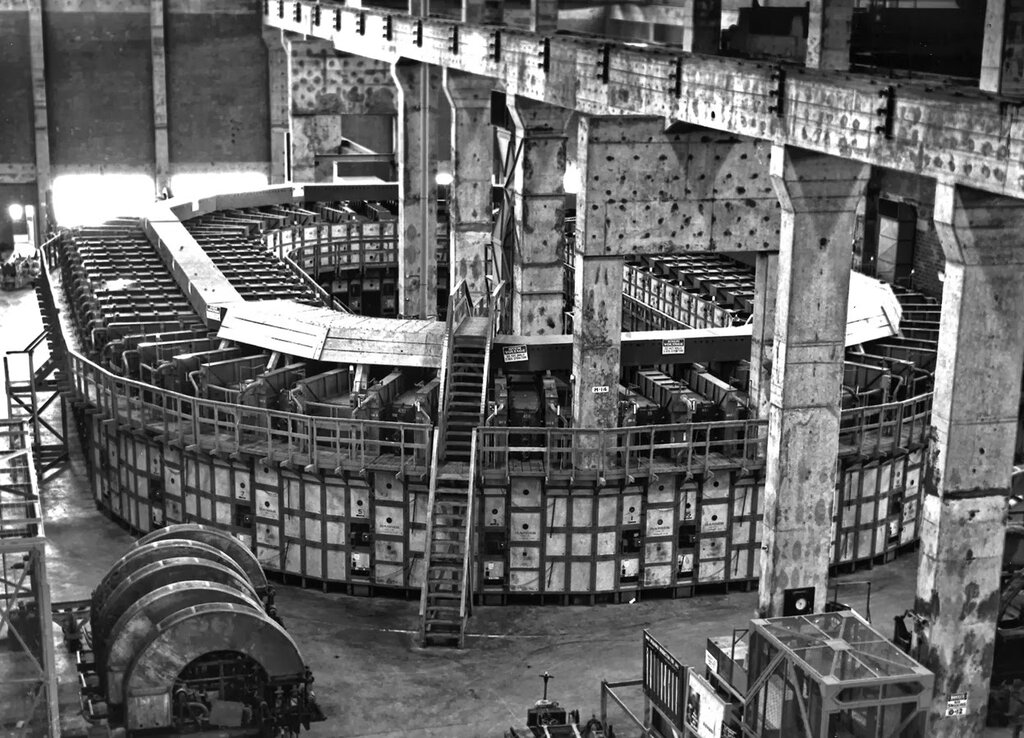
The first approach, implemented at the Y-12 plant, was a brute-force method using magnetism. The process relied on devices called —essentially giant mass spectrometers. First, solid uranium was vaporized, and its atoms were ionized, giving them an electric charge. These charged particles were then fired into a vacuum chamber surrounded by some of the most powerful electromagnets ever built.
As the ion beam traveled through the magnetic field, its path curved. Because the U-235 ions were slightly lighter, they followed a tighter arc than their heavier U-238 counterparts. At the end of the 'racetrack,' two collection bins were carefully placed to catch the separated streams. It worked, but the efficiency was abysmal. The early calutrons had constant technical problems, and the output was measured in grams. To produce enough material, Y-12 was built on an enormous scale, with hundreds of calutrons running 24/7, operated by thousands of people who had no idea what they were actually producing.
Gaseous Diffusion: A Billion-Dollar Gamble
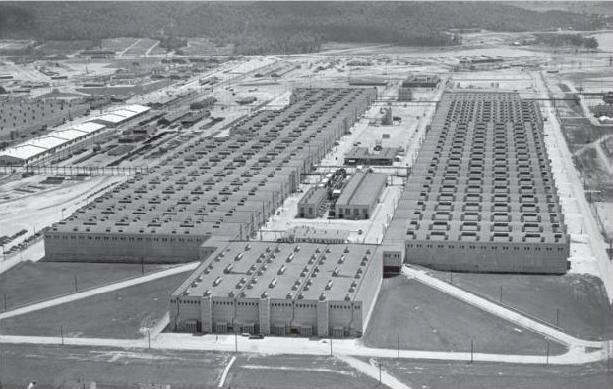
While Y-12 was a precision instrument scaled up to factory size, the K-25 plant was pure industrial might. At the time, its main building was the largest in the world under a single roof, a U-shaped structure half a mile long. Its strategy was based on a simple principle: a lighter gas will move faster and pass through a tiny opening more easily than a heavier one.
Engineers converted uranium into a highly corrosive gas called uranium hexafluoride (UF₆). This gas was then pumped at high pressure against a series of porous barriers, or membranes, with billions of microscopic holes. The lighter U-235 hexafluoride molecules diffused through the barrier slightly faster than the heavier U-238 molecules. The difference was minuscule, so the process had to be repeated thousands of times in a 'cascade' of stages. Each stage enriched the uranium by a tiny fraction. The engineering was a nightmare—the UF₆ gas attacked almost every material, requiring all pipes, pumps, and seals to be coated in nickel. The scale was unprecedented.
Integrating the Production Chain
Neither method was perfect. The calutrons at Y-12 were inefficient but could achieve higher enrichment levels. Gaseous diffusion at K-25 could handle huge volumes of raw material but was only effective at producing low-enriched uranium. A third, less-known facility, S-50, used liquid thermal diffusion. This process, which involved circulating liquid uranium hexafluoride between hot and cold concentric pipes, proved too energy-intensive to be a primary solution. However, it found its niche as an intermediate step.
The solution was to link the three disparate processes. Natural uranium first went to the S-50 plant for an initial, small boost in enrichment. The output from S-50 then became the feedstock for the massive K-25 gaseous diffusion plant, which raised the concentration to around 7%. Finally, this low-enriched uranium was fed into the Y-12 calutrons, which performed the final, difficult separation to achieve weapons-grade purity of around 90% U-235. This integrated chain, combining three unproven and radically different technologies, was a marvel of systems engineering, overcoming immense hurdles to produce the few dozen kilograms of fissile material needed.