The Manhattan Project
Isotope Separation Challenges
The Isotope Dilemma
After physicists confirmed that uranium could fuel a bomb, the Manhattan Project faced a staggering chemical problem. Natural uranium is over 99% uranium-238, an isotope that doesn't sustain a chain reaction. The critical ingredient, uranium-235, makes up only about 0.7% of the mix.
The challenge was that U-235 and U-238 are chemically identical. They have the same number of protons and electrons, so they bond with other elements in the exact same way. This ruled out any standard chemical separation techniques. You couldn't just add a solvent to dissolve one and leave the other. The only difference between them was physical: a U-238 atom has three more neutrons, making it slightly heavier.
Exploiting this tiny mass difference—less than 1%—became one of the greatest engineering challenges of the 20th century.
Oak Ridge: The Secret City
To house the enormous industrial effort required for uranium enrichment, the U.S. Army secretly acquired 59,000 acres of rural land in eastern Tennessee. The site, codenamed the Clinton Engineer Works, was chosen for several strategic reasons. It was remote and sparsely populated, providing security and isolation. It was nestled between ridges, offering natural containment. Most importantly, it had access to massive amounts of electricity from the Tennessee Valley Authority (TVA), essential for powering the separation plants.
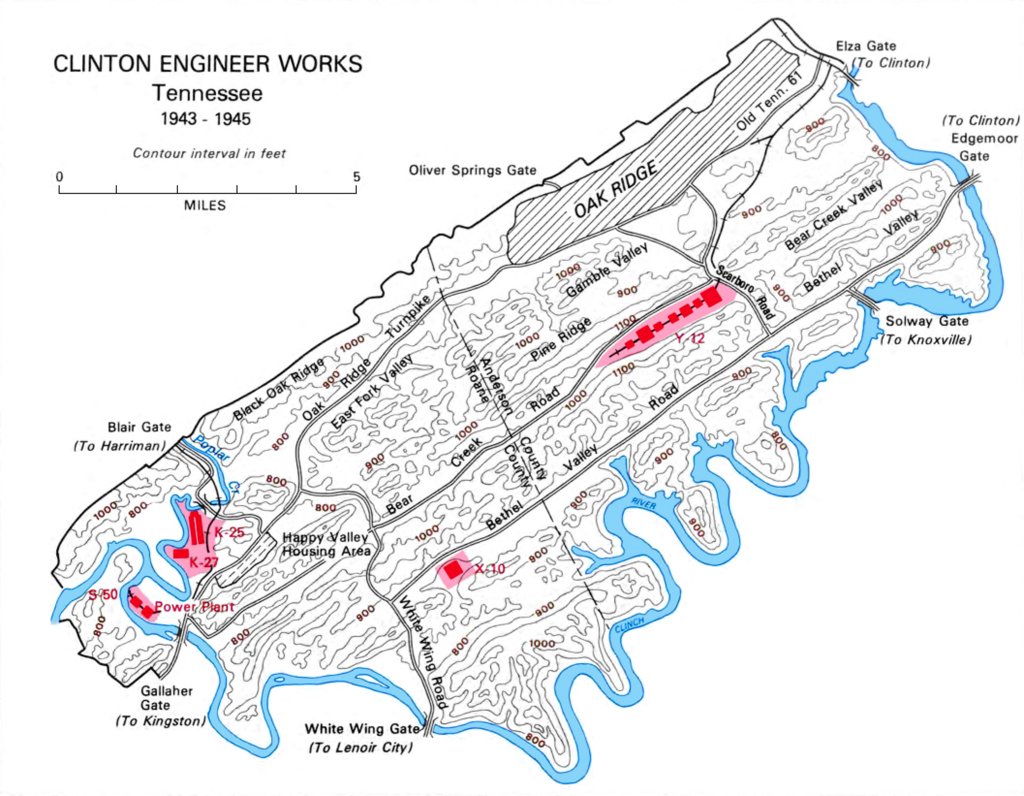
A city, later named Oak Ridge, was built from scratch to house tens of thousands of workers. Three massive, distinct facilities were constructed, each dedicated to a different method of isotope separation: the Y-12 plant for electromagnetic separation, the K-25 plant for gaseous diffusion, and the S-50 plant for liquid thermal diffusion. Each represented a different bet on how to solve the uranium problem.
Brute Force Separation
The electromagnetic separation process, developed at the Y-12 plant, was a form of brute force. The basic principle was a scaled-up mass spectrometer. First, uranium was converted into a gas. Then, its atoms were ionized, giving them an electric charge. These charged ions were fired into a powerful magnetic field.
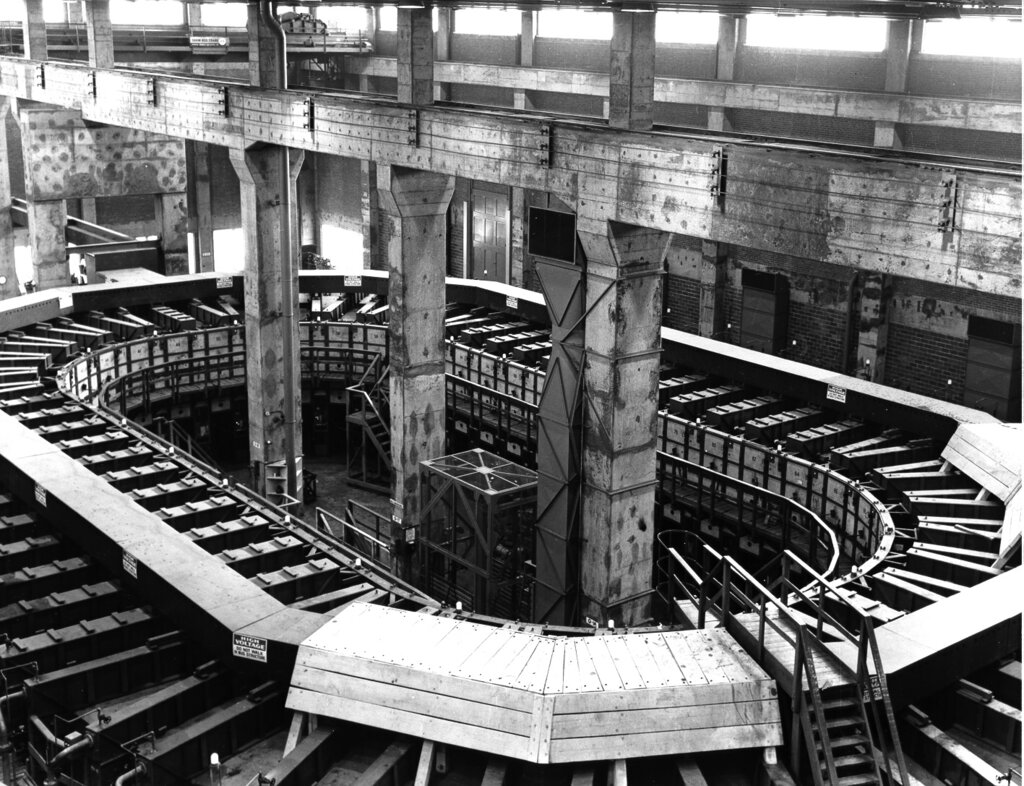
The magnetic field forced the ions into a semicircular path. Because the U-238 ions were heavier, they had more inertia and swung out in a wider arc than the lighter U-235 ions. Carefully placed collectors at the end of the path would catch the two streams of isotopes. The machines built for this task were called —a name blending "California University" and "cyclotron."
This method produced highly enriched uranium but was incredibly inefficient. The ion beams were faint, meaning only grams of material were separated at a time. The Calutrons also required huge amounts of copper for their electromagnets, a metal in short supply during the war. In a creative solution, the project borrowed nearly 15,000 tons of silver from the U.S. Treasury to wind the magnet coils.
A Race Through a Filter
The second major bet was gaseous diffusion at the . This method relied on a simple principle of physics: lighter gas molecules move faster than heavier ones. The process started with converting solid uranium into a highly corrosive gas, uranium hexafluoride (). This gas was then pumped through a cascade of thousands of porous barriers, or filters.
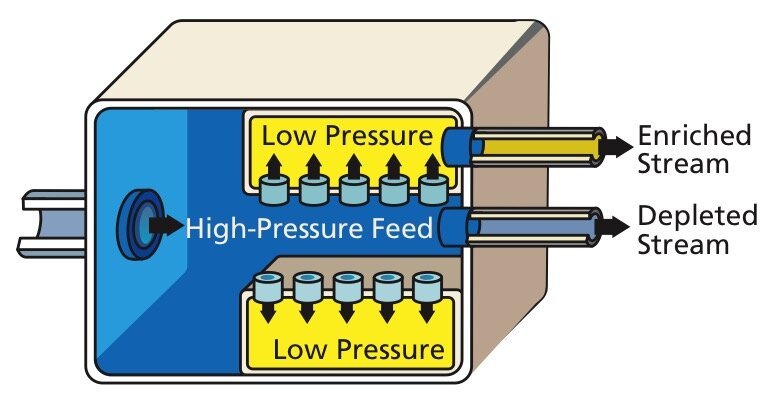
At each barrier, the slightly faster gas molecules containing U-235 had a slightly higher chance of passing through the microscopic holes than those with U-238. The difference was minuscule. A single pass barely enriched the uranium at all. To achieve bomb-grade purity, the gas had to be pumped, compressed, and passed through roughly 4,000 successive stages. This required developing new types of corrosion-resistant pumps, seals, and barriers that could withstand the aggressive gas—a monumental engineering feat in itself.
A third, less prominent method called liquid thermal diffusion was also employed at the S-50 plant. It exploited the tendency for lighter U-235 isotopes to concentrate in warmer regions of a liquid. While less effective than the other two methods, S-50 provided a crucial intermediate enrichment step. The slightly enriched uranium from S-50 was fed into the Calutrons at Y-12, boosting their efficiency and overall production rate.
Ultimately, no single method was sufficient. The final strategy involved a combination: thermal diffusion provided a preliminary boost, gaseous diffusion did the heavy lifting to enrich uranium to about 20%, and the Calutrons performed the final separation to achieve the 90% purity needed for a weapon. This complex, interconnected industrial chain was a testament to the project's willingness to pursue multiple, high-risk solutions simultaneously.