The Magic of Plane Mirrors
Introduction to Light and Reflection
What is Light?
Light is a form of energy that lets us see the world. But at its core, it's a wave, specifically an electromagnetic wave. Think of it like ripples spreading across a pond, but instead of water moving up and down, light is a ripple of electric and magnetic fields traveling through space.
These waves come in a huge range of types, from radio waves to X-rays, creating what's called the electromagnetic spectrum. The light our eyes can see is just a tiny, colorful slice of this spectrum.
How Light Moves
For our purposes, it's helpful to think of light traveling in straight lines called rays. Imagine a laser pointer's beam—that's a good way to visualize a light ray.
When a light ray hits an object, one of three things can happen. It might pass right through, get soaked up, or bounce off.
When light shines on an object, it is reflected, absorbed, or transmitted through the object, depending on the object’s material and the frequency (color) of the light.
Let's focus on what happens when light bounces off a surface. This is called reflection.
The Law of Reflection
Reflection isn't random. It follows a simple, predictable rule. To understand it, we need a few key terms. Imagine a light ray hitting a flat mirror. The incoming ray is the incident ray, and the ray that bounces off is the reflected ray.
To measure the angles, we first draw an imaginary line perpendicular to the mirror's surface at the point where the light hits. This line is called the normal.
The angle between the incident ray and the normal is the angle of incidence. The angle between the reflected ray and the normal is the angle of reflection. The law of reflection states that these two angles are always equal.
A good way to think about this is to imagine throwing a bouncy ball against a flat wall. If you throw it straight at the wall, it comes straight back. If you throw it at an angle, it bounces off at the same angle in the other direction. Light behaves in much the same way.
Mirror-Like vs. Matte
So why can you see your reflection in a mirror but not in a piece of paper? Both reflect light. The difference comes down to the texture of the surface at a microscopic level.
A mirror is extremely smooth. When parallel light rays hit it, they all bounce off in the same direction, preserving the image. This is called specular reflection.
A piece of paper, even though it feels smooth, is actually quite rough on a tiny scale. When parallel light rays hit it, they strike the surface at many different angles and scatter in all directions. This is called diffuse reflection.
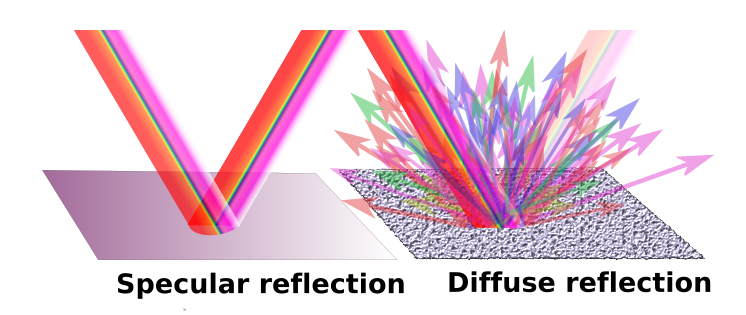
Diffuse reflection is incredibly important. It's how we see most of the world around us. A blue book looks blue because its surface absorbs all colors of light except blue, which it reflects diffusely. Because the blue light scatters everywhere, you can see the book from any angle.