The Lear's Macaw
Introduction to Lear's Macaw
Meet the Indigo Macaw
The Lear's Macaw, also known as the Indigo Macaw, is a large, all-blue parrot from Brazil. Its scientific name is Anodorhynchus leari. The bird gets its common name from Edward Lear, a famous English artist and writer from the 19th century known for his detailed illustrations of birds.
Physical Traits
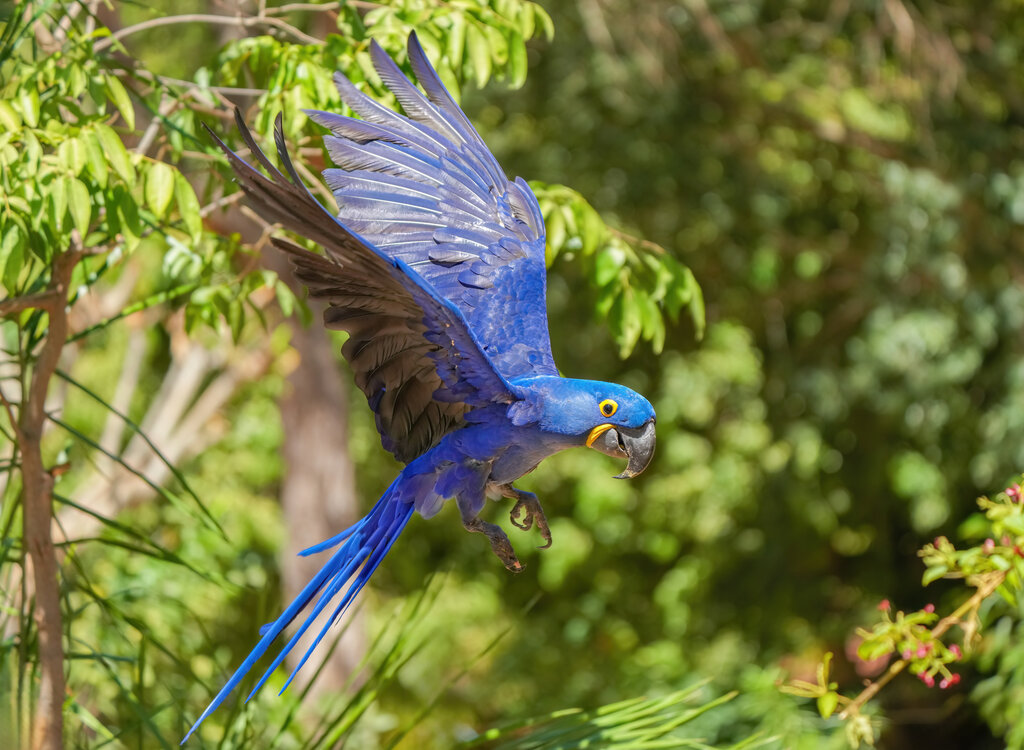
This is a big bird. A typical Lear's Macaw measures about 70 cm (28 inches) from its head to the tip of its tail. It weighs around 950 grams, or just over two pounds. Its body is covered in feathers of a rich, deep blue color, which gives it the 'indigo' nickname.
One of its most striking features is a patch of bare, yellow skin at the base of its large, black bill. This teardrop-shaped patch contrasts sharply with its blue feathers.
| Characteristic | Measurement |
|---|---|
| Length | ~70 cm (28 in) |
| Weight | ~950 g (2.1 lbs) |
| Bill Color | Black |
| Key Marking | Yellow skin patch at base of bill |
Telling Them Apart
The Lear's Macaw is often confused with its close relatives, the Hyacinth Macaw and the now-extinct Glaucous Macaw. While they all share a brilliant blue color, there are subtle differences.
The Hyacinth Macaw is noticeably larger and has a slightly different shade of blue. The yellow patch on the Hyacinth is also a different shape; it forms a ring around the eye and a smaller patch at the base of the lower mandible. The Lear's Macaw's yellow patch is a distinct teardrop shape and doesn't fully encircle the eye.
The Glaucous Macaw was smaller than the Lear's Macaw and had a more greenish-blue or turquoise coloration. Its head and neck were more grayish. These distinct facial markings and specific shades of blue are the key identifiers for each species.
Understanding these small but important details helps ornithologists and bird enthusiasts correctly identify these magnificent creatures.