The Large Hadron Collider Explained
Introduction to Particle Physics
The Building Blocks of Everything
If you could zoom in on any object, past the molecules and atoms, you'd find a world of even smaller particles. For a long time, we thought protons, neutrons, and electrons were the end of the line. But it turns out, even they are made of more fundamental pieces.
Physicists group these fundamental matter particles into two families: quarks and leptons.
Quarks are the social butterflies of the particle world. They are never found alone, always clustering together to form larger particles like protons and neutrons.
There are six types, or "flavors," of quarks, but the most common are the up quark and the down quark. A proton is made of two up quarks and one down quark, while a neutron has one up quark and two down quarks. The other four flavors—charm, strange, top, and bottom—are much heavier and less stable.
lepton
noun
A family of fundamental particles that includes the electron, muon, tau, and their corresponding neutrinos. Unlike quarks, they can exist on their own.
The electron is the star of the lepton family. It's the particle that orbits the nucleus of an atom and is responsible for electricity. Like quarks, leptons also come in six flavors. Besides the electron, there are the heavier muon and tau particles. Each of these has a corresponding lightweight, ghostly particle called a neutrino, which barely interacts with other matter at all.
The Forces That Run the Universe
So we have the matter particles. But what holds them together? What makes them interact? The answer is four fundamental forces. In particle physics, a force isn't just a push or a pull; it's an interaction that happens by exchanging a special kind of particle.
Perhaps the most important as well as surprising thing we can say about them is that fundamental forces are caused by particle exchange.
These force-carrying particles are called bosons. Each fundamental force has its own boson.
| Force | What It Does | Carrier Particle (Boson) |
|---|---|---|
| Strong Nuclear | Binds quarks together in protons and neutrons. | Gluon |
| Electromagnetic | Acts between electrically charged particles. | Photon |
| Weak Nuclear | Governs radioactive decay. | W and Z bosons |
| Gravitational | Attracts objects with mass. | Graviton (hypothetical) |
The strong nuclear force is the most powerful, but it only works over incredibly short distances, like inside an atom's nucleus. It's the "glue" that holds everything together. The electromagnetic force is responsible for light, electricity, and magnetism. The weak nuclear force is what allows the sun to shine, by enabling the nuclear reactions in its core.
And gravity? It's the force we experience most obviously, but at the subatomic level, it's incredibly feeble. Physicists are still searching for its carrier particle, the graviton.
The Standard Model
When you put all these pieces together—the 6 quarks, the 6 leptons, and the force-carrying bosons—you get the Standard Model of particle physics. It's the most complete and experimentally verified theory we have for how the universe works at its most fundamental level.
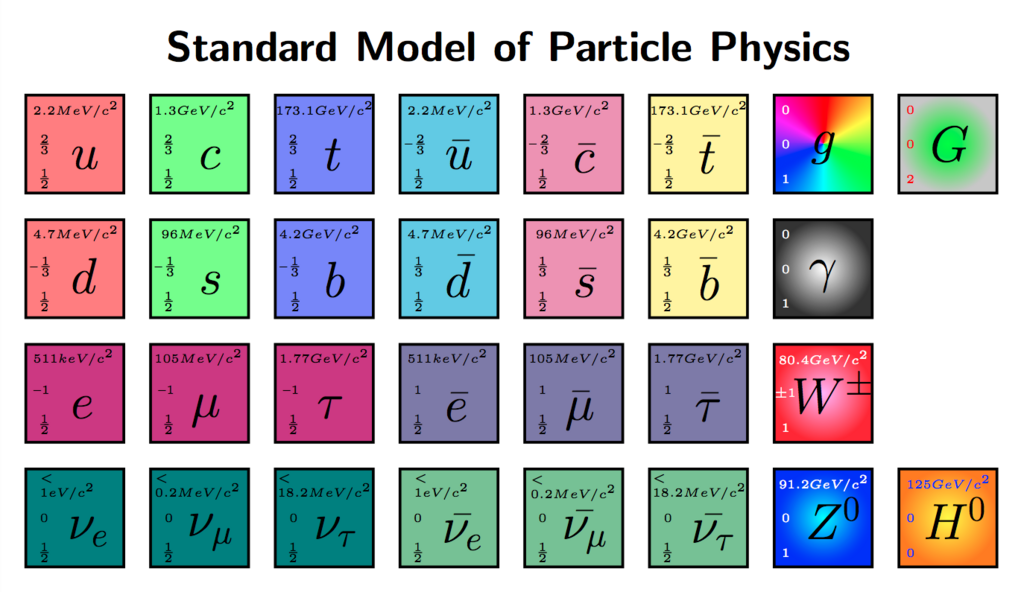
The Standard Model is a triumph of science, successfully predicting the outcomes of particle experiments for decades. There's one more crucial boson in the model: the Higgs boson. Its job is to give other fundamental particles their mass. You can think of the universe as being filled with a Higgs field; particles that interact with this field a lot have more mass, and those that don't interact much have less mass.
A Mirror World of Antimatter
The story has one more twist. For every particle in the Standard Model, there is a corresponding antiparticle. An antiparticle is an identical twin in every way, except it has the opposite electrical charge.
For example, the electron has a negative charge. Its antiparticle, the positron, has a positive charge. The up quark has a charge of , so the anti-up quark has a charge of .
When a particle and its antiparticle meet, they annihilate each other in a flash of energy, converting their mass directly into photons according to Einstein's famous equation, .
This might sound like science fiction, but antimatter is real. It's created in particle accelerators and in some natural processes, like cosmic ray collisions. One of the great mysteries in physics is why the universe seems to be made almost entirely of matter, with very little antimatter to be found.
With these fundamental ideas about particles, forces, and antimatter, we have the basic vocabulary to understand what scientists are searching for when they smash particles together at incredible speeds.
Ready to test your knowledge?
What are the two main families of fundamental matter particles in the Standard Model?
A proton is made of two up quarks and one down quark. What is the composition of a neutron?