The Laplace Transform Explained
Laplace Transform Definition
From Time to Frequency
Some math problems are tough to solve in their original form. Imagine trying to solve a complex puzzle with the wrong set of tools. The Laplace transform is a powerful technique that acts like a translator. It takes a problem from the time domain, where things happen sequentially, and moves it to the complex frequency domain, where the math often becomes much simpler.
Specifically, it's an integral transform used to convert differential equations, which describe how things change over time, into algebraic equations. Differential equations can be tricky, involving rates of change and calculus. Algebraic equations are usually much easier to solve using basic algebra. Once we find the solution in the frequency domain, we can translate it back to the time domain to get our answer.
Let's look at the formal definition. The Laplace transform of a function , where , is denoted by or . It's defined by the following improper integral:
This process essentially re-expresses the function as a sum of infinitely many exponentially decaying sinusoids, with the complex variable controlling their decay rate and frequency.
When Does It Work?
This integral doesn't work for every possible function. For the Laplace transform to exist, the integral must converge to a finite value. This requirement leads to two main conditions for the function :
- Piecewise Continuity: The function must be piecewise continuous for . This means it can have a finite number of jump discontinuities but is otherwise continuous.
- Exponential Order: The function must be of exponential order. This means its growth is limited by an exponential function. Formally, there exist constants and such that for all .
The second condition is crucial. The term in the integral is a decaying exponential (as long as the real part of is large enough). The condition of exponential order ensures that doesn't grow so fast that the decaying term can't 'tame' it, which would cause the integral to diverge to infinity.
Why It Matters
The main reason engineers and physicists use the Laplace transform is its ability to simplify complex problems. Analyzing linear time-invariant (LTI) systems, like electrical circuits or mechanical spring-damper systems, often involves solving differential equations. The Laplace transform turns these calculus problems into algebra.
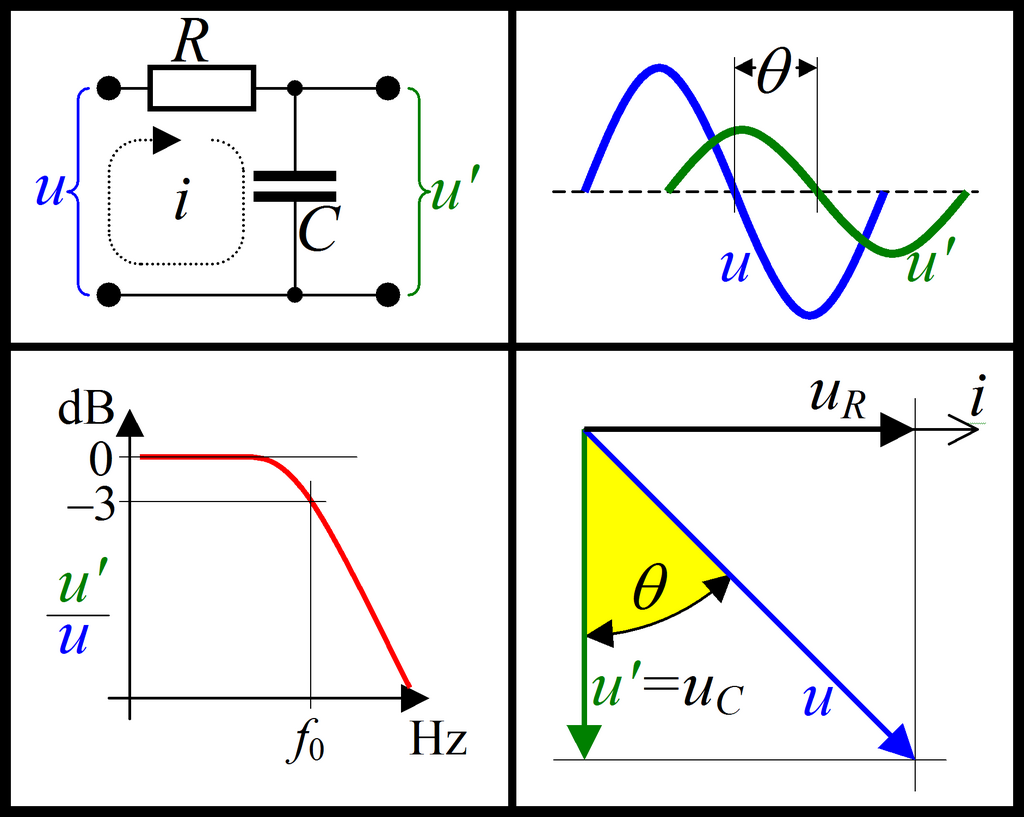
For example, in the time domain, a circuit might be described by an equation like this:
After applying the Laplace transform, this equation becomes an algebraic one:
Suddenly, derivatives are replaced by multiplication with , and the problem is reduced to simple algebraic manipulation. This makes analyzing the behavior of the system, such as its response to different inputs, much more straightforward.
What is the primary advantage of using the Laplace transform to solve differential equations?
Which integral correctly defines the one-sided Laplace transform, , of a function ?
By moving problems into this new domain, we gain a powerful perspective for solving them.