The JD Essentials Crash Course
Introduction to the American Legal System
The Three Branches
The U.S. government is built on a simple but powerful idea: separating power to prevent any one person or group from having too much of it. This separation creates three distinct parts, or branches, each with its own job. This structure is often called a system of "checks and balances," because each branch can limit the power of the other two.
The Legislative Branch is Congress, which is made up of the Senate and the House of Representatives. Its primary job is to write and pass laws, known as statutes.
The Executive Branch, led by the President, is responsible for carrying out and enforcing the laws passed by Congress. This includes a vast network of federal agencies and departments.
The Judicial Branch is the court system, with the Supreme Court at its head. Its role is to interpret the laws and the Constitution, resolving legal disputes and ensuring laws are applied fairly.
Two Governments in One
The United States doesn't have just one government; it has many. The U.S. Constitution established a system called federalism, which divides power between the national (federal) government and the individual state governments.
Think of it like a household. The parents (the federal government) set the main rules for the whole house, like bedtime and safety. But each child (the state government) might have their own rules for their room, like how to organize their toys or decorate their walls. Both sets of rules exist at the same time, but the main house rules apply to everyone.
The federal government has powers specifically granted to it by the Constitution, such as the power to declare war and regulate commerce between states. Any powers not given to the federal government are reserved for the states. This dual system allows states to create laws that fit their own unique populations and needs, while still being part of a unified country.
The Legal Pecking Order
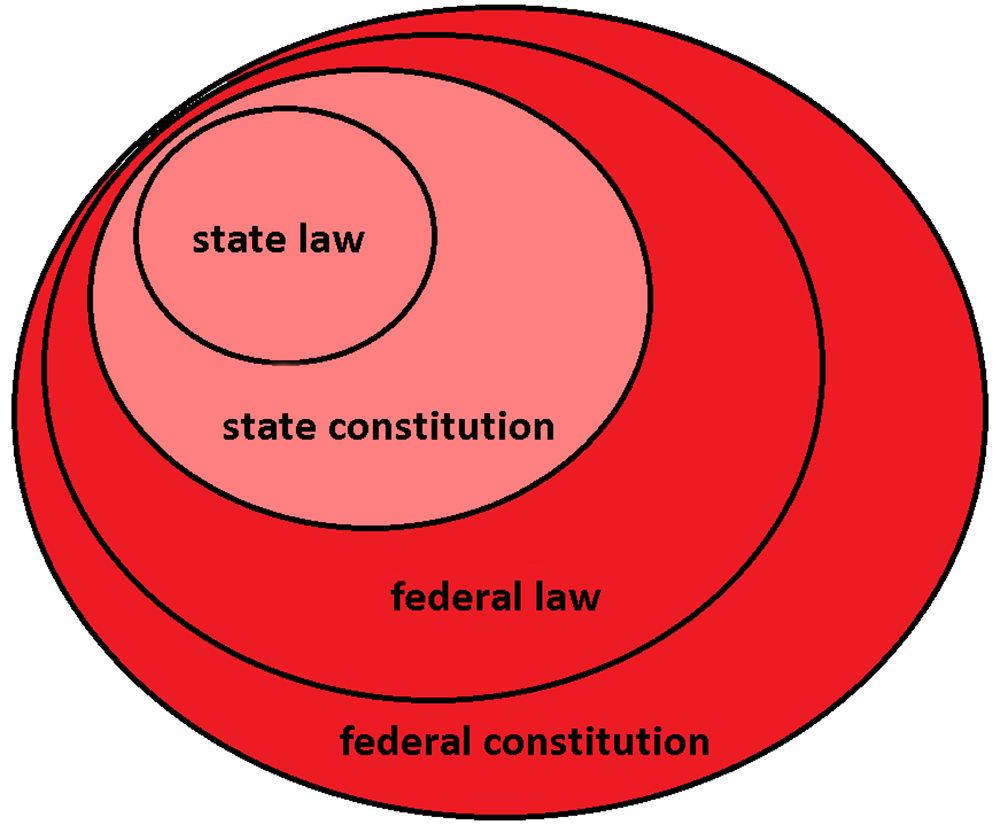
Not all laws are created equal. Because of federalism, there is a clear hierarchy of laws. If a state law conflicts with a federal law, the federal law wins. This is known as the Supremacy Clause of the Constitution.
Here's the basic order, from most powerful to least:
- U.S. Constitution: The supreme law of the country. No law at any level can violate it.
- Federal Laws (Statutes): Laws passed by Congress.
- State Constitutions: The highest law within a specific state, but subordinate to federal law.
- State Laws (Statutes): Laws passed by state legislatures.
- Regulations: Rules created by executive agencies (both federal and state) to implement statutes.
- Case Law: Decisions made by courts, which interpret all the laws above.
Learning from the Past
The U.S. legal system is largely based on the English common law tradition. This means that a significant portion of the law is developed by judges through the decisions they make in court cases, rather than being written down by legislatures.
common law
noun
A body of unwritten laws based on legal precedents established by the courts.
A core principle of the common law system is the doctrine of precedent, also known by the Latin term stare decisis.
precedent
noun
A previous court decision that is recognized as a guide for deciding subsequent cases with similar issues or facts.
In simple terms, stare decisis means "to stand by things decided." When a court decides a case, its ruling becomes a precedent that courts below it in the hierarchy must follow in similar future cases. This ensures that the law is stable, consistent, and predictable. While higher courts can overturn their own precedents, they do so cautiously to maintain that stability.
Imagine a judge has to decide if a dog owner is responsible for their pet digging up a neighbor's garden. If a higher court in the same state previously ruled that owners are responsible, the judge will follow that precedent and rule the same way.
Now, let's test your understanding of these foundational concepts.
Which branch of the U.S. government is primarily responsible for writing and passing laws?
The principle that divides power between the national and state governments is known as __________.
Understanding this structure—the branches of government, the balance of federal and state power, and the role of precedent—is the first step to understanding how American law works.