The Janus Cosmological Model
Introduction to Cosmology
The Study of Everything
Cosmology is the scientific study of the universe as a whole. It asks the biggest questions: Where did everything come from? What is it made of? And where is it all going? Cosmologists use physics and astronomy to piece together the story of our universe, from its first moments to its ultimate fate.
Think of it like being a detective at the grandest possible crime scene. The evidence is scattered across billions of light-years and billions of years in the past. By studying the light from distant galaxies, the faint afterglow of creation, and the distribution of matter, we can reconstruct the history of the cosmos.
The Beginning
The leading scientific theory for how the universe began is the Big Bang. This theory states that about 13.8 billion years ago, the entire observable universe was contained in an incredibly hot, dense point smaller than a single atom. From this singular state, it began to expand and cool, and it has been doing so ever since.
It's a common mistake to picture the Big Bang as an explosion in space, like a bomb going off. It's more accurate to think of it as the expansion of space itself. Every point in the universe began expanding away from every other point simultaneously. The space between galaxies is what's stretching.
The Big Bang wasn't an explosion in space. It was the beginning of space and time.
An Echo of Creation
One of the strongest pieces of evidence for the Big Bang is something called the Cosmic Microwave Background, or CMB. Think of it as the leftover heat from the universe's creation, a faint thermal glow that fills all of space. When the universe was young and hot, it was opaque, filled with a searing fog of plasma. After about 380,000 years, it cooled enough for atoms to form, and the universe became transparent. The light from that moment has been traveling across the cosmos ever since, and we can still detect it today.
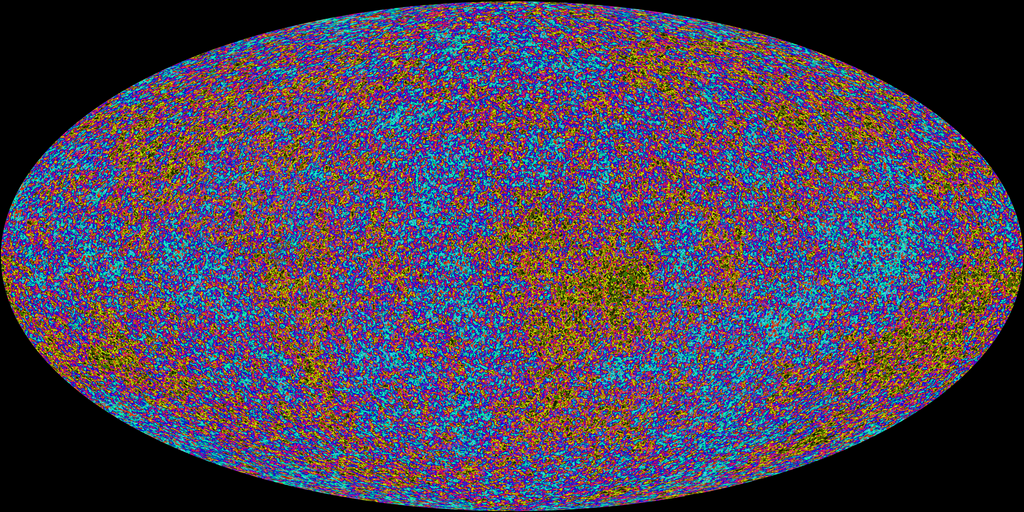
This isn't just a uniform glow. The CMB has tiny temperature variations, seen as different colors in the map above. These minuscule fluctuations in density in the early universe were the seeds. Gravity pulled matter toward the slightly denser regions, and over billions of years, these seeds grew into the galaxies, stars, and planets we see today.
An Expanding Universe
The observation that the universe is expanding was a revolutionary discovery. It means that the space between galaxies is continuously stretching. A good way to visualize this is to imagine baking raisin bread. As the dough rises and expands, the raisins move farther apart from one another. The raisins aren't moving through the dough; the dough itself is carrying them along.
In the same way, galaxies aren't flying away from each other through empty space. Instead, the fabric of space itself is expanding, carrying the galaxies with it. This is why, no matter which galaxy you are in, all other distant galaxies appear to be moving away from you. There is no center to this expansion; it's happening everywhere at once.
All of these concepts—the Big Bang, the CMB, and the expansion of space—form the foundation of our modern understanding of the universe. They are the core components of what is known as the standard cosmological model, a framework scientists use to describe the universe from its earliest moments to the present day. This model provides the context for exploring even deeper mysteries about the cosmos.
Which statement most accurately describes the Big Bang?
What is the Cosmic Microwave Background (CMB)?