The Intuitive Unit Circle
Introduction to the Unit Circle
The Unit Circle
Let's start with a simple but powerful idea: a circle centered at the origin of a coordinate plane with a radius of exactly one. This is the unit circle. Its equation is straightforward, based on the Pythagorean theorem.
Any point that satisfies this equation lies on the circle. The beauty of the unit circle is its simplicity. Fixing the radius at one makes it a perfect reference tool for studying angles and their relationships in trigonometry.
Angles and Coordinates
Angles on the unit circle are measured from a standard starting position: the positive x-axis, at the point (1, 0). From there, we typically move counter-clockwise to measure positive angles.
Every point on the circle's edge can be defined by the angle that leads to it. If we pick any point on the circle and draw a line from the origin to it, we've created a radius. This radius is the hypotenuse of a right-angled triangle, with its other two sides running parallel to the x and y axes.
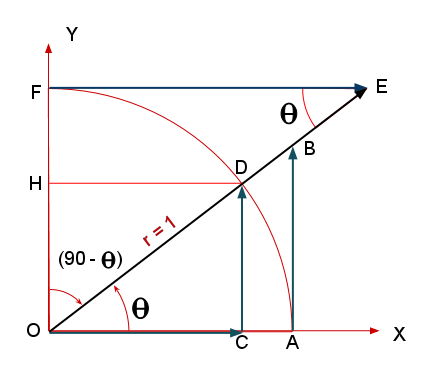
The lengths of the sides of this triangle are directly related to the point's coordinates. The horizontal side has a length equal to the absolute value of the x-coordinate, , and the vertical side has a length equal to the absolute value of the y-coordinate, .
Because the hypotenuse is always 1, the coordinates for any point are always constrained. Neither nor can ever be greater than 1 or less than -1. This direct link between a point's coordinates and the sides of a right triangle is what makes the unit circle so fundamental to trigonometry.
For any point on the unit circle, we know that and .
As we move around the circle, the coordinates of the points change, but their relationship to the origin and the radius of 1 remains constant. This setup allows us to extend the ideas of trigonometry beyond triangles and apply them to any angle, no matter how large.
What is the equation for a unit circle centered at the origin?
True or False: For any point (x, y) on the unit circle, the value of x can be 1.5.
This simple circle is the stage on which all of trigonometry plays out. Next, we'll see how it defines the core trigonometric functions.