The Intriguing World of Complex Numbers
Introduction to Complex Numbers
Beyond the Number Line
For a long time, the number line was the whole universe of numbers. It contains whole numbers, fractions, and even irrational numbers like . But this universe has limits. For example, try to solve this simple-looking equation:
If you try to solve for , you get . What number, when squared, gives you -1? No real number does. Squaring any real number, positive or negative, always results in a positive number. For centuries, this was a dead end. Mathematicians called solutions like this "imaginary."
The breakthrough came from deciding that even if these numbers weren't on the number line, they could still be useful. This led to the creation of a new, foundational number.
imaginary unit
noun
The number denoted by the symbol 'i', defined as the principal square root of -1.
With the imaginary unit, we can build a whole new set of numbers. These are called complex numbers, and they combine a real number with an imaginary number.
complex number
noun
A number of the form a + bi, where 'a' and 'b' are real numbers and 'i' is the imaginary unit.
Every complex number has two parts:
- The real part ()
- The imaginary part ()
For the complex number , the real part is 5 and the imaginary part is 3. For , the real part is 2 and the imaginary part is -7.
What about a regular number, like 4? It can be written as . Its real part is 4, and its imaginary part is 0. This means all real numbers are technically complex numbers. They just have an imaginary part of zero.
A New Dimension for Numbers
Since complex numbers have two components, the real part and the imaginary part, a single number line isn't enough to visualize them. We need a two-dimensional space. This space is called the complex plane, sometimes known as the Argand diagram.
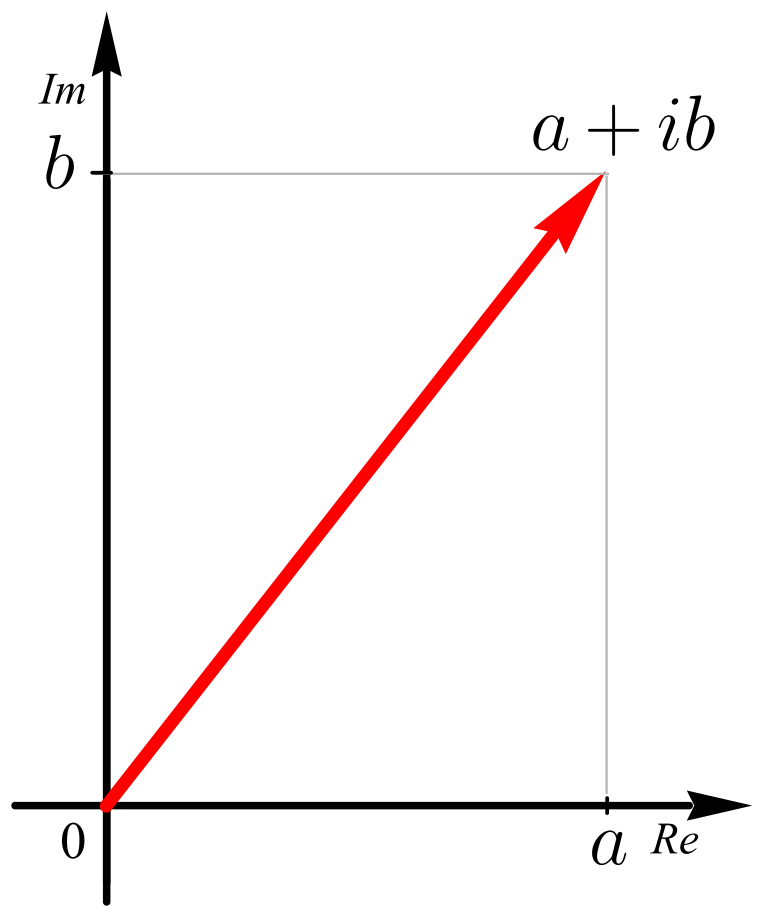
The complex plane looks like a standard coordinate grid, but with different labels.
- The horizontal axis is the Real axis. This is where the real part of the number goes.
- The vertical axis is the Imaginary axis. This is for the imaginary part.
A complex number is represented by the point on this plane. The number corresponds to the point (5, 3). The number corresponds to the point (-2, -4).
This geometric view was a huge step. It showed that complex numbers weren't just an algebraic trick. They had a concrete, visual meaning. By placing numbers on a plane instead of a line, mathematicians opened up a whole new world of possibilities, connecting algebra and geometry in a deeper way.
Ready to check your understanding?
Why was the concept of imaginary numbers originally introduced in mathematics?
In the complex number , what are the real and imaginary parts?
Now you understand what complex numbers are and how they are represented. Next, we'll explore how to perform basic arithmetic with them.