The Internet's Logic Explained
Internet Architecture
A Blueprint for the Internet
The internet feels like a single, seamless entity, but it's actually a massive collection of independent networks all agreeing to speak the same language. This cooperation is possible because of a shared blueprint, or architecture. This architecture isn't about physical wires and servers, but rather a set of rules and layers that organize the complex task of sending information from one computer to another.
Think of it like building a house. You don't just start throwing up walls. You have a plan that separates the job into logical parts: the foundation, the framing, the plumbing, and the electrical work. Each part has its own job, and they all fit together in a specific order. Network models do the same for digital communication, breaking the process down into manageable layers.
The OSI Model: A Seven-Layer Cake
The Open Systems Interconnection (OSI) model is a conceptual framework that standardizes the functions of a telecommunication or computing system in seven distinct layers. It’s like a detailed, idealized blueprint. While the internet doesn't strictly follow the OSI model, it's an essential tool for understanding how networks work because it clearly separates different tasks.
Each layer has a specific responsibility and only interacts with the layers directly above and below it. When you send data, it travels down the stack, and when you receive data, it travels up.
| Layer | Name | Primary Function |
|---|---|---|
| 7 | Application | Provides the interface for the user's application (e.g., web browser). |
| 6 | Presentation | Translates, encrypts, and compresses data. |
| 5 | Session | Manages communication sessions between devices. |
| 4 | Transport | Ensures reliable end-to-end data delivery. |
| 3 | Network | Handles addressing and routing of data packets. |
| 2 | Data Link | Manages data transfer between two directly connected nodes. |
| 1 | Physical | Transmits raw bits over the physical medium (cables, Wi-Fi). |
A popular mnemonic to remember the OSI layers from top to bottom is: "All People Seem To Need Data Processing." From bottom to top, it's "Please Do Not Throw Sausage Pizza Away."
The TCP/IP Suite: The Real Deal
If the OSI model is the detailed architectural drawing, the TCP/IP suite is the model that was actually built. It's the practical framework that the internet is based on. TCP/IP is simpler, combining several of the OSI model's layers into four broader categories.
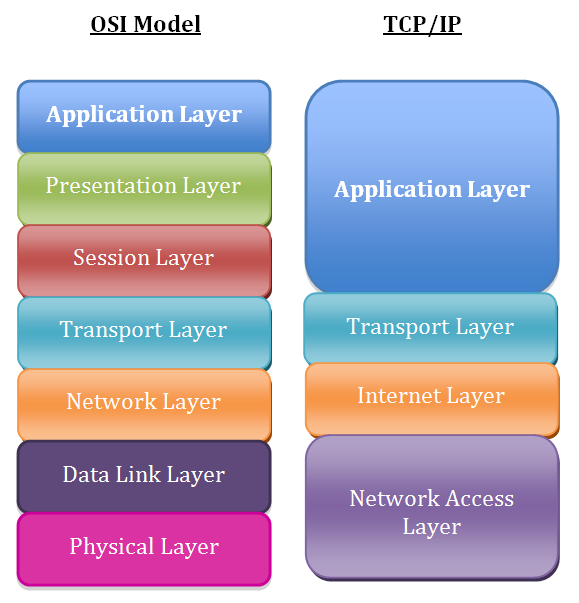
Here’s how they map out:
- Application Layer: This combines the OSI model's Application, Presentation, and Session layers. It’s where protocols you might have heard of, like HTTP (for web browsing) and SMTP (for email), operate.
- Transport Layer: This layer corresponds directly to the OSI Transport layer. It handles the reliability and flow of communication between two hosts. TCP (Transmission Control Protocol) itself is the main player here.
- Internet Layer: This maps to the OSI Network layer. Its job is to move packets from their source to their destination. This is where IP (Internet Protocol) lives, handling the addressing and routing.
- Network Access Layer: This combines the OSI Data Link and Physical layers. It deals with the physical hardware and protocols needed to send data across a specific type of network, like Ethernet or Wi-Fi.
The End-to-End Principle
The layered models are guided by a core design philosophy: the end-to-end principle. This principle suggests that the network itself should be as simple and "dumb" as possible. Its only job is to deliver data packets from point A to point B.
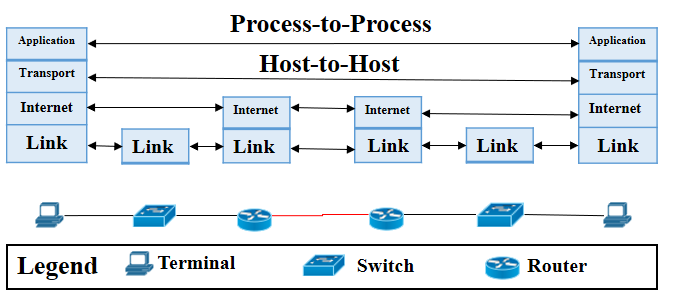
All the complex functions—like checking for errors, making sure data arrives in the correct order, or re-sending lost packets—should be handled by the devices at the ends of the communication path (the “end systems,” like your computer and a web server). The network in the middle doesn't need to know or care about the content of the packets it's forwarding. This keeps the core network fast, flexible, and scalable. It allows new applications to be created without having to change the underlying network infrastructure.
What is the primary purpose of layered network models like OSI and TCP/IP?
The TCP/IP model's Application Layer combines the functions of which three layers from the more detailed OSI model?