The Internet Brain
Introduction to Neuroplasticity
Your Brain Is a Work in Progress
For a long time, scientists believed the adult brain was fixed and unchangeable. Once you reached adulthood, the thinking went, your brain's structure was set for life. But we now know this isn't true. The brain is remarkably adaptable, constantly changing in response to our experiences. This ability to reorganize itself is called neuroplasticity.
neuroplasticity
noun
The brain's ability to reorganize itself by forming new neural connections or pathways throughout life.
Think of your brain like a network of trails in a forest. When you first learn something, you're forging a new, faint path. The more you repeat that activity or thought, the more you travel that path. Over time, it widens from a small trail into a well-worn road, making it easier and faster to travel. Meanwhile, paths you no longer use become overgrown and can eventually disappear. Your brain is constantly landscaping itself based on what you do, think, and experience.
The Mechanics of Change
This remodeling happens at a microscopic level. Your brain is made of billions of neurons that communicate with each other at junctions called synapses. Every time you have a thought, learn a fact, or practice a skill, signals travel across these synapses. Neuroplasticity occurs through two main processes: synaptic plasticity and cortical remapping.
Synaptic plasticity is the process of strengthening or weakening these connections. The more a neural pathway is used, the stronger and more efficient the synaptic connections become. This is the origin of the famous saying, "Neurons that fire together, wire together."
When you practice playing the piano, for example, the neurons responsible for finger movements and reading music fire together repeatedly. This strengthens their connections, making the actions smoother and more automatic over time. Conversely, if you stop practicing, these connections can weaken.
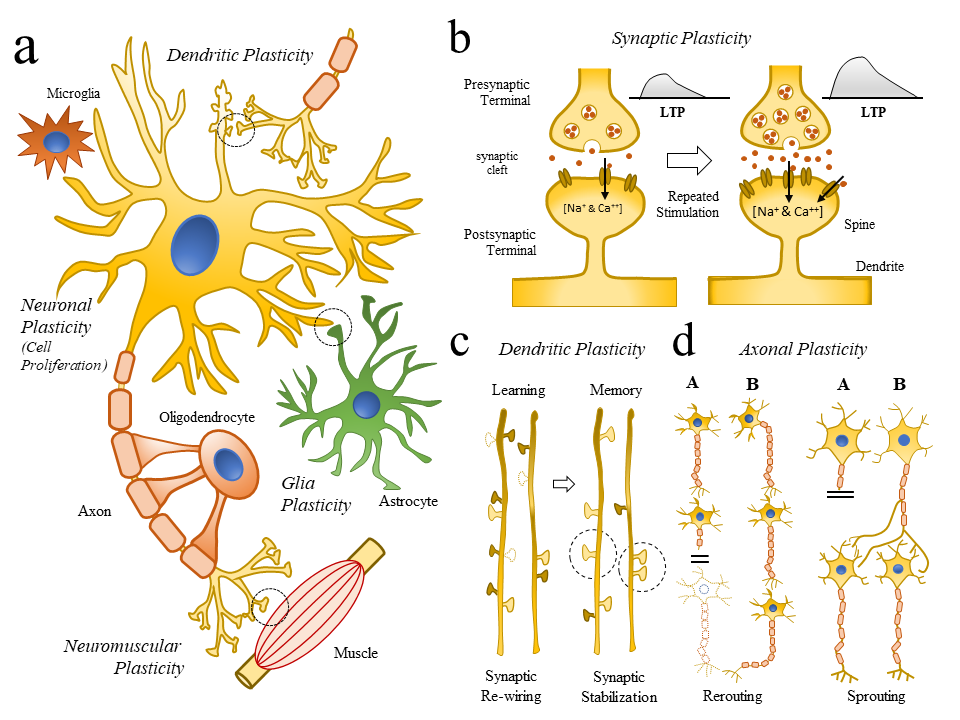
Cortical remapping is a more dramatic form of change. It involves entire areas of the cerebral cortex, the brain's outer layer, taking on new functions. For instance, in individuals who are blind from an early age, the part of the brain that normally processes vision—the visual cortex—doesn't sit idle. Instead, it often gets rewired to process information from other senses, like hearing or touch, making them more acute.
What Shapes Your Brain?
Many factors influence your brain's ability to change. New experiences are a primary driver. Exposing yourself to novel activities and environments stimulates the brain and encourages the formation of new neural pathways. This could be anything from traveling to a new country to learning to cook a new dish.
Focused attention and practice are also critical. Simply being exposed to something isn't enough; you have to actively engage with it. The repetition involved in learning a new skill, whether it's juggling or coding, strengthens specific circuits in the brain.
The brain follows a "use it or lose it" principle – unused neural pathways weaken through synaptic pruning, while frequently activated pathways strengthen and expand.
While plasticity is most powerful in childhood, the brain remains adaptable throughout our entire lives. Lifestyle factors like exercise, sleep, and managing stress can also support the processes that enable brain change. Understanding that your brain is constantly being shaped by your actions and thoughts is a powerful idea. It means you have a role in wiring your own mind.
What is the best definition of neuroplasticity?
According to the 'forest trails' analogy for brain function, what happens when you repeatedly practice a new skill?