The Interconnected World: A Systems Overview
Universal Physical Principles
The Universe's Rulebook
Everything in the universe, from a star collapsing into a black hole to you reading this sentence, is governed by a handful of fundamental rules. These aren't suggestions; they are the laws of physics. At the heart of these laws are four fundamental forces that dictate how every particle of matter and every wave of energy interacts.
These forces operate on vastly different scales. Two of them, gravity and electromagnetism, have an infinite range, shaping the cosmos and our daily lives. The other two, the strong and weak nuclear forces, operate only within the tiny confines of an atom's nucleus. Despite their short reach, they are essential for the existence of matter as we know it.
| Force | Relative Strength | Range | Acts On |
|---|---|---|---|
| Strong Nuclear | 1 | ~ m | Quarks, Protons, Neutrons |
| Electromagnetic | Infinite | Electrically Charged Particles | |
| Weak Nuclear | ~ m | Quarks, Leptons | |
| Gravitational | Infinite | Mass and Energy |
Gravity is the weakest of the four, yet it holds planets in orbit and galaxies together. Electromagnetism governs the interactions between charged particles, making it responsible for everything from chemistry to electricity. The strong nuclear force is the universe's superglue, binding protons and neutrons together inside atomic nuclei. Without it, atoms heavier than hydrogen couldn't exist. Finally, the weak nuclear force is responsible for radioactive decay, a process that powers stars and allows for carbon dating.
Energy is a Constant
One of the most profound principles in physics is the conservation of energy. It states that energy cannot be created or destroyed, only transformed from one form to another. When you switch on a light bulb, electrical energy is converted into light and heat energy. The total amount of energy remains the same throughout the process.
A car engine converts the chemical energy in fuel into kinetic energy (motion), heat, and sound. The total energy output equals the initial chemical energy, just in different, less organised forms.
This leads us to thermodynamics, the study of heat, work, and energy. Natural systems tend to evolve toward states of higher disorder or randomness. This tendency is quantified by a concept called entropy A hot cup of coffee in a cool room will always cool down, never spontaneously heat up, as its thermal energy disperses into the room, increasing the overall entropy of the system.
Mass, Energy, and the Universe
Perhaps the most famous equation in physics connects the concepts of mass and energy. Albert Einstein's theory of revealed that mass is a highly concentrated form of energy. They are two sides of the same coin.
This relationship explains the immense power of nuclear energy. In a nuclear reaction, a tiny amount of mass is converted into a huge amount of energy. It's also the process that powers the sun, where hydrogen atoms fuse into helium, releasing energy that sustains life on Earth.
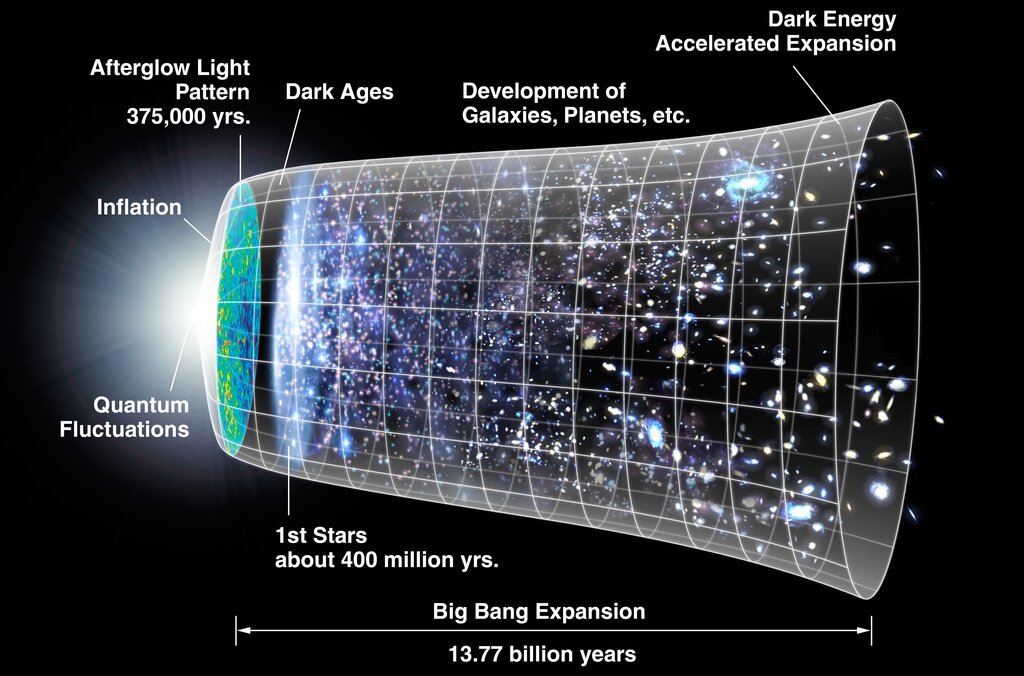
These principles aren't just abstract ideas; they explain the world around us. The mechanics of flight rely on balancing the force of gravity with lift generated by airflow. Planetary orbits are a delicate dance between the forward momentum of a planet and the constant pull of the sun's gravity. Understanding these core rules provides a powerful framework for seeing the interconnectedness of everything.
Which fundamental force is responsible for binding protons and neutrons together inside atomic nuclei?
Which two fundamental forces have an infinite range, shaping both the cosmos and our daily lives?