The Humble Proton
Atomic Structure
The Building Blocks of Matter
Everything you see around you, from the chair you're sitting on to the air you're breathing, is made of atoms. For a long time, people thought atoms were the smallest possible things, tiny, indivisible spheres. But we now know they're made of even smaller pieces called subatomic particles. The three main players are protons, neutrons, and electrons.
At the center of every atom is a dense core called the nucleus. It’s like the pit of a peach. This nucleus contains two types of particles: protons and neutrons.
Proton
noun
A subatomic particle with a positive electric charge, found in the nucleus of an atom.
Protons have a positive electrical charge, which we can think of as a charge of +1. Packed in right beside them are neutrons, which, as their name suggests, are neutral. They have no charge at all.
Neutron
noun
A subatomic particle with no net electric charge, found in the nucleus of an atom.
Zipping around the nucleus at incredible speeds are the electrons. They are much, much smaller and lighter than protons or neutrons. Electrons have a negative electrical charge of -1, which perfectly balances the positive charge of a proton. They don't follow neat, circular orbits like planets around the sun. Instead, they exist in a region of space around the nucleus called an electron cloud.
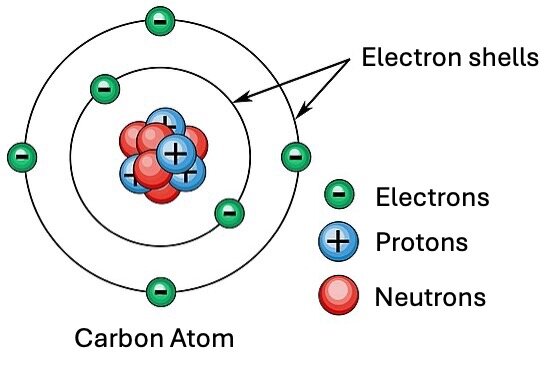
Protons and neutrons are heavyweights, making up almost all of an atom's mass. An electron's mass is so tiny by comparison that it's often ignored when calculating the total mass of an atom.
| Particle | Charge | Relative Mass | Location |
|---|---|---|---|
| Proton | +1 | ~1 | In the nucleus |
| Neutron | 0 | ~1 | In the nucleus |
| Electron | -1 | ~1/1836 | Outside nucleus |
An Element's Identity
What makes an atom of gold different from an atom of oxygen? It all comes down to the number of protons. The number of protons in an atom's nucleus is called its atomic number, and it's the single most important thing about an atom. It defines the element.
Every atom with 6 protons is a carbon atom. Every atom with 8 protons is an oxygen atom. No exceptions.
In a neutral atom, the number of electrons is equal to the number of protons. Their charges cancel out, giving the atom an overall charge of zero. It’s the behavior of these electrons, particularly the ones in the outermost shell, that dictates how an atom interacts with other atoms. They are the key to all chemical reactions.
Isotopes and Ions
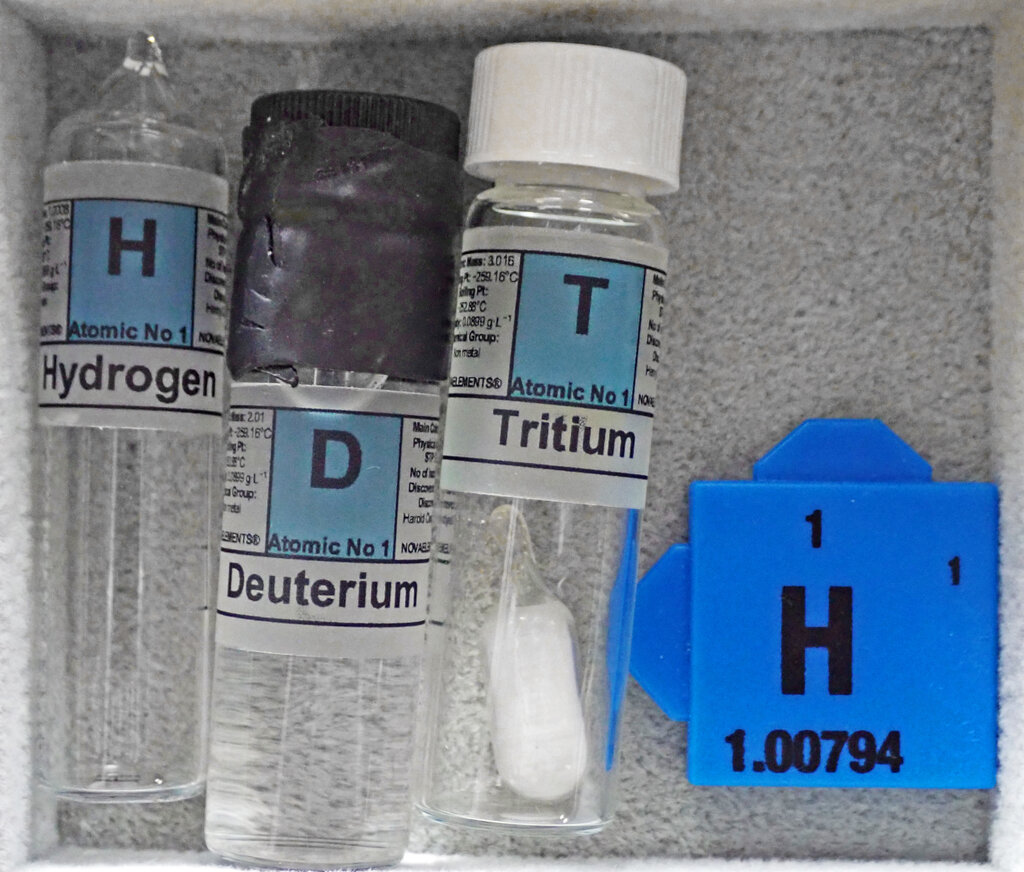
While the number of protons for a given element is fixed, the number of neutrons can vary. Atoms of the same element that have different numbers of neutrons are called isotopes. For example, every carbon atom has 6 protons. But some carbon atoms have 6 neutrons (called carbon-12), while others might have 7 (carbon-13) or 8 (carbon-14). They are all still carbon, but they have slightly different masses.
Just as the number of neutrons can vary, so can the number of electrons. When an atom gains or loses electrons, it becomes an ion. If it loses an electron, it has more protons than electrons, resulting in a positive charge. If it gains an electron, it has a negative charge. This ability to gain or lose electrons is what allows atoms to form bonds and create the molecules that make up our world.
Let's check your understanding of these atomic building blocks.
What two subatomic particles are found in the nucleus of an atom?
If a scientist discovers an atom with 79 protons in its nucleus, what has been fundamentally determined?
Understanding these three particles, protons, neutrons, and electrons, is the first step to understanding chemistry and the physical world.