The Human Upper Limb
Upper Limb Bones
The Shoulder Girdle
Your upper limb isn't just floating in space; it's anchored to your torso by a clever arrangement of bones called the shoulder girdle. This structure, made up of the clavicle and the scapula, provides a stable base for the arm while allowing an incredible range of motion.
First up is the clavicle, more commonly known as the collarbone. It's the slender, S-shaped bone you can feel at the top of your chest. The clavicle acts like a strut, bracing your shoulder and keeping it positioned away from the central part of your skeleton. This positioning is crucial for the arm's mobility.
It connects to the sternum (breastbone) at one end and to a part of the scapula called the acromion at the other, forming the acromioclavicular joint. This is the only direct bony connection between the shoulder girdle and the main trunk of the skeleton.
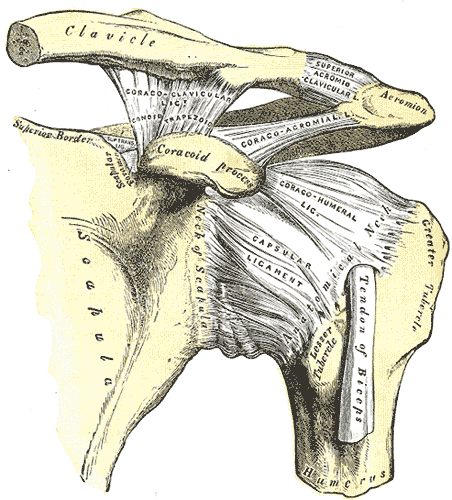
The other half of the girdle is the scapula, or shoulder blade. This is a large, triangular, flat bone that sits on the back of your ribcage. Unlike the clavicle, the scapula isn't fixed in one spot. It glides and rotates across your back, contributing significantly to movements like shrugging your shoulders or reaching overhead.
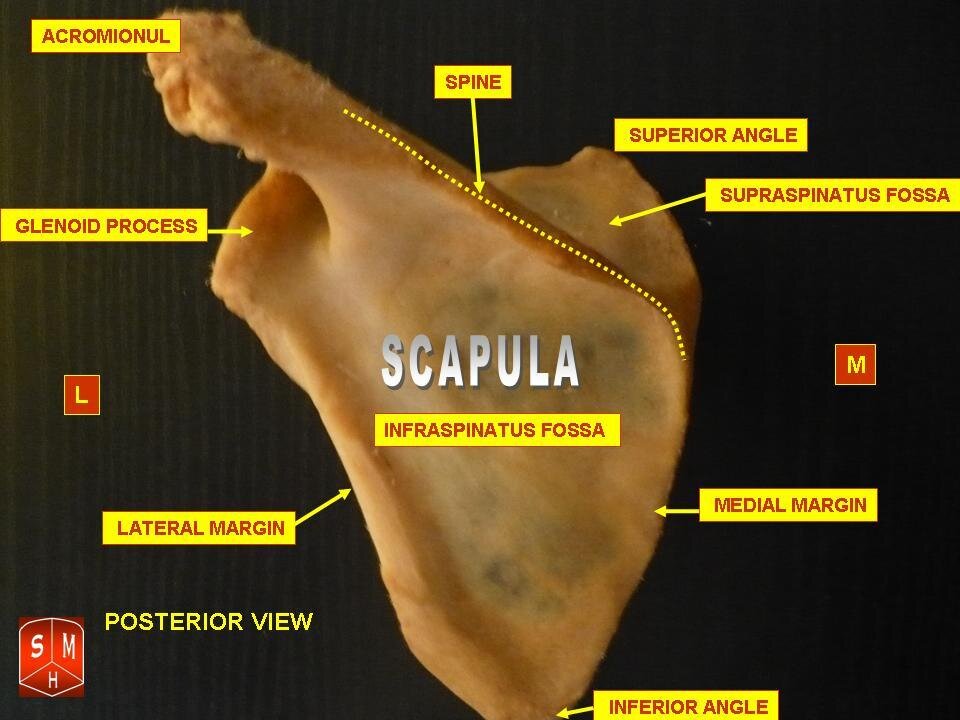
Several important landmarks are found on the scapula. The spine is a prominent ridge on its back surface, which ends in a projection called the acromion—the part that meets the clavicle. On the front side, another hook-like projection called the coracoid process serves as an attachment point for muscles. Most importantly, the scapula has a shallow socket called the glenoid cavity. This is where the head of the arm bone sits, forming the main shoulder joint.
The Arm and Forearm
Moving down from the shoulder, we find the bones of the arm and forearm. These long bones provide the structural framework that allows us to lift, push, and pull.
humerus
noun
The single long bone of the upper arm, extending from the shoulder to the elbow.
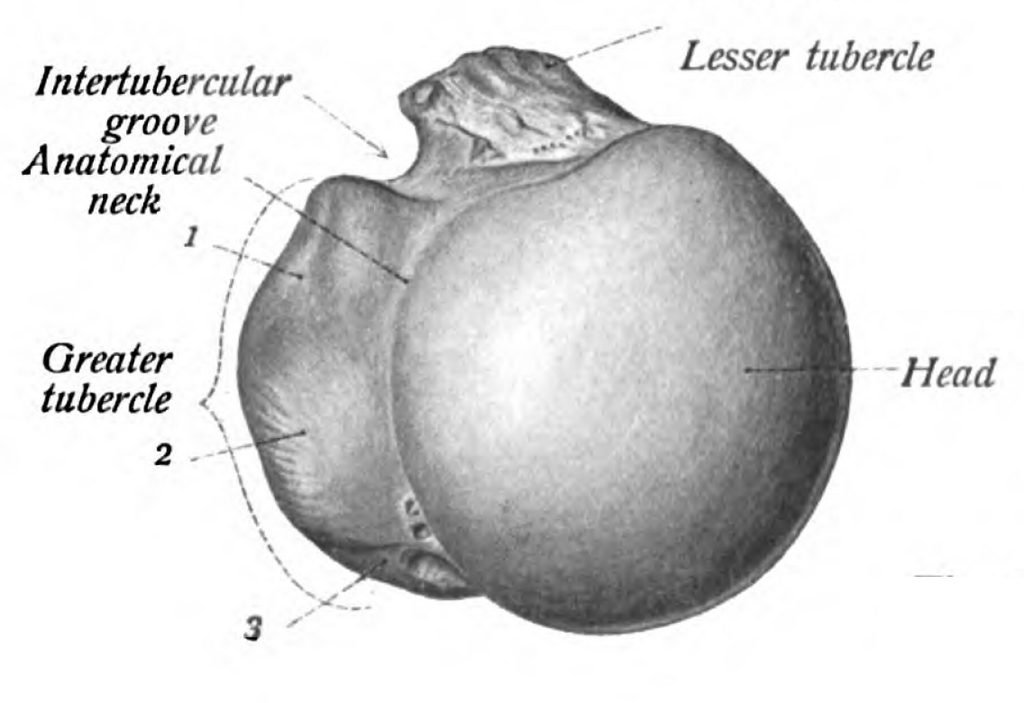
The humerus is the bone of the upper arm. At its top, or proximal end, is a large, smooth, rounded head that articulates with the glenoid cavity of the scapula. This ball-and-socket joint, the glenohumeral joint, gives the shoulder its amazing flexibility. Near the head are two bumps, the greater and lesser tubercles, which are important sites for muscle attachment.
The long shaft of the humerus extends down to the elbow. The bottom, or distal end, of the humerus is more complex. It has specific structures that connect with the two bones of the forearm to form the elbow joint, which functions like a hinge.
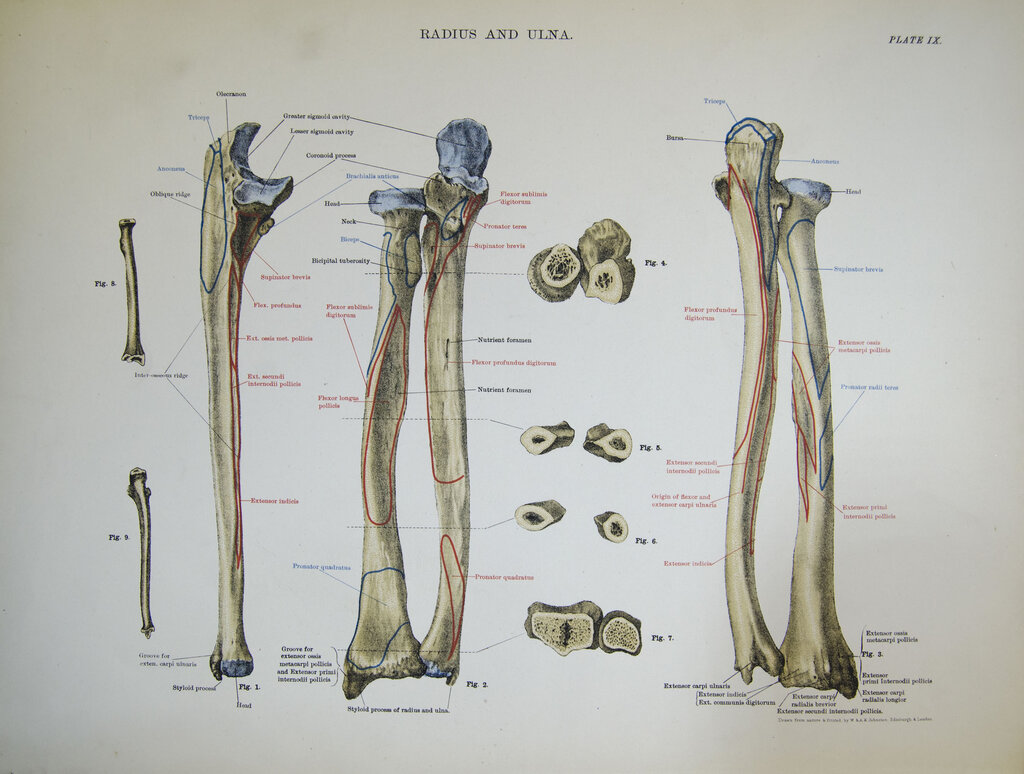
The forearm contains two bones: the radius and the ulna. They lie parallel to each other, running from the elbow to the wrist.
When your palm faces forward, the ulna is on the side of your little finger (medial), and the radius is on the thumb side (lateral). The ulna is larger at the elbow, where its C-shaped trochlear notch grips the humerus to create the hinge. The prominent point of your elbow is a part of the ulna called the olecranon process.
The radius is wider at the wrist, where it forms the main connection with the wrist bones. A unique feature of these two bones is their ability to pivot around each other. This is what allows you to rotate your forearm and turn your palm up or down, a movement called supination and pronation.
The Wrist and Hand
The hand is a marvel of engineering, and its dexterity starts with the complex arrangement of bones in the wrist and palm.
The wrist, or carpus, contains eight small, irregularly shaped carpal bones arranged in two rows of four. These bones are tightly bound by ligaments, allowing for some gliding movements but providing a stable and flexible base for the hand. The proximal row articulates with the radius and ulna, while the distal row connects to the bones of the palm.
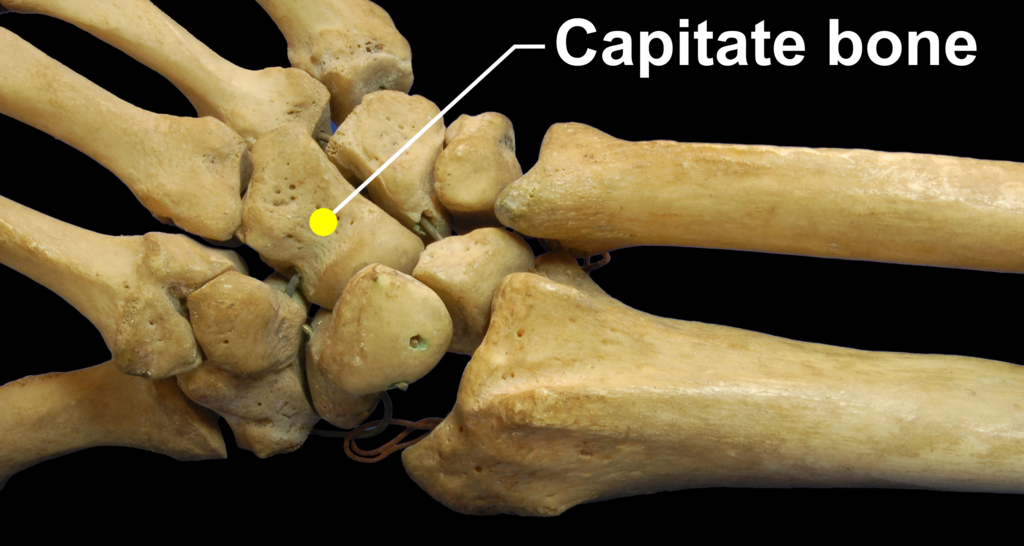
The palm of the hand is formed by five metacarpal bones. These are miniature long bones, numbered one to five starting from the thumb. Their bases connect to the distal row of carpal bones, and their heads form the knuckles you see when you make a fist.
Finally, we have the phalanges, the bones of the fingers. The thumb has two phalanges (proximal and distal), while the other four fingers each have three (proximal, middle, and distal). These bones form hinge joints with each other, allowing you to bend and straighten your fingers to grip objects.
Now that you've seen all the bones of the upper limb, let's review the key terms.
Ready to test your knowledge?
What two bones form the shoulder girdle?
The head of the humerus articulates with which shallow socket on the scapula to form the main shoulder joint?
From the flexible shoulder girdle to the delicate bones of the fingers, the skeletal framework of the upper limb provides the structure necessary for an impressive range of tasks.