The Human Baby Journey
Conception and Early Development
The First Week
Human development begins with a single event: fertilization. This is the moment a sperm cell fuses with an oocyte, or egg cell. This union combines genetic material from both parents, creating a new, unique cell called a zygote. This is the very first cell of a new individual.
zygote
noun
A diploid cell resulting from the fusion of two haploid gametes; a fertilized ovum.
The zygote doesn't stay a single cell for long. Within about 30 hours, it begins a rapid series of cell divisions called cleavage. The single cell divides into two, then four, then eight, and so on. These early cells are called blastomeres.
Interestingly, during this cleavage phase, the overall size of the cluster of cells doesn't increase. The cells just become smaller and more numerous, all while contained within a protective outer layer called the zona pellucida. After about three days, this process results in a solid, 16-cell ball that looks a bit like a raspberry. This structure is called a morula.
Forming the Blastocyst
As cell division continues, the solid morula begins to change. A fluid-filled cavity, called the blastocoel, forms within the ball of cells. This transforms the morula into a new structure: the blastocyst. This typically happens around the fifth day after fertilization.
The blastocyst isn't just a hollow ball. Its cells have started to differentiate, or specialize, into two distinct groups. The outer layer of cells is called the trophectoderm. These cells will later develop into the placenta, the organ that provides oxygen and nutrients to the growing embryo. The cluster of cells on the interior is called the inner cell mass. This is the group of cells that will eventually form the embryo itself.
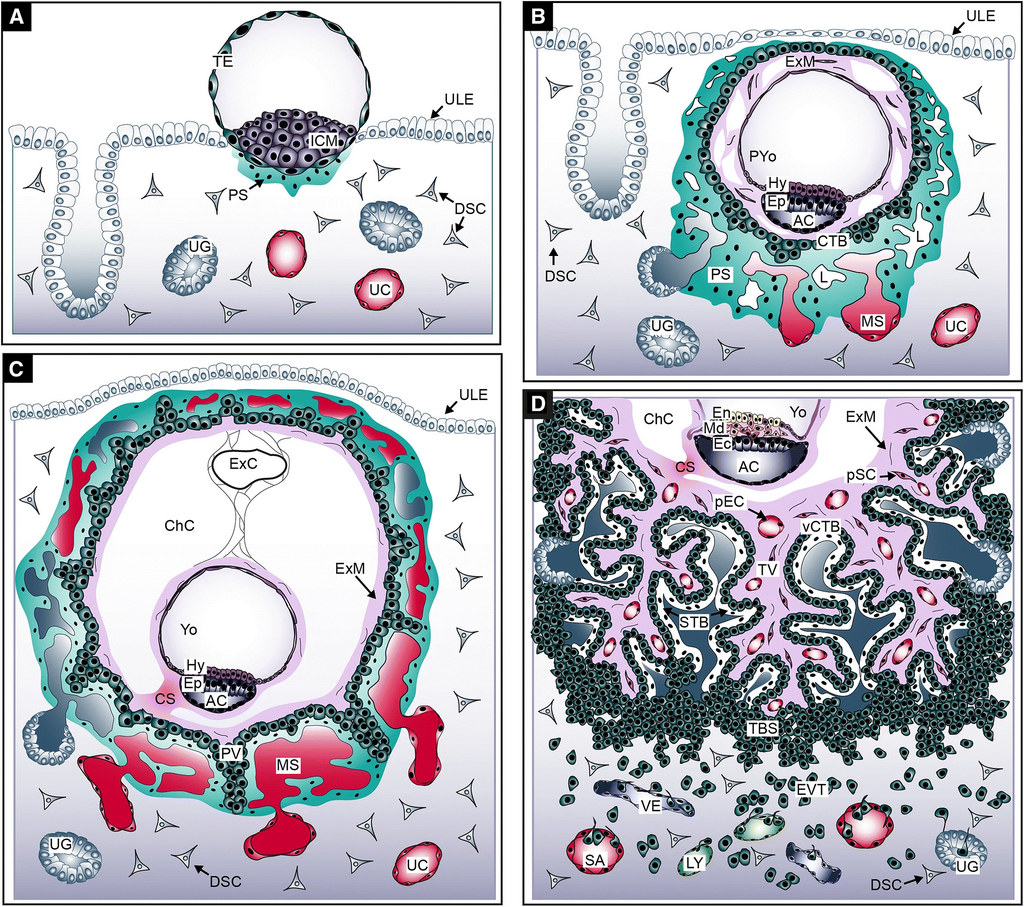
Around day six or seven, the blastocyst is ready for its next big step: implantation. It breaks free from the zona pellucida, a process called "hatching." It then attaches itself to the endometrium, the lining of the uterus. The cells of the trophectoderm begin to invade the uterine tissue, burrowing in to establish a secure connection.
Implantation is critical. It's the process that connects the developing blastocyst to the mother's circulatory system, allowing it to receive the nourishment it needs to grow.
Once implantation is complete, a new phase of development begins. The foundation has been laid for the complex structures and systems that will form over the coming weeks.
Ready to check your understanding of this first week of development?
What is the name of the very first cell formed after a sperm fertilizes an oocyte?
Which of the following correctly lists the stages of early embryonic development in chronological order?
This incredible journey, from a single cell to an implanted blastocyst, all happens within about a week. It sets the stage for the next period of development, the embryonic stage, where the inner cell mass will begin to form the distinct layers of the embryo.