The Howard-Gordon XCS8D Model Explained
Introduction to Signal Processing
What Is a Signal?
A signal is information in motion. Think of your voice traveling through the air, the music coming from your headphones, or the Wi-Fi data beaming to your laptop. All of these are signals. They are ways of representing and transmitting information, whether it's sound, images, or temperature readings.
At its core, a signal is a function that conveys information about a phenomenon. It usually describes how a quantity changes over time or space. For example, an audio signal represents the variation of air pressure over time, while an image is a signal representing brightness and color variations over a two-dimensional space.
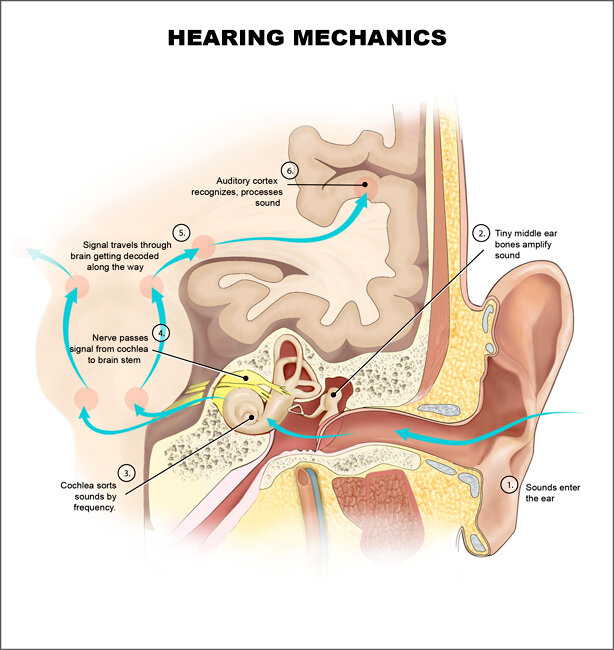
Signal processing is the art and science of manipulating these signals. We might want to remove noise from a recording, sharpen a blurry photo, or compress a large file to send it more quickly. It's a fundamental part of the technology that powers our modern world.
Analog and Digital Signals
Signals come in two main flavors: analog and digital.
An analog signal is continuous. Imagine a dimmer switch on a light. You can slide it smoothly to any brightness level you want. The signal is uninterrupted and can take on an infinite number of values within its range. A sound wave recorded by a microphone is a classic analog signal.
A digital signal is discrete. It's like a standard light switch: either on or off. Digital signals are represented by a series of numbers, usually binary 0s and 1s. To create a digital signal from an analog one, we measure, or sample, the analog signal at regular intervals and assign a numerical value to each sample. Computers, smartphones, and most modern electronics work exclusively with digital signals.
The Language of Signals
To work with signals, we need tools to describe and change them. One of the most powerful tools is the Fourier Transform. It's a mathematical concept that sounds complex, but the idea behind it is quite intuitive.
The Fourier Transform is a way of seeing the recipe of a signal. It takes a complex signal and tells you which simple frequencies it's made of, and how much of each.
Think of a musical chord played on a piano. Your ear hears a single, complex sound. The Fourier Transform is like having perfect pitch; it can break down that chord into its individual notes, like C, E, and G. In signal processing, these
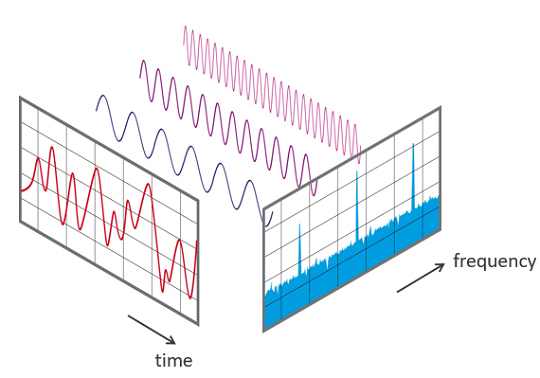
This ability is incredibly useful. If you want to boost the bass in a song, you use the Fourier Transform to find the low frequencies and then amplify them. If you want to remove an annoying hum from a recording, you find the frequency of the hum and turn it down.
The transform takes a signal from the time domain, where we see its amplitude over time, to the frequency domain, where we see how much of each frequency it contains. The continuous Fourier Transform is expressed as:
Here, is our signal in the time domain, and is the resulting signal in the frequency domain. This equation essentially checks the signal for every possible frequency .
Why Signal Processing Matters
Signal processing is a hidden hero of technology. It's the reason we can talk to people across the globe, stream movies without interruption, and get clear images from medical scans like MRIs.
Here are just a few applications:
- Audio Engineering: Removing noise, equalizing sound, and creating audio effects.
- Image Processing: Sharpening photos, detecting edges, and compressing images into formats like JPEG.
- Telecommunications: Enabling clear mobile phone calls and fast internet by encoding and decoding signals sent over radio waves.
- Biomedical Engineering: Analyzing brain signals (EEG) and heart rhythms (ECG) to diagnose medical conditions.
Understanding these fundamentals—what signals are, how they are represented, and how we can analyze them with tools like the Fourier Transform—is the first step to understanding more complex systems that rely on processing information.
Let's test your understanding of these core concepts.
What is the most fundamental description of a signal?
A key difference between an analog signal and a digital signal is that an analog signal is _______, while a digital signal is _______.
Grasping these ideas provides a solid foundation for exploring how information is captured, manipulated, and understood in nearly every field of science and engineering.