The Great Schism and the Dividing of Christendom
Ecclesiastical Authority Structures
Two Empires, Two Churches
As the Roman Empire fractured, its Christian church began to follow two different paths. The split wasn't sudden; it was a slow divergence in language, culture, and, most importantly, power. In the Latin-speaking West, the Bishop of Rome began to see himself as the singular head of the entire Christian world. In the Greek-speaking East, authority was seen as a shared responsibility. These weren't just theological disagreements. They were fundamental arguments about how the church should be run, top to bottom.
The core of the Roman argument was , the belief that the Pope, as the successor to Saint Peter, held supreme authority over all other bishops. Peter was considered the "rock" on which Jesus would build his church, and Roman bishops claimed to inherit that unique position. This created a top-down, hierarchical structure with the Pope at the apex, much like the old Roman Empire itself.
The East operated on a completely different model: the . This was a system of governance built on the idea of shared authority among the five most important centres of Christianity: Rome, Constantinople, Alexandria, Antioch, and Jerusalem. According to this view, the Bishop of Rome was respected as the primus inter pares, or "first among equals." He held a place of honour but not absolute power. Major decisions affecting the whole church had to be made collectively through councils, not by a single decree from Rome.
Clash in the Borderlands
This theoretical disagreement had real-world consequences. The regions of Illyricum and the Balkans, located at the geographic crossroads of the two halves of the old empire, became a battleground for ecclesiastical control. Traditionally, these areas were under the jurisdiction of Rome. However, as Constantinople grew in importance as the new capital of the Empire, its patriarchs began to assert authority there as well. Popes would appoint bishops, and patriarchs in Constantinople would do the same, leading to parallel church hierarchies and intense political friction.
Both sides saw control over these provinces not just as an administrative matter, but as a validation of their entire model of church governance.
Fueling Rome's confidence was a document that emerged in the 8th century: the Donation of Constantine. This was a forged imperial decree claiming that Emperor Constantine the Great had transferred authority over Rome and the entire Western Roman Empire to the Pope. Though later proven to be a fake, for centuries it was used to justify the Papacy's claims to not only spiritual supremacy but also vast secular power in Italy and beyond. This move directly challenged the traditional role of the Byzantine Emperor, who had always seen himself as the protector and senior governor of all Christendom.
An Irreconcilable Divide
The Byzantine Emperor was not just a political leader; he had a quasi-priestly role. He convened church councils, and his laws governed church administration. When the Pope began acting like a territorial ruler in Italy, crowned the Frankish king Charlemagne as 'Holy Roman Emperor' in 800 AD, it was seen from Constantinople as an outrageous political and spiritual betrayal. It suggested there was another emperor and another church, independent of Constantinople's authority.
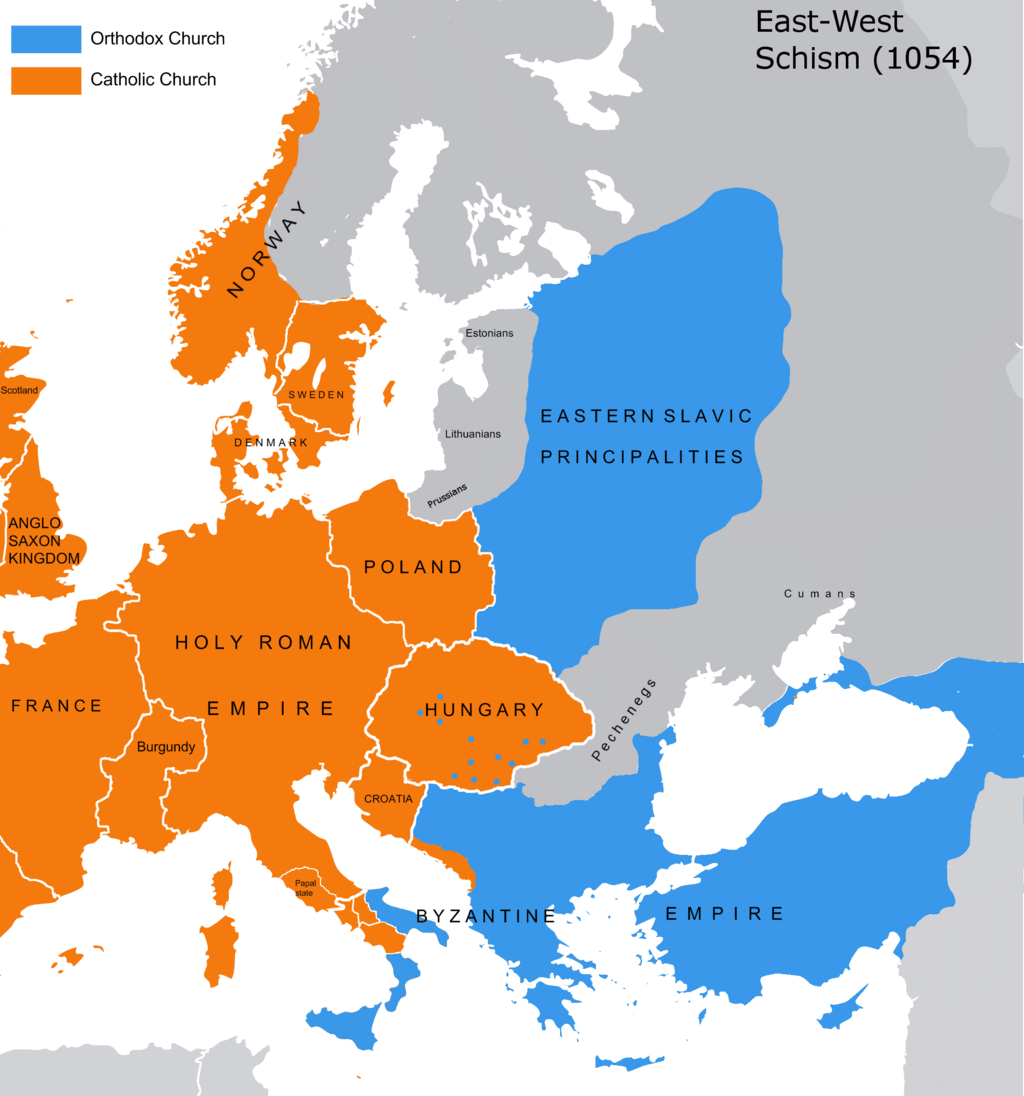
These competing models of authority proved irreconcilable. For the West, the church was a universal monarchy headed by the Pope. For the East, it was a commonwealth of churches governed by consensus. This fundamental difference in structure and governance created a rift that diplomacy and debate could not heal, paving the way for the formal split in 1054.