The Great Divide Partition and the Fall of the Raj
Two Nation Theory Origin
Two Competing Visions
As British control over India weakened, the question of what would come next loomed large. Two powerful, and ultimately incompatible, ideas emerged. The Indian National Congress, led by figures like Jawaharlal Nehru and Mahatma Gandhi, championed a secular, unified India. They envisioned a single nation where people of all faiths would be equal citizens, and religion would be a personal matter, separate from the state.
In contrast, the All-India Muslim League, under the leadership of Muhammad Ali Jinnah, grew increasingly concerned about the future of the subcontinent's large Muslim minority. The League feared that in a united, democratic India, Muslims would be permanently outnumbered and politically marginalized by the Hindu majority. This fear gave rise to the —the belief that Hindus and Muslims were not just two different religious communities, but two distinct nations, each deserving of its own homeland.
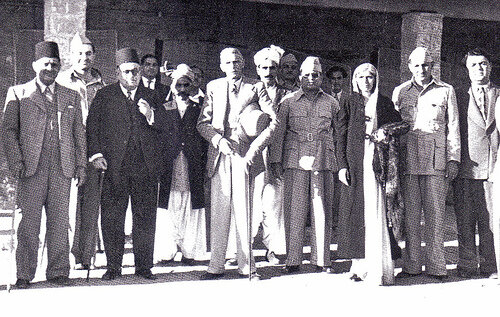
The Demand for Pakistan
For years, the Muslim League's demands focused on securing constitutional safeguards, separate electorates, and guaranteed representation for Muslims within a united India. But by 1940, this position had hardened. The League concluded that no safeguard could truly protect Muslim interests in a Hindu-dominated state.
This shift was formalized at the League's annual session in March 1940 with the This declaration was a pivotal moment. It stated that geographically contiguous areas with Muslim majorities, such as those in the northwestern and eastern zones of India, should be grouped to constitute “Independent States” in which the constituent units would be autonomous and sovereign.
Jinnah's argument was clear: Hindus and Muslims belonged to two different religious philosophies, social customs, and literatures. They neither intermarry nor inter-dine together, and they belong to two different civilizations based on conflicting ideas.
The Last Chance for Unity
With the end of World War II, Britain was eager to grant India independence but desperate to avoid dividing the subcontinent. In 1946, they sent a high-level delegation to broker a deal. The resulting proposal was the —a final, complex attempt to preserve a united India.
The plan failed. The Indian National Congress and the Muslim League interpreted the proposal differently, particularly regarding the power of the central government and whether provinces could opt out of their assigned groups. The Congress wanted a strong center to hold the nation together, while the League insisted on maximum autonomy for the provincial groups, viewing them as the foundation of a future Pakistan. Mistrust ran too deep, and neither side was willing to concede.
The collapse of the Cabinet Mission Plan was the point of no return. With a negotiated settlement off the table, the Muslim League felt it had to demonstrate the strength of its demand. Jinnah called for a "Direct Action Day" on August 16, 1946, to peacefully demand the creation of Pakistan.
The call for protest, however, spiraled into unprecedented communal violence. In Calcutta, what became known as the "Great Calcutta Killing" left thousands dead in a matter of days. The violence quickly spread to other regions. The bloodshed of hardened attitudes on all sides, convincing many in the Congress and the British government that a united India was no longer possible. Partition, once a political demand, now seemed like the only way to avoid a full-scale civil war.
What was the central idea of the Two-Nation Theory?
The 1940 Lahore Resolution is significant because it was the first time the Muslim League formally...
The failure of political compromise and the eruption of violence set the stage for the final, tragic division of British India.