The Great Depression
Banking Sector Fragility
Inside the Banking Collapse of 1929
While history books focus on the stock market panic, the true story of the 1929 crash lies in the crumbling foundations of the American banking system. In this chapter, we will uncover how rural debt and a fragile unit banking structure turned a market dip into a total financial catastrophe. By the end, you will understand the mechanics of bank runs and the systemic failures that left the economy without a safety net.
The Fragile Islands of American Finance
To understand why American banks collapsed so spectacularly, we must look at a system called . Unlike the robust branch banking systems in Canada or Britain, where a single large bank might have hundreds of offices across the country, American law largely restricted a bank to one single location. These banks were essentially financial islands, completely cut off from the resources of larger metropolitan centers.
In the rural Midwest and South, these independent institutions were the lifeblood of small towns. However, their isolation was a fatal flaw. They relied entirely on the of their immediate neighbors. If you were a banker in a wheat-growing county, nearly every loan on your books was tied to the price of wheat. You didn't have the luxury of balancing those risky farm loans with stable industrial accounts from a distant city.
Imagine a bank as a small wooden boat on a lake. In a branch system, many boats are lashed together into a massive, stable raft; if one boat springs a leak, the others keep it afloat. In the American unit system, every boat was alone. When the storm of 1929 hit, a single bad harvest was enough to sink the entire vessel.
The Psychology of the Run
The collapse of a bank often began not with a ledger error, but with a whisper. Because these banks were so small, everyone in town knew who was struggling. A rumor that the local miller couldn't pay his debt could spark a panic. This created the psychological wildfire known as a bank run .
Depositors faced a terrifying paradox. Even if they believed the bank was fundamentally healthy, they knew that if their neighbors rushed to the teller window, the bank would quickly run out of physical cash. The only rational response to the fear of a run was to participate in it. This turned a simple liquidity problem into a self-fulfilling prophecy of destruction.
Drag the slider to increase withdrawal pressure and observe how cash reserves are depleted before illiquid assets are forced into sale.
When the crowd gathered outside, the banker was trapped. Most of the bank's wealth wasn't sitting in the vault; it was tied up in long-term loans to the very farmers standing in line. To raise cash, the bank had to call in those loans immediately. This forced farmers to sell their equipment or land at fire-sale prices, which further drained money from the local economy and lowered property values. It was a vicious cycle: the attempt to save the bank ended up destroying the community it served.
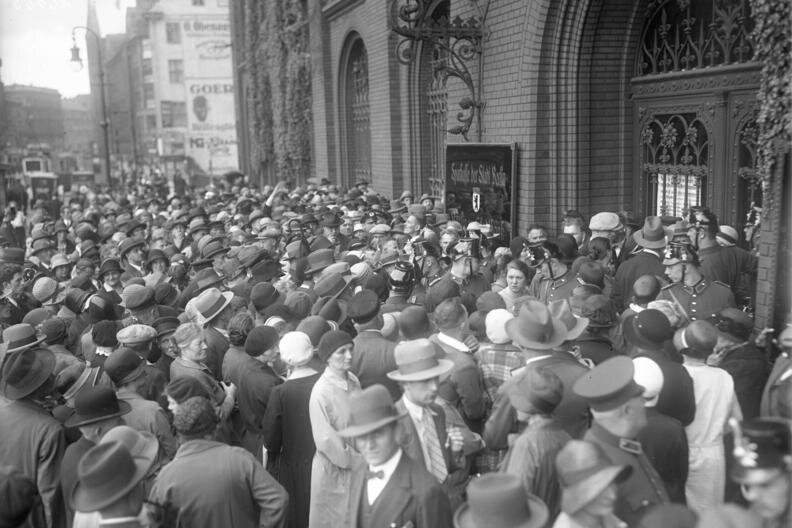
This structural isolation meant that once the first few bricks fell in the rural interior, there was nothing to stop the rest of the wall from coming down. Without a centralized authority to provide emergency cash, these small-town banks were left to face the storm alone. In the next section, we will see how this lack of a 'lender of last resort' allowed the local panics of 1929 to grow into a global catastrophe.