The Grand Tour of English Literature
Old English Literature
The Language of Heroes
The English you're reading right now would be completely unrecognizable to someone from 1,500 years ago. The language spoken in England back then is what we now call Old English, or Anglo-Saxon. It was the tongue of Germanic tribes who migrated to the island, and it sounds more like German or Dutch than Modern English.
For starters, it had a different alphabet, incorporating runic letters like thorn (þ) and eth (ð), both of which made a 'th' sound. Grammar was also far more complex. Nouns had grammatical gender (masculine, feminine, neuter), and words changed their endings depending on their role in a sentence, much like in modern German or Latin.
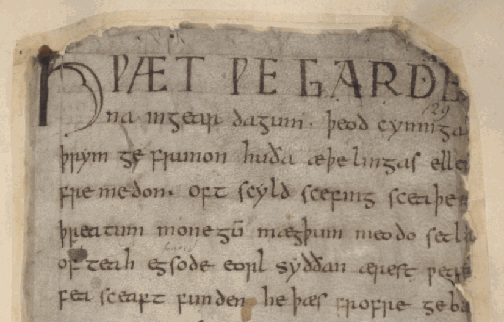
Let’s look at a simple example. The first line of the Lord's Prayer in Old English is:
Fæder ūre, þū þe eart on heofonum...
Some words might look faintly familiar. Fæder is 'father', and on heofonum is 'in heaven'. But ūre ('our') and þū þe eart ('you who are') show just how much the language has changed. You couldn't just guess your way through an Old English text.
A World of Warriors and Fate
The Anglo-Saxon period (roughly 450-1066 CE) was a time of warrior culture, political instability, and a slow conversion from paganism to Christianity. The literature reflects this world perfectly. It’s filled with tales of brave heroes, fierce battles, and a deep sense of an inescapable fate, which they called wyrd.
Poetry was the heart of their literature. It wasn't written to be read quietly in a corner. It was performed aloud in mead-halls, often to the accompaniment of a harp. To make these spoken poems memorable and rhythmic, poets used specific literary devices.
alliteration
noun
The repetition of the same sound at the beginning of words in a line of poetry.
Another key feature was the kenning, a kind of compound metaphor. It's a poetic way of renaming something. For example, a king might be a 'ring-giver', the sea a 'whale-road', and a battle 'the storm of swords'. These kennings added a rich, descriptive layer to the poetry.
Kenning Examples: • Sea: whale-road, gannet's-bath • Body: bone-house • Sword: battle-light
The Tale of Beowulf
Beowulf is the crown jewel of Old English literature and the longest epic poem to survive from the period. It tells the story of a great Geatish hero, Beowulf, who sails to Denmark to help King Hrothgar. Hrothgar's magnificent mead-hall, Heorot, is being terrorized by a monstrous creature named Grendel.
Beowulf, relying on his superhuman strength, fights Grendel with his bare hands and tears the monster's arm from its socket. The victory celebration is short-lived. Grendel's mother, enraged by her son's death, attacks the hall. Beowulf follows her to her lair at the bottom of a lake and kills her in a desperate battle.
Years later, an aging Beowulf, now king of his own people, faces his final challenge: a fearsome dragon guarding a treasure hoard. He kills the dragon but is mortally wounded in the process. The poem ends with his funeral, a somber tribute to a great hero who sacrificed himself for his people.
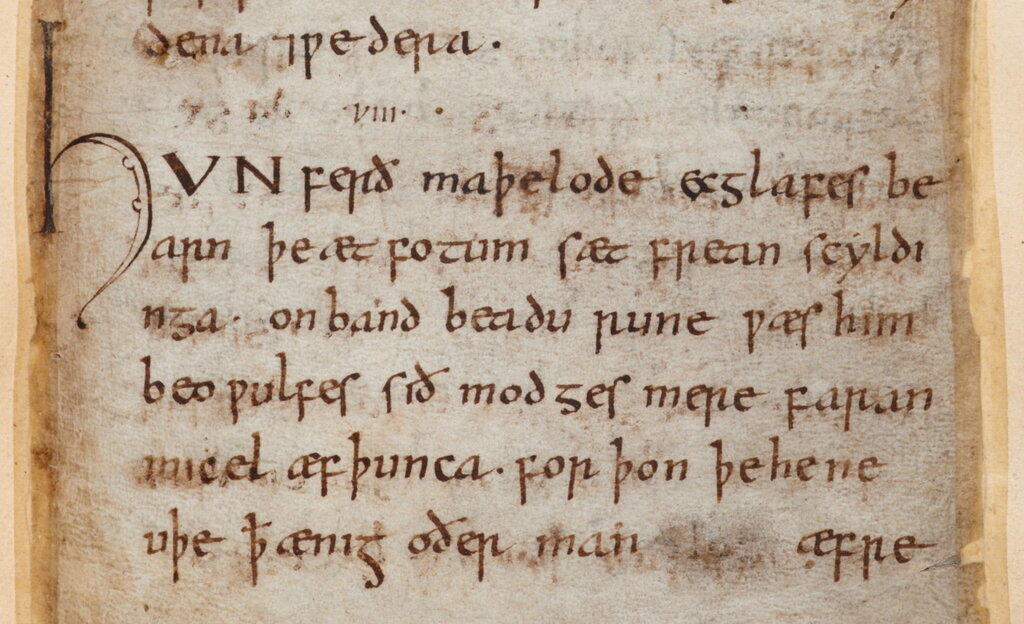
The story is more than just a monster mash. It explores deep themes of heroism, loyalty, and the struggle between good and evil. Beowulf embodies the heroic code: strength, courage, and a commitment to one's community. Yet, the poem is also tinged with sadness. It acknowledges that all glory is temporary and that even the greatest heroes must eventually face death.
More Than Just Monsters
While Beowulf is the most famous work, other important texts survive. Old English poetry wasn't all about fighting. A group of poems known as elegies express deep sadness and a sense of loss. In 'The Wanderer', an aging warrior remembers his fallen lord and comrades, adrift in a cold, lonely world. 'The Seafarer' describes the harsh, miserable life of a sailor who is nonetheless drawn irresistibly to the sea.
Christianity also had a profound influence. Monks and religious figures were the ones writing and preserving these stories. Poems like 'The Dream of the Rood' re-imagine the story of Christ's crucifixion from the perspective of the cross itself, blending Christian themes with the heroic language of warrior poetry.
| Type | Key Features | Example |
|---|---|---|
| Epic Poetry | Long narrative, heroic deeds, supernatural elements | Beowulf |
| Elegiac Poetry | Mournful, expresses loss and sorrow, first-person perspective | The Wanderer |
| Religious Poetry | Biblical themes, fusion of Christian and heroic values | The Dream of the Rood |
These surviving works give us a window into a culture that valued strength, loyalty, and poetic storytelling. It was a world both brutal and beautiful, and its language formed the very bedrock of English.
Ready to test your knowledge?