The Grand Arc of Scientific Knowledge
First Scientific Revolution
A New Way of Seeing
For centuries, understanding the universe meant reading the works of ancient Greek philosophers, especially Aristotle. The world worked according to his principles. Heavy objects fell because their natural place was at the center of the universe, which was the Earth. Stars and planets, made of a perfect celestial substance, moved in flawless circles.
This view was elegant and intuitive, but it relied on logic and observation alone. The idea of actively testing these assumptions was foreign. The First Scientific Revolution, spanning from the 16th to the 18th centuries, changed everything. It wasn't just about discovering new facts; it was about discovering a new way to ask questions.
The shift was profound: from accepting ancient authority to challenging it with direct evidence.
This period saw the birth of the scientific method. Thinkers began to systematically observe the world, form hypotheses about how it worked, and then, most importantly, design experiments to test those hypotheses. Nature was no longer just a subject for contemplation. It was a puzzle to be solved, and the new tools were mathematics and experimentation.
Galileo and the Heavens
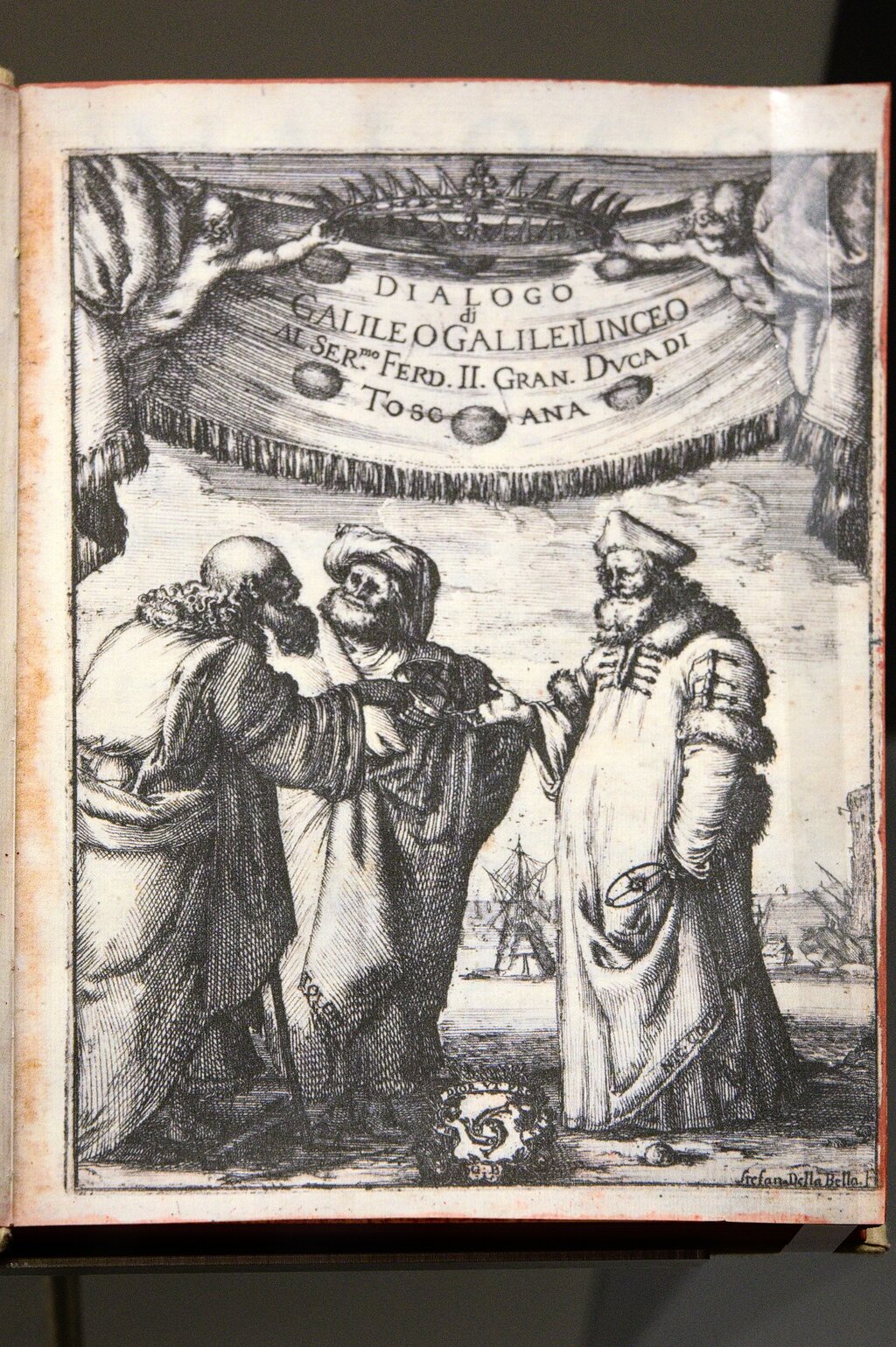
Galileo Galilei was a central figure in this new movement. While he didn't invent the telescope, he was one of the first to point it at the night sky, and what he saw shattered the old worldview.
He observed that the Moon wasn't a perfect, smooth sphere; it was covered in mountains and craters, much like the Earth. He discovered four moons orbiting Jupiter, proving that not everything in the heavens revolved around our planet. These observations directly contradicted the long-held belief that the Earth was the center of all motion.
Perhaps most convincingly, he observed that Venus goes through a full set of phases, just like our Moon. This was impossible in the Earth-centered model of Ptolemy, which was built on Aristotle's ideas. It could only be explained if Venus orbited the Sun.
Galileo's work wasn't limited to the stars. He also meticulously studied motion here on Earth. By rolling balls down inclined planes, he could slow down the effect of gravity and measure it accurately. He discovered that all objects accelerate at the same rate, regardless of their mass, and that this acceleration is constant. He was describing the world with mathematics, turning messy reality into clean, predictable equations. This was the foundation of a new, mechanistic view of the universe: a giant clockwork machine governed by universal laws.
Newton's Grand Synthesis
If Galileo laid the groundwork, Isaac Newton built the cathedral. His work was a stunning synthesis of the ideas that came before him. In his groundbreaking book, Philosophiæ Naturalis Principia Mathematica (Mathematical Principles of Natural Philosophy), published in 1687, Newton laid out a complete mathematical system for describing motion and gravity.
Newton's Principia formulated the laws of motion and universal gravitation, which dominated scientists’ view of the physical universe for the next three centuries.
He proposed three fundamental laws of motion that we still use today. The first states that an object will stay at rest or in uniform motion unless a force acts on it. The second provides a way to calculate how an object's motion will change when a force is applied. And the third states that for every action, there is an equal and opposite reaction.
| Law | Description |
|---|---|
| First Law (Inertia) | An object remains in its state of motion unless acted upon by an external force. |
| Second Law | The force on an object is equal to its mass times its acceleration (). |
| Third Law | For every action, there is an equal and opposite reaction. |
Newton’s true genius was connecting these earthly laws to the heavens. He proposed the law of universal gravitation, suggesting that the same force that makes an apple fall from a tree is what keeps the Moon in orbit around the Earth. It was a universal law, applying to every object in the cosmos.
With this single equation, Newton could explain the orbits of planets, the paths of comets, and the tides of the oceans. The universe, once mysterious and divine, was now understandable and predictable through the language of mathematics. The Scientific Revolution had established a powerful new way of knowing the world.
Now, let's test your understanding of these revolutionary ideas.
Before the Scientific Revolution, what was the primary basis for understanding the natural world?
Which of Galileo's telescopic discoveries provided the strongest evidence that Venus orbits the Sun, not the Earth?
This era laid the foundation for modern science, changing not just what we know, but how we know it.